4QI0 | pdb_00004qi0

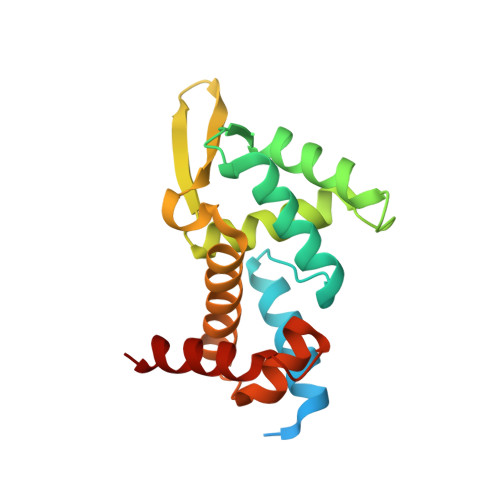
X-ray structure of the ROQ domain from murine Roquin-1


Experimental Data Snapshot

  • Method: X-RAY DIFFRACTION
  • Resolution: 1.94 Å
  • R-Value Free: 
    0.206 (Depositor), 0.209 (DCC) 
  • R-Value Work: 
    0.161 (Depositor), 0.173 (DCC) 
  • R-Value Observed: 
    0.163 (Depositor) 

wwPDB Validation 3D Report Full Report

Validation slider image for 4QI0

This is version 1.2 of the entry. See complete history

Literature

Structural basis for RNA recognition in roquin-mediated post-transcriptional gene regulation.

Schlundt, A.Heinz, G.A.Janowski, R.Geerlof, A.Stehle, R.Heissmeyer, V.Niessing, D.Sattler, M.

(2014) Nat Struct Mol Biol 21: 671-678

  • DOI: https://doi.org/10.1038/nsmb.2855
  • Primary Citation Related Structures: 
    4QI0, 4QI2

  • PubMed Abstract: 

    Roquin function in T cells is essential for the prevention of autoimmune disease. Roquin interacts with the 3' untranslated regions (UTRs) of co-stimulatory receptors and controls T-cell activation and differentiation. Here we show that the N-terminal ROQ domain from mouse roquin adopts an extended winged-helix (WH) fold, which is sufficient for binding to the constitutive decay element (CDE) in the Tnf 3' UTR. The crystal structure of the ROQ domain in complex with a prototypical CDE RNA stem-loop reveals tight recognition of the RNA stem and its triloop. Surprisingly, roquin uses mainly non-sequence-specific contacts to the RNA, thus suggesting a relaxed CDE consensus and implicating a broader spectrum of target mRNAs than previously anticipated. Consistently with this, NMR and binding experiments with CDE-like stem-loops together with cell-based assays confirm roquin-dependent regulation of relaxed CDE consensus motifs in natural 3' UTRs.


  • Organizational Affiliation
    • 1] Biomolecular NMR Spectroscopy, Institute of Structural Biology, Helmholtz Zentrum München, Neuherberg, Germany. [2] Center for Integrated Protein Science Munich at Biomolecular NMR Spectroscopy, Department Chemie, Technische Universität München, Garching, Germany. [3].

Macromolecule Content 

  • Total Structure Weight: 41.12 kDa 
  • Atom Count: 2,973 
  • Modeled Residue Count: 315 
  • Deposited Residue Count: 360 
  • Unique protein chains: 1

Macromolecules

Find similar proteins by:|  3D Structure
Entity ID: 1
MoleculeChains  Sequence LengthOrganismDetailsImage
Roquin-1
A, B
180Mus musculusMutation(s): 0 
Gene Names: Gm551Kiaa2025Rc3h1
EC: 2.3.2.27
UniProt
Find proteins for Q4VGL6 (Mus musculus)
Explore Q4VGL6 
Go to UniProtKB:  Q4VGL6
Entity Groups
Sequence Clusters30% Identity50% Identity70% Identity90% Identity95% Identity100% Identity
UniProt GroupQ4VGL6
Sequence Annotations
Expand
Reference Sequence

Small Molecules

Ligands 1 Unique
IDChains Name / Formula / InChI Key2D Diagram3D Interactions
EDO

Query on EDO


Download:Ideal Coordinates CCD File
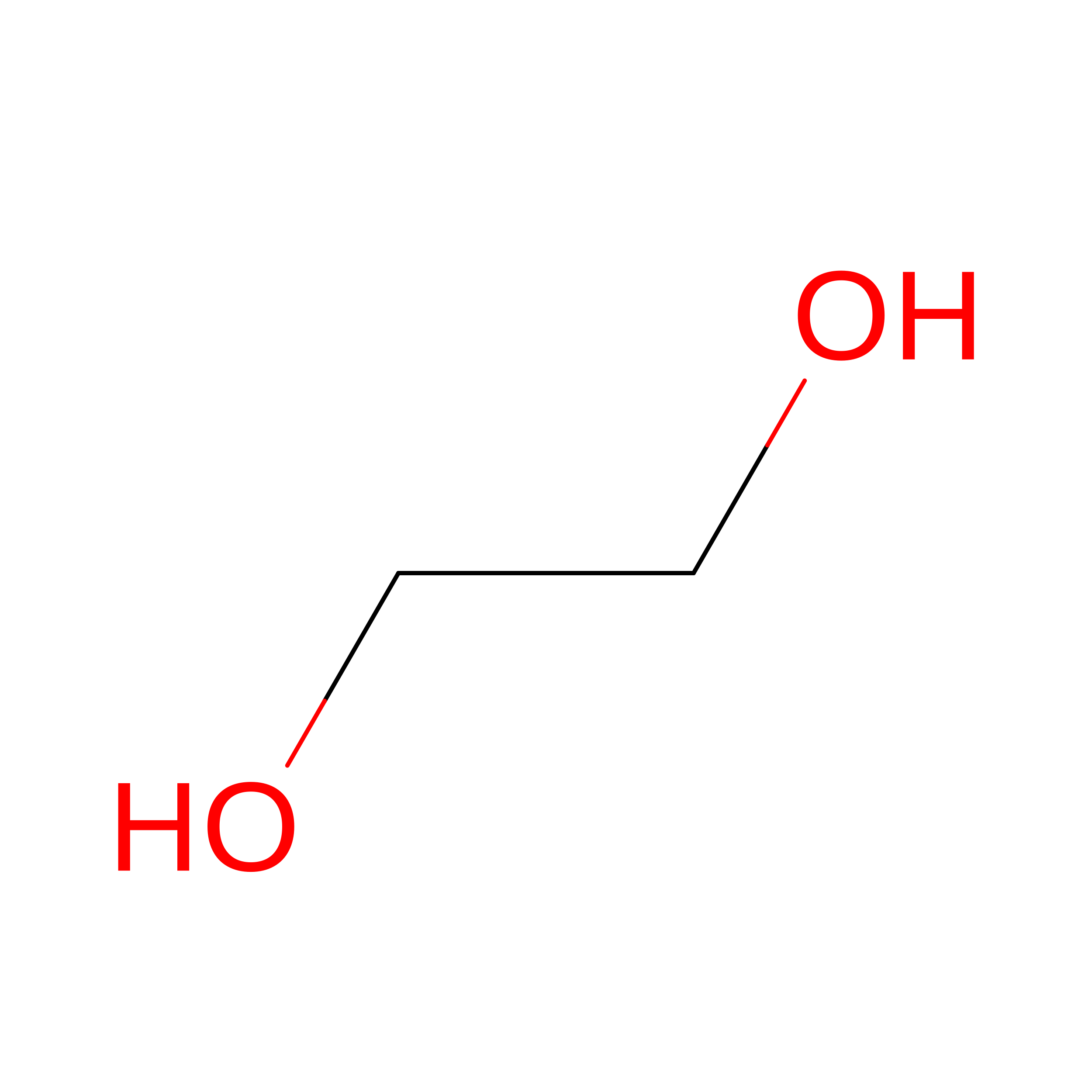
C [auth A]1,2-ETHANEDIOL
C2 H6 O2
LYCAIKOWRPUZTN-UHFFFAOYSA-N

Experimental Data & Validation

Experimental Data

  • Method: X-RAY DIFFRACTION
  • Resolution: 1.94 Å
  • R-Value Free:  0.206 (Depositor), 0.209 (DCC) 
  • R-Value Work:  0.161 (Depositor), 0.173 (DCC) 
  • R-Value Observed: 0.163 (Depositor) 
Space Group: C 2 2 21
Unit Cell:
Length ( Å )Angle ( ˚ )
a = 55.22α = 90
b = 79.51β = 90
c = 184.91γ = 90
Software Package:
Software NamePurpose
DNAdata collection
Auto-Rickshawphasing
REFMACrefinement
XDSdata reduction
SCALAdata scaling

Structure Validation

View Full Validation Report


Entry History 

Deposition Data

Revision History  (Full details and data files)

  • Version 1.0: 2014-07-16
    Type: Initial release
  • Version 1.1: 2014-08-20
    Changes: Database references
  • Version 1.2: 2024-02-28
    Changes: Data collection, Database references, Derived calculations