4PVD | pdb_00004pvd

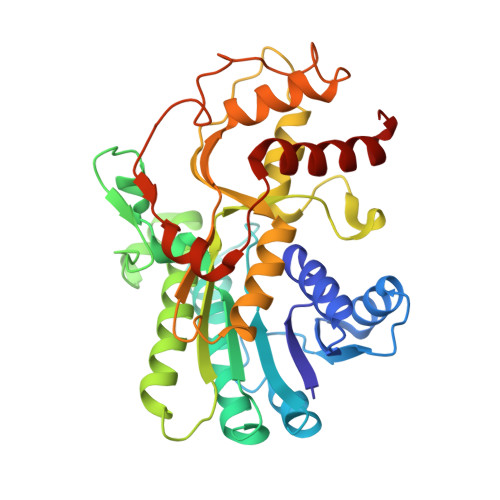
Crystal structure of yeast methylglyoxal/isovaleraldehyde reductase Gre2 complexed with NADPH


Experimental Data Snapshot

  • Method: X-RAY DIFFRACTION
  • Resolution: 2.40 Å
  • R-Value Free: 
    0.288 (Depositor), 0.277 (DCC) 
  • R-Value Work: 
    0.242 (Depositor), 0.237 (DCC) 
  • R-Value Observed: 
    0.245 (Depositor) 

Starting Model: experimental
View more details

wwPDB Validation 3D Report Full Report

Validation slider image for 4PVD

Ligand Structure Quality Assessment 


This is version 1.1 of the entry. See complete history

Literature

Structural insights into the cofactor-assisted substrate recognition of yeast methylglyoxal/isovaleraldehyde reductase Gre2

Guo, P.C.Bao, Z.Z.Ma, X.X.Xia, Q.Li, W.F.

(2014) Biochim Biophys Acta 1844: 1486-1492

  • DOI: https://doi.org/10.1016/j.bbapap.2014.05.008
  • Primary Citation Related Structures: 
    4PVC, 4PVD

  • PubMed Abstract: 

    Saccharomyces cerevisiae Gre2 (EC1.1.1.283) serves as a versatile enzyme that catalyzes the stereoselective reduction of a broad range of substrates including aliphatic and aromatic ketones, diketones, as well as aldehydes, using NADPH as the cofactor. Here we present the crystal structures of Gre2 from S. cerevisiae in an apo-form at 2.00Å and NADPH-complexed form at 2.40Å resolution. Gre2 forms a homodimer, each subunit of which contains an N-terminal Rossmann-fold domain and a variable C-terminal domain, which participates in substrate recognition. The induced fit upon binding to the cofactor NADPH makes the two domains shift toward each other, producing an interdomain cleft that better fits the substrate. Computational simulation combined with site-directed mutagenesis and enzymatic activity analysis enabled us to define a potential substrate-binding pocket that determines the stringent substrate stereoselectivity for catalysis.


  • Organizational Affiliation
    • State Key Laboratory of Silkworm Genome Biology, Southwest University, 216, Tiansheng Road, Beibei, Chongqing 400716, People's Republic of China; Hefei National Laboratory for Physical Sciences at Microscale and School of Life Sciences, University of Science and Technology of China, Hefei, Anhui 230027, People's Republic of China.

Macromolecule Content 

  • Total Structure Weight: 154.37 kDa 
  • Atom Count: 10,416 
  • Modeled Residue Count: 1,297 
  • Deposited Residue Count: 1,368 
  • Unique protein chains: 1

Macromolecules

Find similar proteins by:|  3D Structure
Entity ID: 1
MoleculeChains  Sequence LengthOrganismDetailsImage
NADPH-dependent methylglyoxal reductase GRE2
A, B, C, D
342Saccharomyces cerevisiae S288CMutation(s): 0 
Gene Names: GRE2YOL151W
EC: 1.1.1.283 (PDB Primary Data), 1.1.1.265 (PDB Primary Data)
UniProt
Find proteins for Q12068 (Saccharomyces cerevisiae (strain ATCC 204508 / S288c))
Explore Q12068 
Go to UniProtKB:  Q12068
Entity Groups
Sequence Clusters30% Identity50% Identity70% Identity90% Identity95% Identity100% Identity
UniProt GroupQ12068
Sequence Annotations
Expand
Reference Sequence

Small Molecules

Ligands 1 Unique
IDChains Name / Formula / InChI Key2D Diagram3D Interactions
NDP

Query on NDP


Download:Ideal Coordinates CCD File
E [auth A],
F [auth B]
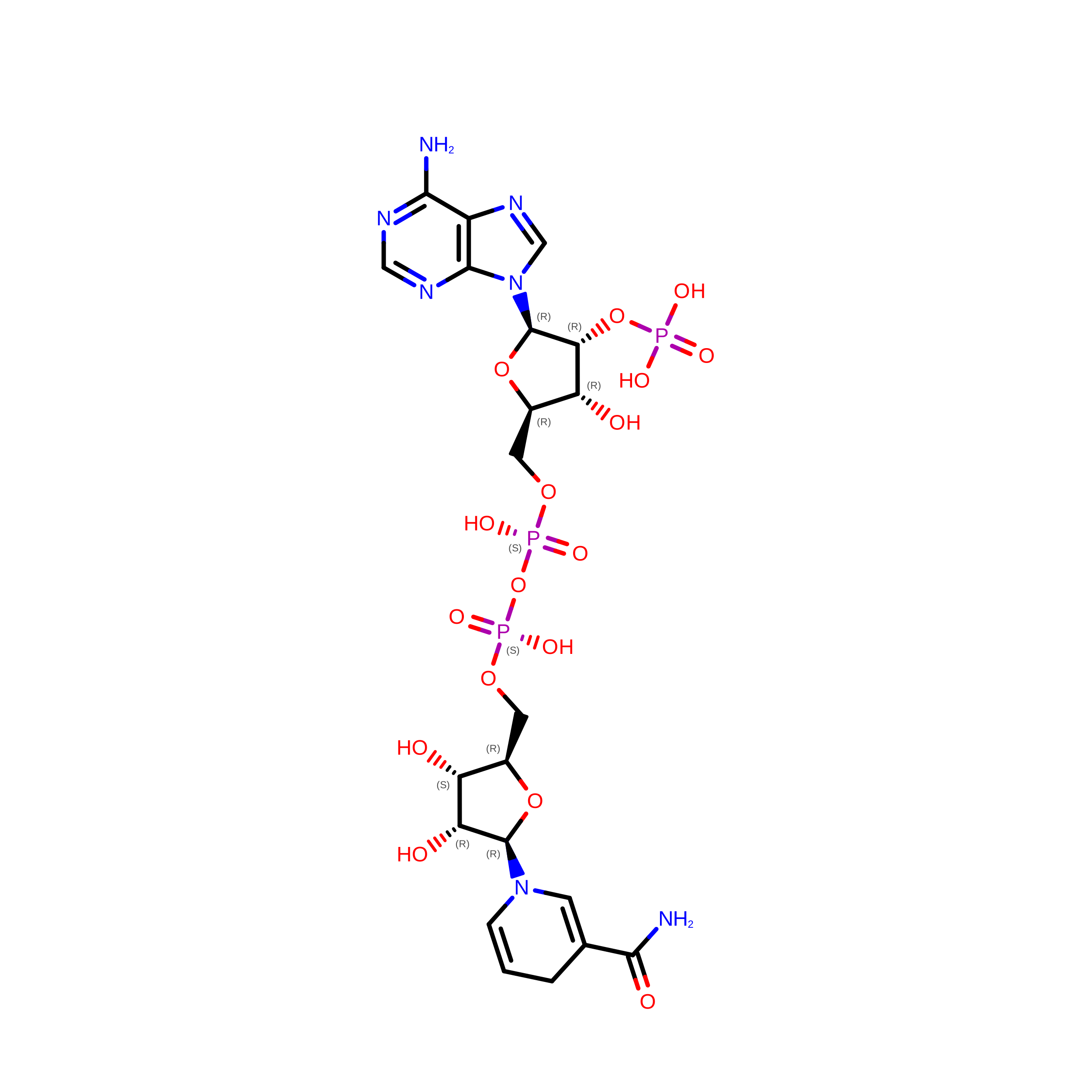
NADPH DIHYDRO-NICOTINAMIDE-ADENINE-DINUCLEOTIDE PHOSPHATE
C21 H30 N7 O17 P3
ACFIXJIJDZMPPO-NNYOXOHSSA-N

Experimental Data & Validation

Experimental Data

  • Method: X-RAY DIFFRACTION
  • Resolution: 2.40 Å
  • R-Value Free:  0.288 (Depositor), 0.277 (DCC) 
  • R-Value Work:  0.242 (Depositor), 0.237 (DCC) 
  • R-Value Observed: 0.245 (Depositor) 
Space Group: P 21 21 21
Unit Cell:
Length ( Å )Angle ( ˚ )
a = 90.309α = 90
b = 92.891β = 90
c = 201.094γ = 90
Software Package:
Software NamePurpose
HKL-2000data collection
AMoREphasing
REFMACrefinement
HKL-2000data reduction
HKL-2000data scaling

Structure Validation

View Full Validation Report


Ligand Structure Quality Assessment 


Entry History 

Deposition Data

Revision History  (Full details and data files)

  • Version 1.0: 2014-10-22
    Type: Initial release
  • Version 1.1: 2023-11-08
    Changes: Data collection, Database references, Derived calculations, Refinement description