4JLL | pdb_00004jll

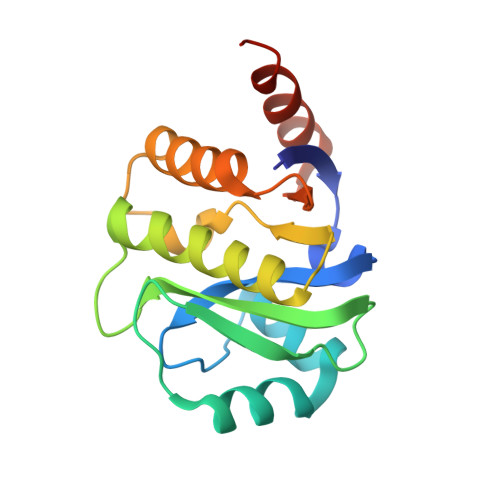
Crystal Structure of the evolved variant of the computationally designed serine hydrolase, OSH55.4_H1 covalently bound with FP-alkyne, Northeast Structural Genomics Consortium (NESG) Target OR273


Experimental Data Snapshot

  • Method: X-RAY DIFFRACTION
  • Resolution: 1.36 Å
  • R-Value Free: 
    0.161 (Depositor), 0.163 (DCC) 
  • R-Value Work: 
    0.145 (Depositor), 0.147 (DCC) 
  • R-Value Observed: 
    0.145 (Depositor) 

Starting Model: experimental
View more details

wwPDB Validation 3D Report Full Report

Validation slider image for 4JLL

Ligand Structure Quality Assessment 


This is version 1.4 of the entry. See complete history

Literature

Design of activated serine-containing catalytic triads with atomic-level accuracy.

Rajagopalan, S.Wang, C.Yu, K.Kuzin, A.P.Richter, F.Lew, S.Miklos, A.E.Matthews, M.L.Seetharaman, J.Su, M.Hunt, J.F.Cravatt, B.F.Baker, D.

(2014) Nat Chem Biol 10: 386-391

  • DOI: https://doi.org/10.1038/nchembio.1498
  • Primary Citation Related Structures: 
    3TP4, 3V45, 4DRT, 4ESS, 4ETJ, 4ETK, 4F2V, 4JCA, 4JLL, 4JVV

  • PubMed Abstract: 

    A challenge in the computational design of enzymes is that multiple properties, including substrate binding, transition state stabilization and product release, must be simultaneously optimized, and this has limited the absolute activity of successful designs. Here, we focus on a single critical property of many enzymes: the nucleophilicity of an active site residue that initiates catalysis. We design proteins with idealized serine-containing catalytic triads and assess their nucleophilicity directly in native biological systems using activity-based organophosphate probes. Crystal structures of the most successful designs show unprecedented agreement with computational models, including extensive hydrogen bonding networks between the catalytic triad (or quartet) residues, and mutagenesis experiments demonstrate that these networks are critical for serine activation and organophosphate reactivity. Following optimization by yeast display, the designs react with organophosphate probes at rates comparable to natural serine hydrolases. Co-crystal structures with diisopropyl fluorophosphate bound to the serine nucleophile suggest that the designs could provide the basis for a new class of organophosphate capture agents.


  • Organizational Affiliation
    • 1] Department of Biochemistry, University of Washington, Seattle, Washington, United States. [2].

Macromolecule Content 

  • Total Structure Weight: 18.85 kDa 
  • Atom Count: 1,523 
  • Modeled Residue Count: 161 
  • Deposited Residue Count: 167 
  • Unique protein chains: 1

Macromolecules

Find similar proteins by:|  3D Structure
Entity ID: 1
MoleculeChains  Sequence LengthOrganismDetailsImage
Evolved variant of computationally designed serine hydrolase OSH55.4_H1167synthetic constructMutation(s): 0 

Small Molecules

Ligands 5 Unique
IDChains Name / Formula / InChI Key2D Diagram3D Interactions
SEF

Query on SEF


Download:Ideal Coordinates CCD File
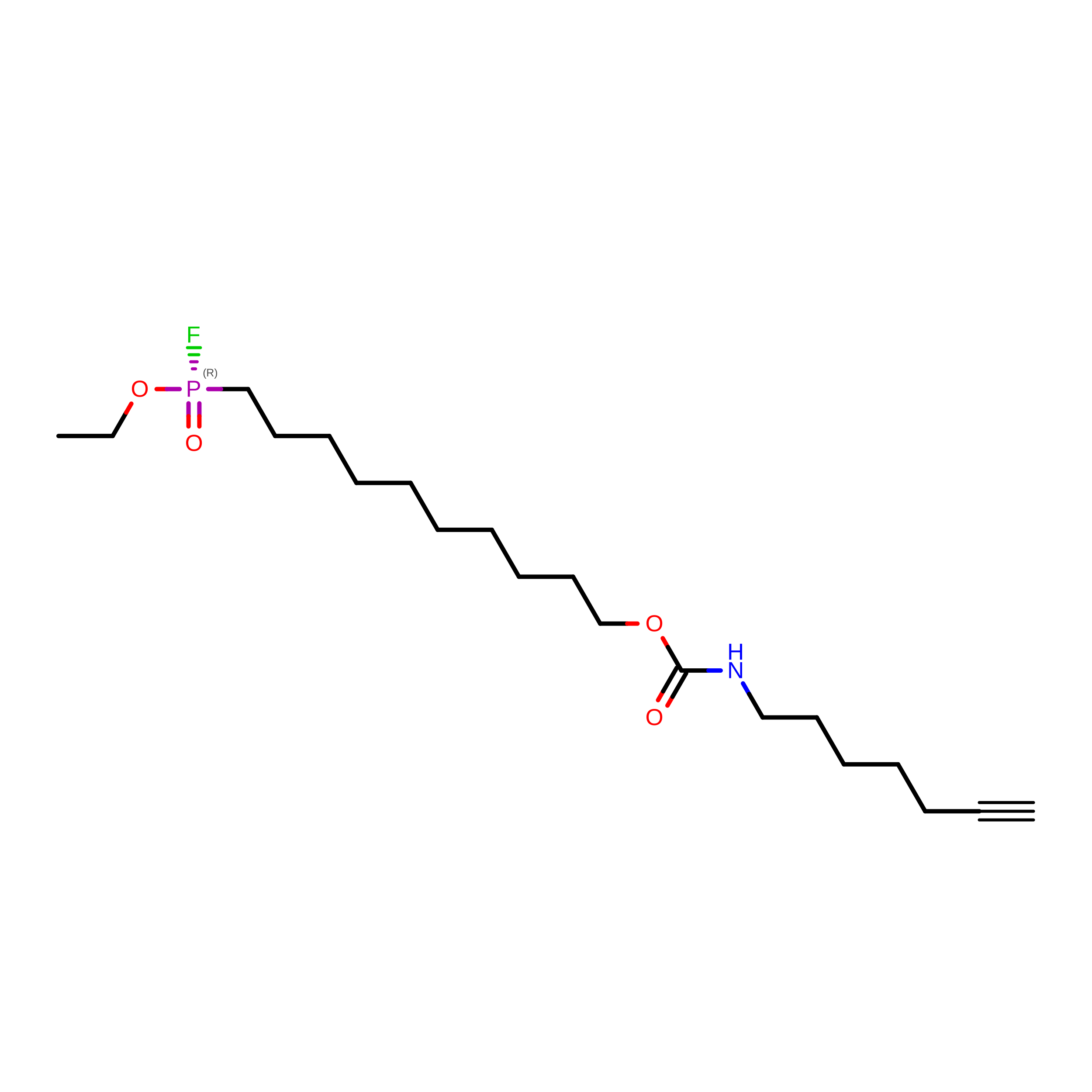
B [auth A]ethyl (R)-{10-[(hept-6-yn-1-ylcarbamoyl)oxy]decyl}phosphonofluoridate
C20 H37 F N O4 P
JFCFPSBLBVUKMV-HHHXNRCGSA-N
PEG

Query on PEG


Download:Ideal Coordinates CCD File
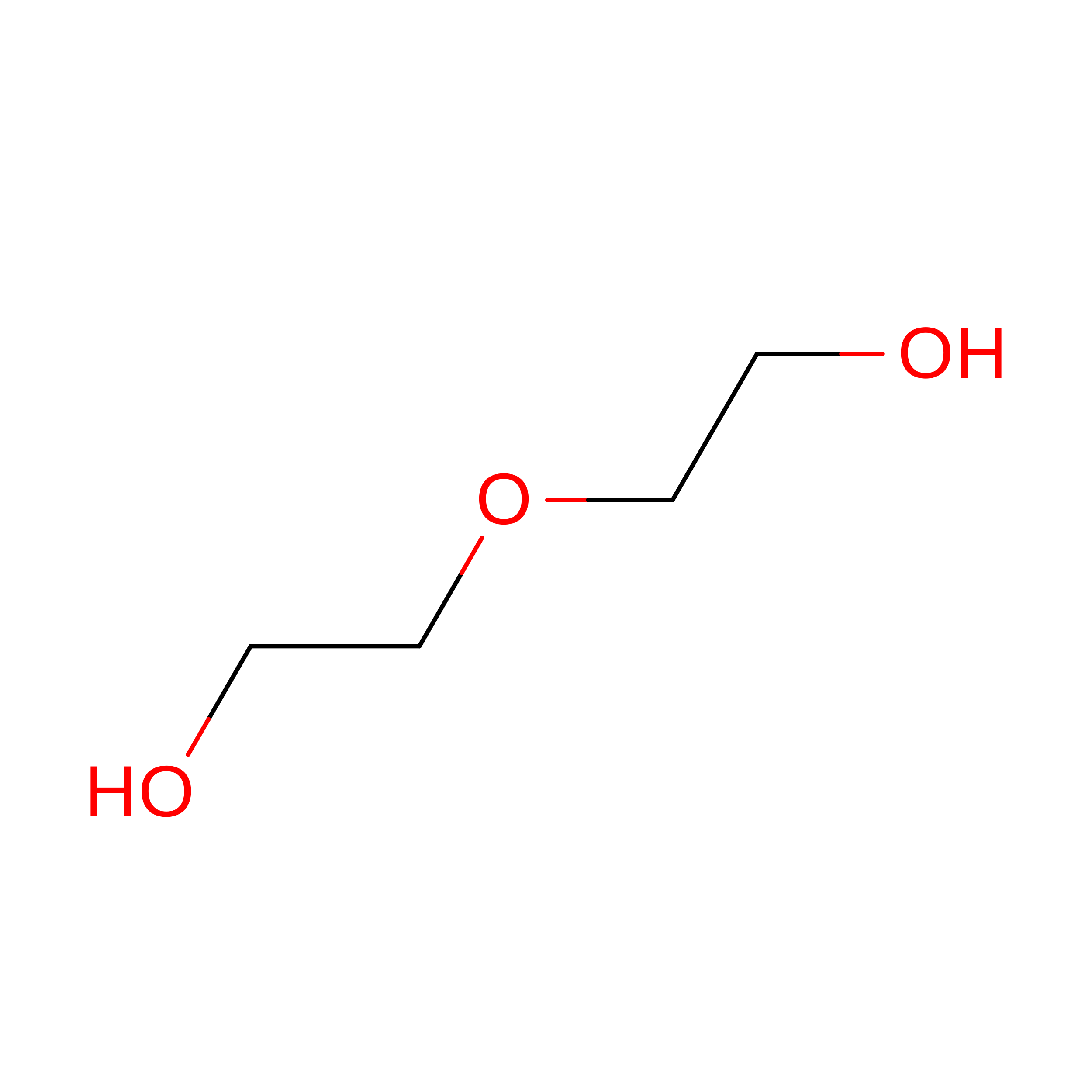
I [auth A]DI(HYDROXYETHYL)ETHER
C4 H10 O3
MTHSVFCYNBDYFN-UHFFFAOYSA-N
GOL

Query on GOL


Download:Ideal Coordinates CCD File
J [auth A],
K [auth A]
GLYCEROL
C3 H8 O3
PEDCQBHIVMGVHV-UHFFFAOYSA-N
EDO

Query on EDO


Download:Ideal Coordinates CCD File
D [auth A],
E [auth A],
F [auth A],
G [auth A],
H [auth A]
1,2-ETHANEDIOL
C2 H6 O2
LYCAIKOWRPUZTN-UHFFFAOYSA-N
CL

Query on CL


Download:Ideal Coordinates CCD File
C [auth A]CHLORIDE ION
Cl
VEXZGXHMUGYJMC-UHFFFAOYSA-M

Experimental Data & Validation

Experimental Data

  • Method: X-RAY DIFFRACTION
  • Resolution: 1.36 Å
  • R-Value Free:  0.161 (Depositor), 0.163 (DCC) 
  • R-Value Work:  0.145 (Depositor), 0.147 (DCC) 
  • R-Value Observed: 0.145 (Depositor) 
Space Group: C 1 2 1
Unit Cell:
Length ( Å )Angle ( ˚ )
a = 68.846α = 90
b = 66.977β = 100.27
c = 37.911γ = 90
Software Package:
Software NamePurpose
PHENIXrefinement
PDB_EXTRACTdata extraction
ADSCdata collection
HKL-2000data reduction
HKL-2000data scaling
BALBESphasing

Structure Validation

View Full Validation Report


Ligand Structure Quality Assessment 


Entry History 

Revision History  (Full details and data files)

  • Version 1.0: 2013-04-10
    Type: Initial release
  • Version 1.1: 2014-04-16
    Changes: Database references
  • Version 1.2: 2014-05-14
    Changes: Database references
  • Version 1.3: 2023-09-20
    Changes: Data collection, Database references, Derived calculations, Refinement description
  • Version 1.4: 2024-11-20
    Changes: Structure summary