4IVK | pdb_00004ivk

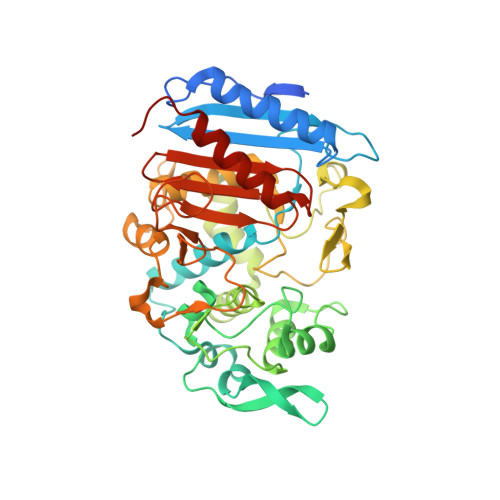
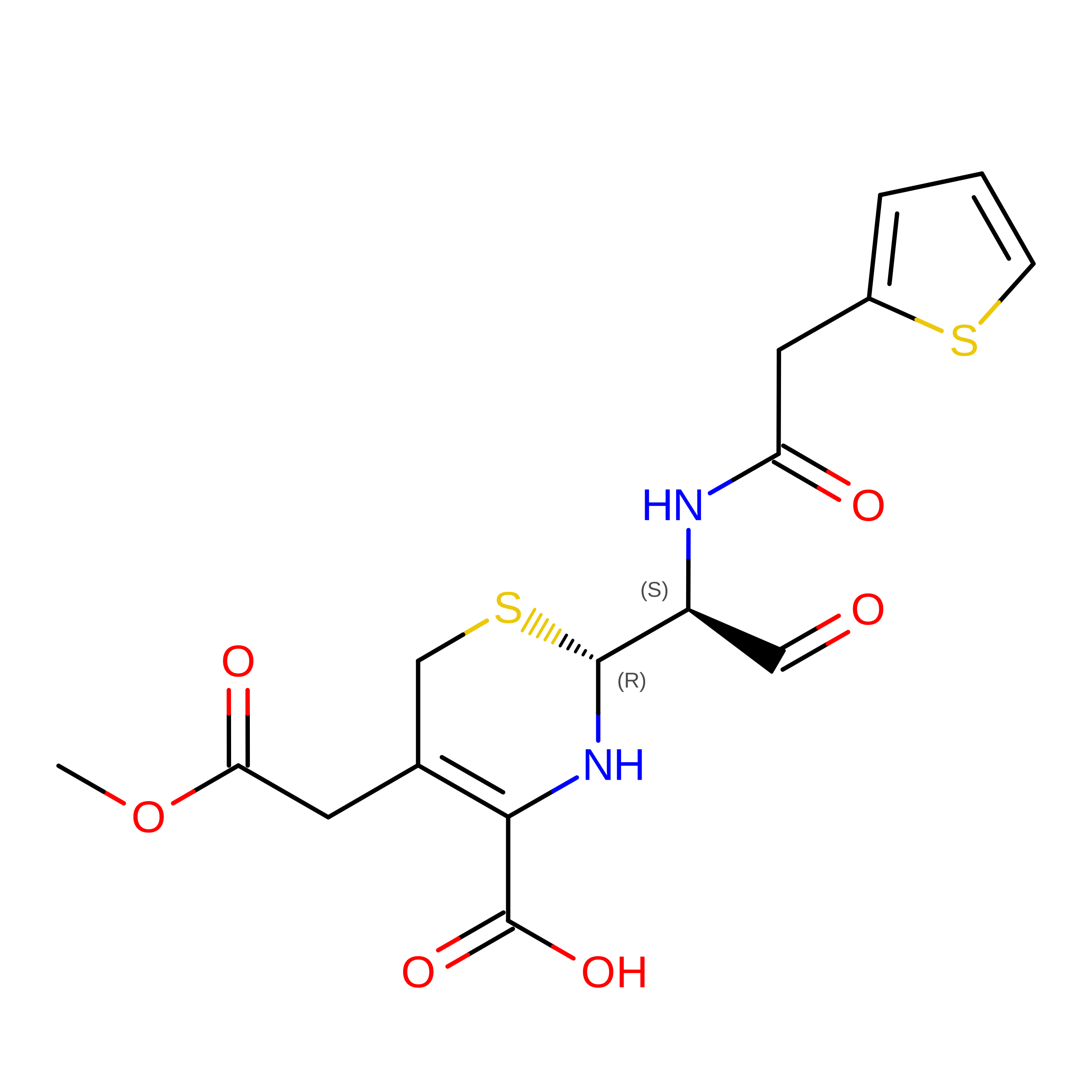
Crystal structure of a fammily VIII carboxylesterase in a complex with cephalothin.


Experimental Data Snapshot

  • Method: X-RAY DIFFRACTION
  • Resolution: 1.80 Å
  • R-Value Free: 
    0.182 (Depositor), 0.193 (DCC) 
  • R-Value Work: 
    0.161 (Depositor), 0.173 (DCC) 
  • R-Value Observed: 
    0.162 (Depositor) 

Starting Model: experimental
View more details

wwPDB Validation 3D Report Full Report

Validation slider image for 4IVK

Ligand Structure Quality Assessment 


This is version 1.3 of the entry. See complete history

Literature

Structural basis for the beta-lactamase activity of EstU1, a family VIII carboxylesterase.

Cha, S.S.An, Y.J.Jeong, C.S.Kim, M.K.Jeon, J.H.Lee, C.M.Lee, H.S.Kang, S.G.Lee, J.H.

(2013) Proteins 81: 2045-2051

  • DOI: https://doi.org/10.1002/prot.24334
  • Primary Citation Related Structures: 
    4IVI, 4IVK

  • PubMed Abstract: 

    EstU1 is a unique family VIII carboxylesterase that displays hydrolytic activity toward the amide bond of clinically used β-lactam antibiotics as well as the ester bond of p-nitrophenyl esters. EstU1 assumes a β-lactamase-like modular architecture and contains the residues Ser100, Lys103, and Tyr218, which correspond to the three catalytic residues (Ser64, Lys67, and Tyr150, respectively) of class C β-lactamases. The structure of the EstU1/cephalothin complex demonstrates that the active site of EstU1 is not ideally tailored to perform an efficient deacylation reaction during the hydrolysis of β-lactam antibiotics. This result explains the weak β-lactamase activity of EstU1 compared with class C β-lactamases. Finally, structural and sequential comparison of EstU1 with other family VIII carboxylesterases elucidates an operative molecular strategy used by family VIII carboxylesterases to extend their substrate spectrum.


  • Organizational Affiliation
    • Marine Biotechnology Research Division, Korea Institute of Ocean Science and Technology, Ansan, 426-744, Republic of Korea; Ocean Science and Technology School, Korea Maritime University, Pusan, 606-791, Republic of Korea; Department of Marine Biotechnology, University of Science and Technology, Daejeon, 305-333, Republic of Korea.

Macromolecule Content 

  • Total Structure Weight: 48.19 kDa 
  • Atom Count: 3,466 
  • Modeled Residue Count: 404 
  • Deposited Residue Count: 434 
  • Unique protein chains: 1

Macromolecules

Find similar proteins by:|  3D Structure
Entity ID: 1
MoleculeChains  Sequence LengthOrganismDetailsImage
Carboxylesterases434uncultured bacteriumMutation(s): 0 
EC: 3.1.1.1
UniProt
Find proteins for A0ACD6B8M6 (uncultured bacterium)
Explore A0ACD6B8M6 
Go to UniProtKB:  A0ACD6B8M6
Entity Groups
Sequence Clusters30% Identity50% Identity70% Identity90% Identity95% Identity100% Identity
UniProt GroupA0ACD6B8M6
Sequence Annotations
Expand
Reference Sequence

Experimental Data & Validation

Experimental Data

  • Method: X-RAY DIFFRACTION
  • Resolution: 1.80 Å
  • R-Value Free:  0.182 (Depositor), 0.193 (DCC) 
  • R-Value Work:  0.161 (Depositor), 0.173 (DCC) 
  • R-Value Observed: 0.162 (Depositor) 
Space Group: I 4 2 2
Unit Cell:
Length ( Å )Angle ( ˚ )
a = 149.102α = 90
b = 149.102β = 90
c = 172.571γ = 90
Software Package:
Software NamePurpose
ADSCdata collection
AMoREphasing
REFMACrefinement
HKL-2000data reduction
HKL-2000data scaling

Structure Validation

View Full Validation Report


Ligand Structure Quality Assessment 


Entry History 

Deposition Data

Revision History  (Full details and data files)

  • Version 1.0: 2013-06-19
    Type: Initial release
  • Version 1.1: 2013-10-30
    Changes: Database references
  • Version 1.2: 2023-09-20
    Changes: Data collection, Database references, Derived calculations, Refinement description
  • Version 1.3: 2024-11-27
    Changes: Structure summary