4G7V | pdb_00004g7v

Crystal structure of voltage sensing domain of Ci-VSP with fragment antibody (R217E, 2.5 A)


Experimental Data Snapshot

  • Method: X-RAY DIFFRACTION
  • Resolution: 2.50 Å
  • R-Value Free: 
    0.240 (Depositor), 0.246 (DCC) 
  • R-Value Work: 
    0.201 (Depositor), 0.215 (DCC) 
  • R-Value Observed: 
    0.203 (Depositor) 

wwPDB Validation 3D Report Full Report

Validation slider image for 4G7V

Ligand Structure Quality Assessment 


This is version 1.3 of the entry. See complete history

Literature

Structural mechanism of voltage-dependent gating in an isolated voltage-sensing domain.

Li, Q.Wanderling, S.Paduch, M.Medovoy, D.Singharoy, A.McGreevy, R.Villalba-Galea, C.A.Hulse, R.E.Roux, B.Schulten, K.Kossiakoff, A.Perozo, E.

(2014) Nat Struct Mol Biol 21: 244-252

  • DOI: https://doi.org/10.1038/nsmb.2768
  • Primary Citation Related Structures: 
    4G7V, 4G7Y, 4G80

  • PubMed Abstract: 

    The transduction of transmembrane electric fields into protein motion has an essential role in the generation and propagation of cellular signals. Voltage-sensing domains (VSDs) carry out these functions through reorientations of positive charges in the S4 helix. Here, we determined crystal structures of the Ciona intestinalis VSD (Ci-VSD) in putatively active and resting conformations. S4 undergoes an ~5-Å displacement along its main axis, accompanied by an ~60° rotation. This movement is stabilized by an exchange in countercharge partners in helices S1 and S3 that generates an estimated net charge transfer of ~1 eo. Gating charges move relative to a ''hydrophobic gasket' that electrically divides intra- and extracellular compartments. EPR spectroscopy confirms the limited nature of S4 movement in a membrane environment. These results provide an explicit mechanism for voltage sensing and set the basis for electromechanical coupling in voltage-dependent enzymes and ion channels.


  • Organizational Affiliation
    • Department of Biochemistry and Molecular Biology, University of Chicago, Chicago, Illinois, USA.

Macromolecule Content 

  • Total Structure Weight: 68.21 kDa 
  • Atom Count: 4,559 
  • Modeled Residue Count: 562 
  • Deposited Residue Count: 615 
  • Unique protein chains: 3

Macromolecules

Find similar proteins by:|  3D Structure
Entity ID: 1
MoleculeChains  Sequence LengthOrganismDetailsImage
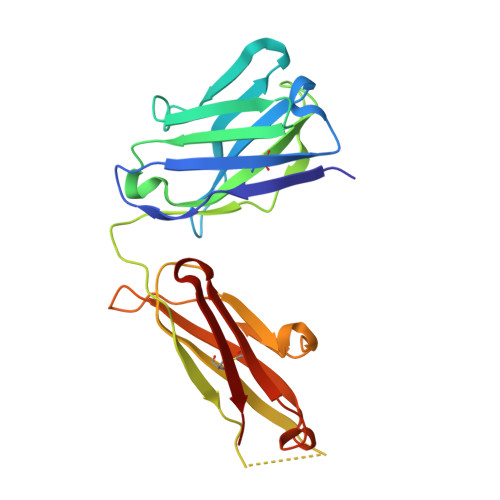
fragment antibody heavy chainA [auth H]219Homo sapiensMutation(s): 0 
Find similar proteins by:|  3D Structure
Entity ID: 2
MoleculeChains  Sequence LengthOrganismDetailsImage
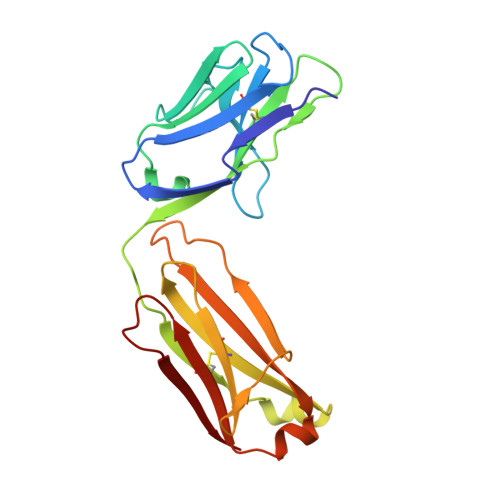
fragment antibody light chainB [auth L]211Homo sapiensMutation(s): 0 
Find similar proteins by:|  3D Structure
Entity ID: 3
MoleculeChains  Sequence LengthOrganismDetailsImage
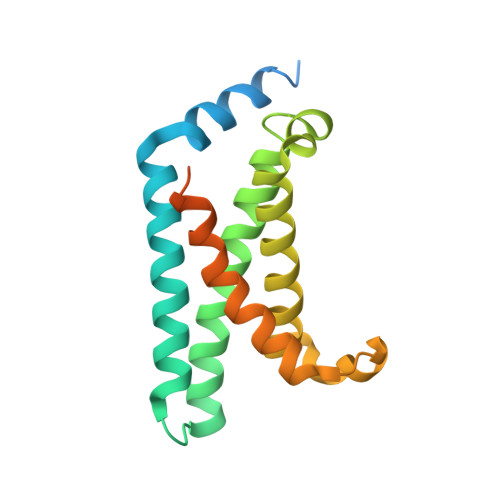
Voltage-sensor containing phosphataseC [auth S]185Ciona intestinalisMutation(s): 1 
Gene Names: Ci-VSP
Membrane Entity: Yes 
UniProt
Find proteins for F6XHE4 (Ciona intestinalis)
Explore F6XHE4 
Go to UniProtKB:  F6XHE4
Entity Groups
Sequence Clusters30% Identity50% Identity70% Identity90% Identity95% Identity100% Identity
UniProt GroupF6XHE4
Sequence Annotations
Expand
Reference Sequence

Experimental Data & Validation

Experimental Data

  • Method: X-RAY DIFFRACTION
  • Resolution: 2.50 Å
  • R-Value Free:  0.240 (Depositor), 0.246 (DCC) 
  • R-Value Work:  0.201 (Depositor), 0.215 (DCC) 
  • R-Value Observed: 0.203 (Depositor) 
Space Group: P 65 2 2
Unit Cell:
Length ( Å )Angle ( ˚ )
a = 120.25α = 90
b = 120.25β = 90
c = 229.88γ = 120
Software Package:
Software NamePurpose
JBlucedata collection
PHASERphasing
PHENIXrefinement
HKL-2000data reduction
HKL-2000data scaling

Structure Validation

View Full Validation Report


Ligand Structure Quality Assessment 


Entry History 

Deposition Data

  • Released Date: 2014-02-05 
  • Deposition Author(s): Li, Q.

Revision History  (Full details and data files)

  • Version 1.0: 2014-02-05
    Type: Initial release
  • Version 1.1: 2017-11-15
    Changes: Refinement description
  • Version 1.2: 2017-12-13
    Changes: Database references
  • Version 1.3: 2024-11-06
    Changes: Data collection, Database references, Derived calculations, Structure summary