4CGR | pdb_00004cgr

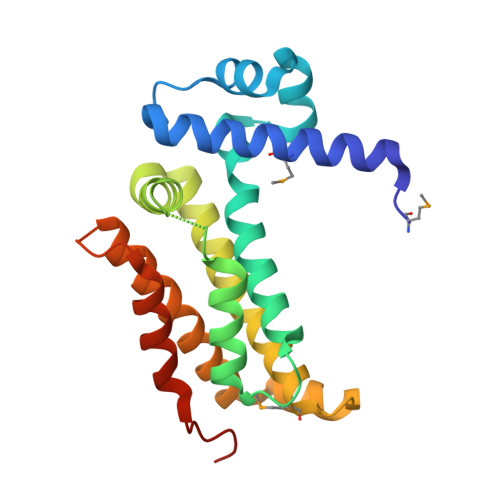
Structure of Regulator Protein SCO3201 from Streptomyces coelicolor


Experimental Data Snapshot

  • Method: X-RAY DIFFRACTION
  • Resolution: 2.10 Å
  • R-Value Free: 
    0.269 (Depositor), 0.275 (DCC) 
  • R-Value Work: 
    0.227 (Depositor), 0.236 (DCC) 
  • R-Value Observed: 
    0.229 (Depositor) 

wwPDB Validation 3D Report Full Report

Validation slider image for 4CGR

This is version 1.4 of the entry. See complete history

Literature

Structure and Regulatory Targets of Sco3201, a Highly Promiscuous Tetr-Like Regulator of Streptomyces Coelicolor M145.

Xu, D.Waack, P.Zhang, Q.Werten, S.Hinrichs, W.Virolle, M.

(2014) Biochem Biophys Res Commun 450: 513

  • DOI: https://doi.org/10.1016/j.bbrc.2014.06.003
  • Primary Citation Related Structures: 
    4CGR

  • PubMed Abstract: 

    SCO3201, a regulator of the TetR family, is a strong repressor of both morphological differentiation and antibiotic production when overexpressed in Streptomyces coelicolor. Here, we report the identification of 14 novel putative regulatory targets of this regulator using in vitro formaldehyde cross-linking. Direct binding of purified His6-SCO3201 was demonstrated for the promoter regions of 5 regulators (SCO1716, SCO1950, SCO3367, SCO4009 and SCO5046), a putative histidine phosphatase (SCO1809), an acetyltransferase (SCO0988) and the polyketide synthase RedX (SCO5878), using EMSA. Reverse transcriptional analysis demonstrated that the expression of the transcriptional regulators SCO1950, SCO4009, SCO5046, as well as of SCO0988 and RedX was down regulated, upon SCO3201 overexpression, whereas the expression of SCO1809 and SCO3367 was up regulated. A consensus binding motif was derived via alignment of the promoter regions of the genes negatively regulated. The positions of the predicted operator sites were consistent with a direct repressive effect of SCO3201 on 5 out of 7 of these promoters. Furthermore, the 2.1Å crystal structure of SCO3201 was solved, which provides a possible explanation for the high promiscuity of this regulator that might account for its dramatic effect on the differentiation process of S. coelicolor.


  • Organizational Affiliation
    • Department of Ecology, Institute of Hydrobiology, School of Life Science and Technology, Jinan University, Guangzhou 510632, PR China. Electronic address: xudelin@live.com.

Macromolecule Content 

  • Total Structure Weight: 47 kDa 
  • Atom Count: 2,908 
  • Modeled Residue Count: 388 
  • Deposited Residue Count: 432 
  • Unique protein chains: 1

Macromolecules

Find similar proteins by:|  3D Structure
Entity ID: 1
MoleculeChains  Sequence LengthOrganismDetailsImage
PUTATIVE TETR-FAMILY TRANSCRIPTIONAL REGULATOR
A, B
216Streptomyces coelicolorMutation(s): 0 
UniProt
Find proteins for Q9KYU4 (Streptomyces coelicolor (strain ATCC BAA-471 / A3(2) / M145))
Explore Q9KYU4 
Go to UniProtKB:  Q9KYU4
Entity Groups
Sequence Clusters30% Identity50% Identity70% Identity90% Identity95% Identity100% Identity
UniProt GroupQ9KYU4
Sequence Annotations
Expand
Reference Sequence

Small Molecules

Ligands 1 Unique
IDChains Name / Formula / InChI Key2D Diagram3D Interactions
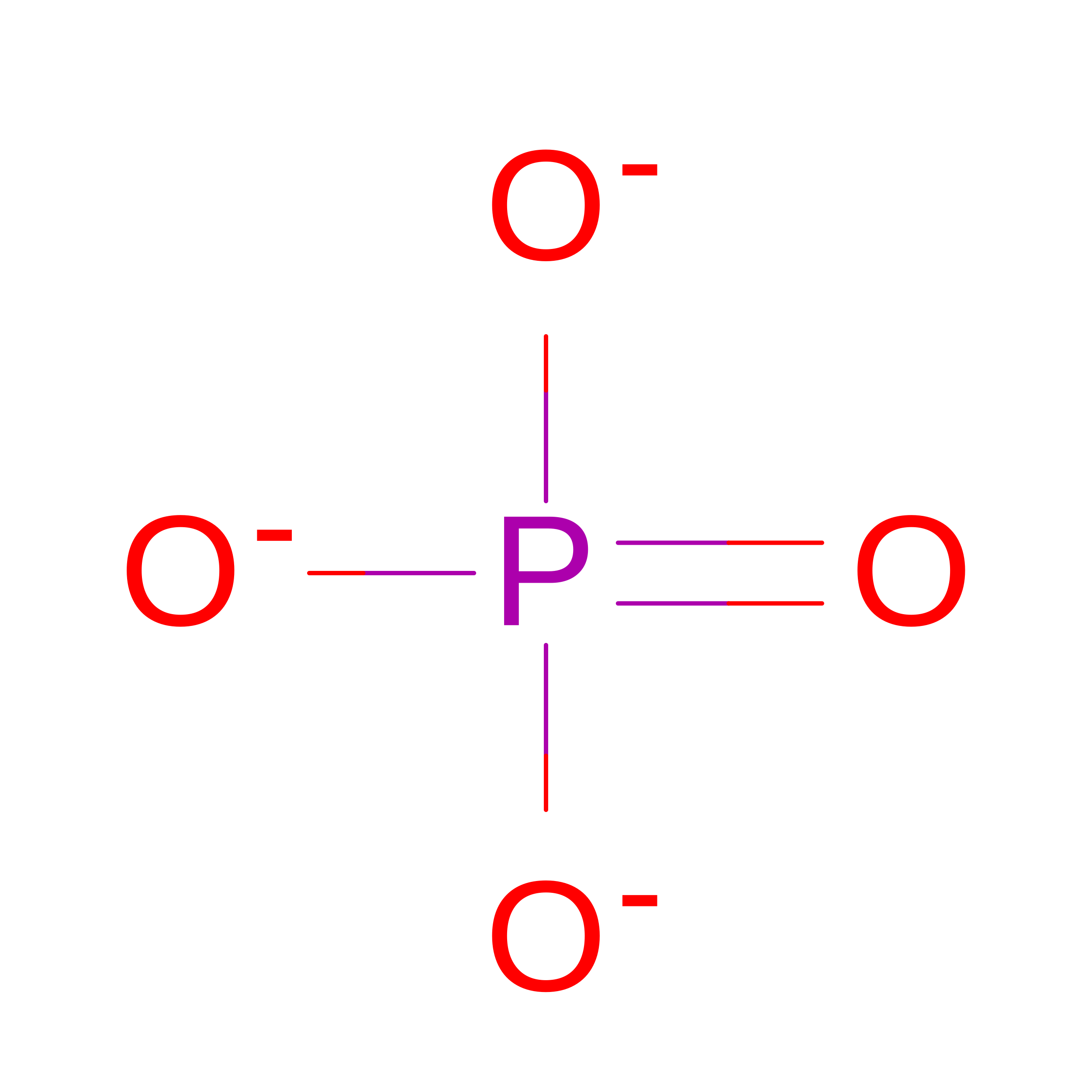
PO4

Query on PO4


Download:Ideal Coordinates CCD File
C [auth A]PHOSPHATE ION
O4 P
NBIIXXVUZAFLBC-UHFFFAOYSA-K
Modified Residues  1 Unique
IDChains TypeFormula2D DiagramParent
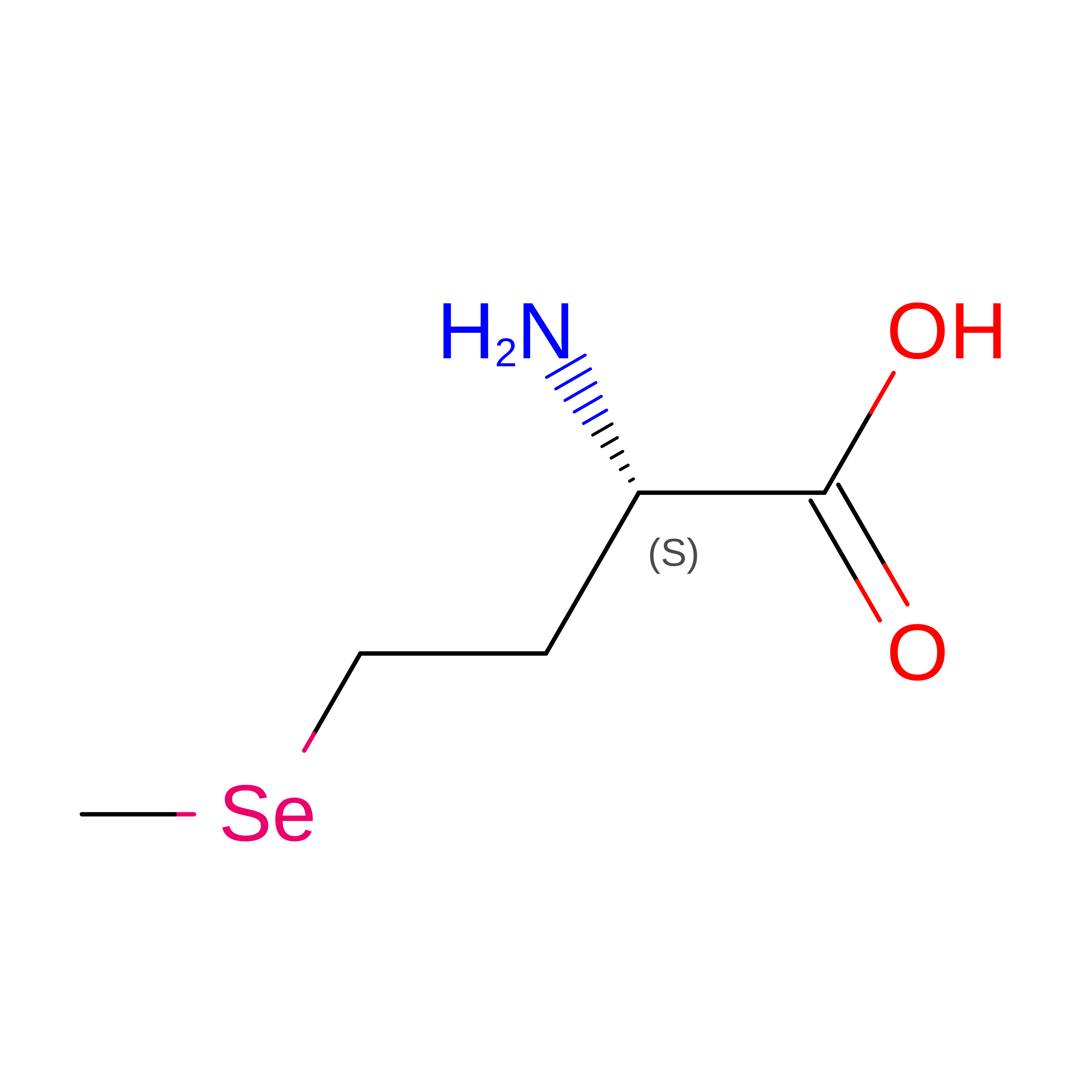
MSE
Query on MSE
A, B
L-PEPTIDE LINKINGC5 H11 N O2 SeMET

Experimental Data & Validation

Experimental Data

  • Method: X-RAY DIFFRACTION
  • Resolution: 2.10 Å
  • R-Value Free:  0.269 (Depositor), 0.275 (DCC) 
  • R-Value Work:  0.227 (Depositor), 0.236 (DCC) 
  • R-Value Observed: 0.229 (Depositor) 
Space Group: P 21 21 21
Unit Cell:
Length ( Å )Angle ( ˚ )
a = 54.68α = 90
b = 79.63β = 90
c = 95.98γ = 90
Software Package:
Software NamePurpose
REFMACrefinement
MOSFLMdata reduction
SCALAdata scaling
SHELXphasing

Structure Validation

View Full Validation Report


Entry History 

Deposition Data

Revision History  (Full details and data files)

  • Version 1.0: 2014-07-09
    Type: Initial release
  • Version 1.1: 2014-08-06
    Changes: Database references
  • Version 1.2: 2018-01-24
    Changes: Source and taxonomy
  • Version 1.3: 2019-05-08
    Changes: Data collection, Derived calculations, Experimental preparation
  • Version 1.4: 2024-11-20
    Changes: Data collection, Database references, Derived calculations, Other, Structure summary