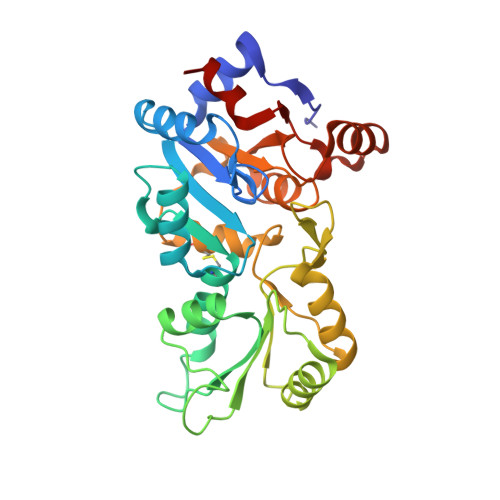
4BX3 | pdb_00004bx3

Crystal Structure of murine Chronophin (Pyridoxal Phosphate Phosphatase)


Experimental Data Snapshot

  • Method: X-RAY DIFFRACTION
  • Resolution: 2.19 Å
  • R-Value Free: 
    0.207 (Depositor), 0.210 (DCC) 
  • R-Value Work: 
    0.171 (Depositor), 0.181 (DCC) 
  • R-Value Observed: 
    0.172 (Depositor) 

Starting Model: experimental
View more details

wwPDB Validation 3D Report Full Report

Validation slider image for 4BX3

This is version 2.1 of the entry. See complete history

Literature

Chronophin Dimerization is Required for Proper Positioning of its Substrate Specificity Loop.

Kestler, C.Knobloch, G.Tessmer, I.Jeanclos, E.Schindelin, H.Gohla, A.

(2014) J Biological Chem 289: 3094

  • DOI: https://doi.org/10.1074/jbc.M113.536482
  • Primary Citation Related Structures: 
    4BX0, 4BX2, 4BX3

  • PubMed Abstract: 

    Mammalian phosphatases of the haloacid dehalogenase (HAD) superfamily have emerged as important regulators of physiology and disease. Many of these enzymes are stable homodimers; however, the role of their dimerization is largely unknown. Here, we explore the function of the obligatory homodimerization of chronophin, a mammalian HAD phosphatase known to dephosphorylate pyridoxal 5'-phosphate (PLP) and serine/threonine-phosphorylated proteins. The exchange of two residues in the murine chronophin homodimerization interface (chronophin(A194K,A195K)) yields a constitutive monomer both in vitro and in cells. The catalytic activity of monomeric chronophin toward PLP is strongly impaired. X-ray crystallographic studies of chronophin(A194K,A195K) revealed that dimer formation is essential for an intermolecular arginine-arginine-tryptophan stacking interaction that positions a critical histidine residue in the substrate specificity loop of chronophin for PLP coordination. Analysis of all available crystal structures of HAD hydrolases that are grouped together with chronophin in the C2a-type structural subfamily uncovered a highly conserved mode of dimerization that results in intermolecular contacts involving the substrate specificity loop. Our results explain how the dimerization of HAD hydrolases contributes to their catalytic efficiency and substrate specificity.


  • Organizational Affiliation
    • From the Institute for Pharmacology and Toxicology, University of Würzburg, 97078 Würzburg, Germany and.

Macromolecule Content 

  • Total Structure Weight: 63.46 kDa 
  • Atom Count: 4,645 
  • Modeled Residue Count: 582 
  • Deposited Residue Count: 586 
  • Unique protein chains: 1

Macromolecules

Find similar proteins by:|  3D Structure
Entity ID: 1
MoleculeChains  Sequence LengthOrganismDetailsImage
PYRIDOXAL PHOSPHATE PHOSPHATASE
A, B
293Mus musculusMutation(s): 0 
EC: 3.1.3.74 (PDB Primary Data), 3.1.3.3 (PDB Primary Data), 3.1.3.16 (UniProt)
UniProt & NIH Common Fund Data Resources
Find proteins for P60487 (Mus musculus)
Explore P60487 
Go to UniProtKB:  P60487
IMPC:  MGI:1919282
Entity Groups
Sequence Clusters30% Identity50% Identity70% Identity90% Identity95% Identity100% Identity
UniProt GroupP60487
Sequence Annotations
Expand
Reference Sequence

Experimental Data & Validation

Experimental Data

  • Method: X-RAY DIFFRACTION
  • Resolution: 2.19 Å
  • R-Value Free:  0.207 (Depositor), 0.210 (DCC) 
  • R-Value Work:  0.171 (Depositor), 0.181 (DCC) 
  • R-Value Observed: 0.172 (Depositor) 
Space Group: I 2 3
Unit Cell:
Length ( Å )Angle ( ˚ )
a = 167.1α = 90
b = 167.1β = 90
c = 167.1γ = 90
Software Package:
Software NamePurpose
PHENIXrefinement
iMOSFLMdata reduction
SCALAdata scaling
PHASERphasing

Structure Validation

View Full Validation Report


Entry History 

Deposition Data

Revision History  (Full details and data files)

  • Version 1.0: 2013-12-25
    Type: Initial release
  • Version 1.1: 2014-02-12
    Changes: Database references
  • Version 2.0: 2023-12-20
    Changes: Atomic model, Data collection, Database references, Derived calculations, Other, Refinement description
  • Version 2.1: 2024-11-20
    Changes: Structure summary