3ZRJ | pdb_00003zrj

Complex of ClpV N-domain with VipB peptide


Experimental Data Snapshot

  • Method: X-RAY DIFFRACTION
  • Resolution: 1.94 Å
  • R-Value Free: 
    0.225 (Depositor), 0.237 (DCC) 
  • R-Value Work: 
    0.183 (Depositor), 0.195 (DCC) 

wwPDB Validation 3D Report Full Report

Validation slider image for 3ZRJ

This is version 1.3 of the entry. See complete history

Literature

Molecular Basis for the Unique Role of the Aaa+ Chaperone Clpv in Type Vi Protein Secretion.

Pietrosiuk, A.Lenherr, E.D.Falk, S.Bonemann, G.Kopp, J.Zentgraf, H.Sinning, I.Mogk, A.

(2011) J Biological Chem 286: 30010

  • DOI: https://doi.org/10.1074/jbc.M111.253377
  • Primary Citation Related Structures: 
    3ZRI, 3ZRJ

  • PubMed Abstract: 

    Ring-forming AAA(+) ATPases act in a plethora of cellular processes by remodeling macromolecules. The specificity of individual AAA(+) proteins is achieved by direct or adaptor-mediated association with substrates via distinct recognition domains. We investigated the molecular basis of substrate interaction for Vibrio cholerae ClpV, which disassembles tubular VipA/VipB complexes, an essential step of type VI protein secretion and bacterial virulence. We identified the ClpV recognition site within VipB, showed that productive ClpV-VipB interaction requires the oligomeric state of both proteins, solved the crystal structure of a ClpV N-domain-VipB peptide complex, and verified the interaction surface by mutant analysis. Our results show that the substrate is bound to a hydrophobic groove, which is formed by the addition of a single α-helix to the core N-domain. This helix is absent from homologous N-domains, explaining the unique substrate specificity of ClpV. A limited interaction surface between both proteins accounts for the dramatic increase in binding affinity upon ATP-driven ClpV hexamerization and VipA/VipB tubule assembly by coupling multiple weak interactions. This principle ensures ClpV selectivity toward the VipA/VipB macromolecular complex.


  • Organizational Affiliation
    • Zentrum für Molekulare Biologie Heidelberg (ZMBH), DKFZ-ZMBH Alliance, Universität Heidelberg, Heidelberg, Germany.

Macromolecule Content 

  • Total Structure Weight: 43.43 kDa 
  • Atom Count: 3,054 
  • Modeled Residue Count: 349 
  • Deposited Residue Count: 382 
  • Unique protein chains: 2

Macromolecules

Find similar proteins by:|  3D Structure
Entity ID: 1
MoleculeChains  Sequence LengthOrganismDetailsImage
CLPB PROTEIN
A, B
171Vibrio cholerae V52Mutation(s): 0 
Find similar proteins by:  Sequence   |   3D Structure  
Entity ID: 2
MoleculeChains  Sequence LengthOrganismDetailsImage
VIPBC [auth X],
D [auth Y]
20Vibrio cholerae V52Mutation(s): 0 
UniProt
Find proteins for Q9KN57 (Vibrio cholerae serotype O1 (strain ATCC 39315 / El Tor Inaba N16961))
Explore Q9KN57 
Go to UniProtKB:  Q9KN57
Entity Groups
Sequence Clusters30% Identity50% Identity70% Identity90% Identity95% Identity100% Identity
UniProt GroupQ9KN57
Sequence Annotations
Expand
Reference Sequence

Small Molecules

Ligands 1 Unique
IDChains Name / Formula / InChI Key2D Diagram3D Interactions
EDO

Query on EDO


Download:Ideal Coordinates CCD File
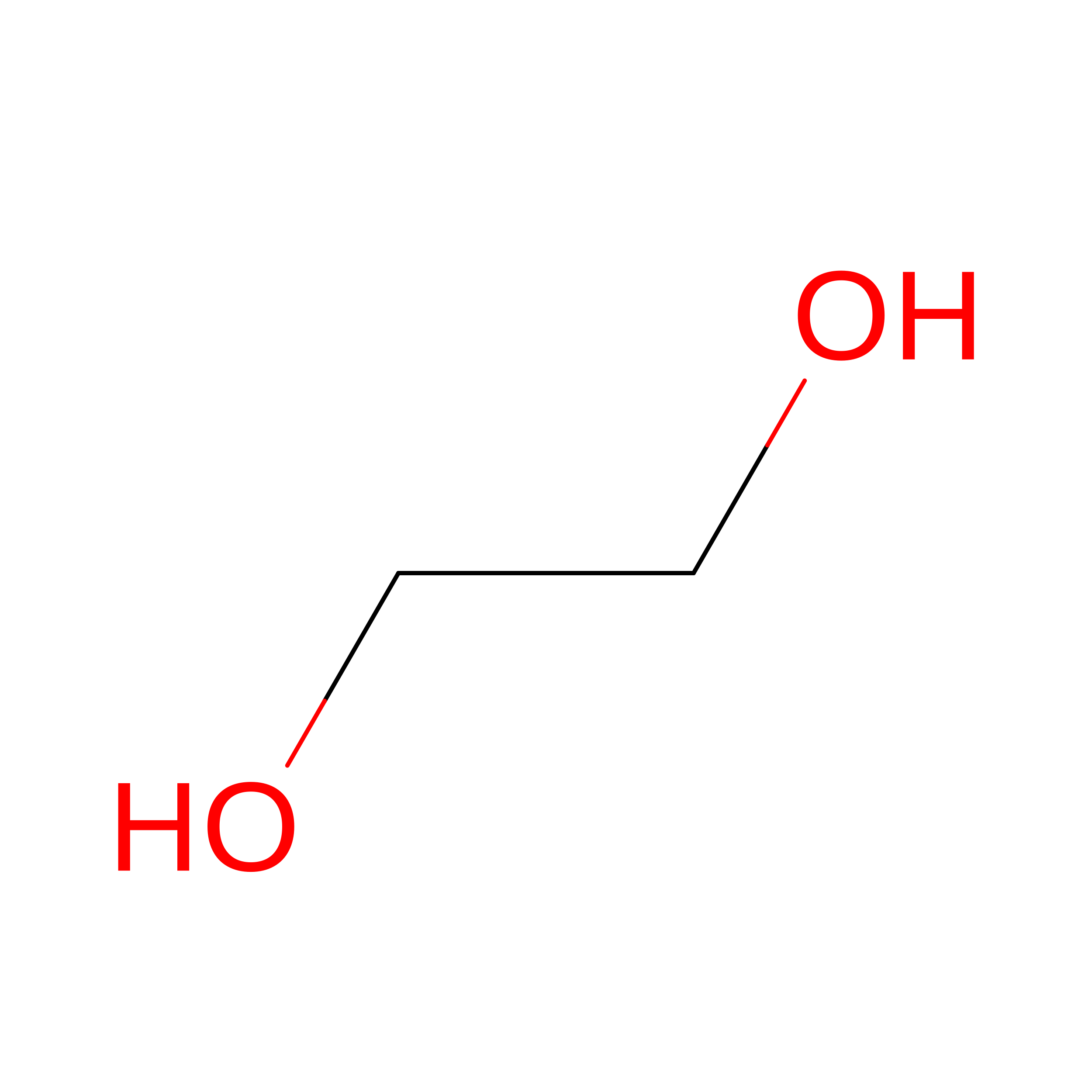
E [auth A]1,2-ETHANEDIOL
C2 H6 O2
LYCAIKOWRPUZTN-UHFFFAOYSA-N

Experimental Data & Validation

Experimental Data

  • Method: X-RAY DIFFRACTION
  • Resolution: 1.94 Å
  • R-Value Free:  0.225 (Depositor), 0.237 (DCC) 
  • R-Value Work:  0.183 (Depositor), 0.195 (DCC) 
Space Group: C 1 2 1
Unit Cell:
Length ( Å )Angle ( ˚ )
a = 124.24α = 90
b = 37.61β = 107.54
c = 88.13γ = 90
Software Package:
Software NamePurpose
REFMACrefinement
XDSdata reduction
XDSdata scaling

Structure Validation

View Full Validation Report


Entry History 

Deposition Data

Revision History  (Full details and data files)

  • Version 1.0: 2011-07-06
    Type: Initial release
  • Version 1.1: 2013-04-17
    Changes: Database references
  • Version 1.2: 2019-05-15
    Changes: Data collection, Experimental preparation, Other
  • Version 1.3: 2024-11-13
    Changes: Data collection, Database references, Derived calculations, Other, Structure summary