3VMP | pdb_00003vmp

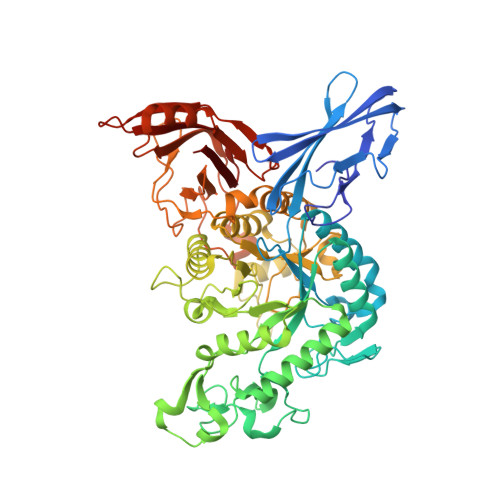
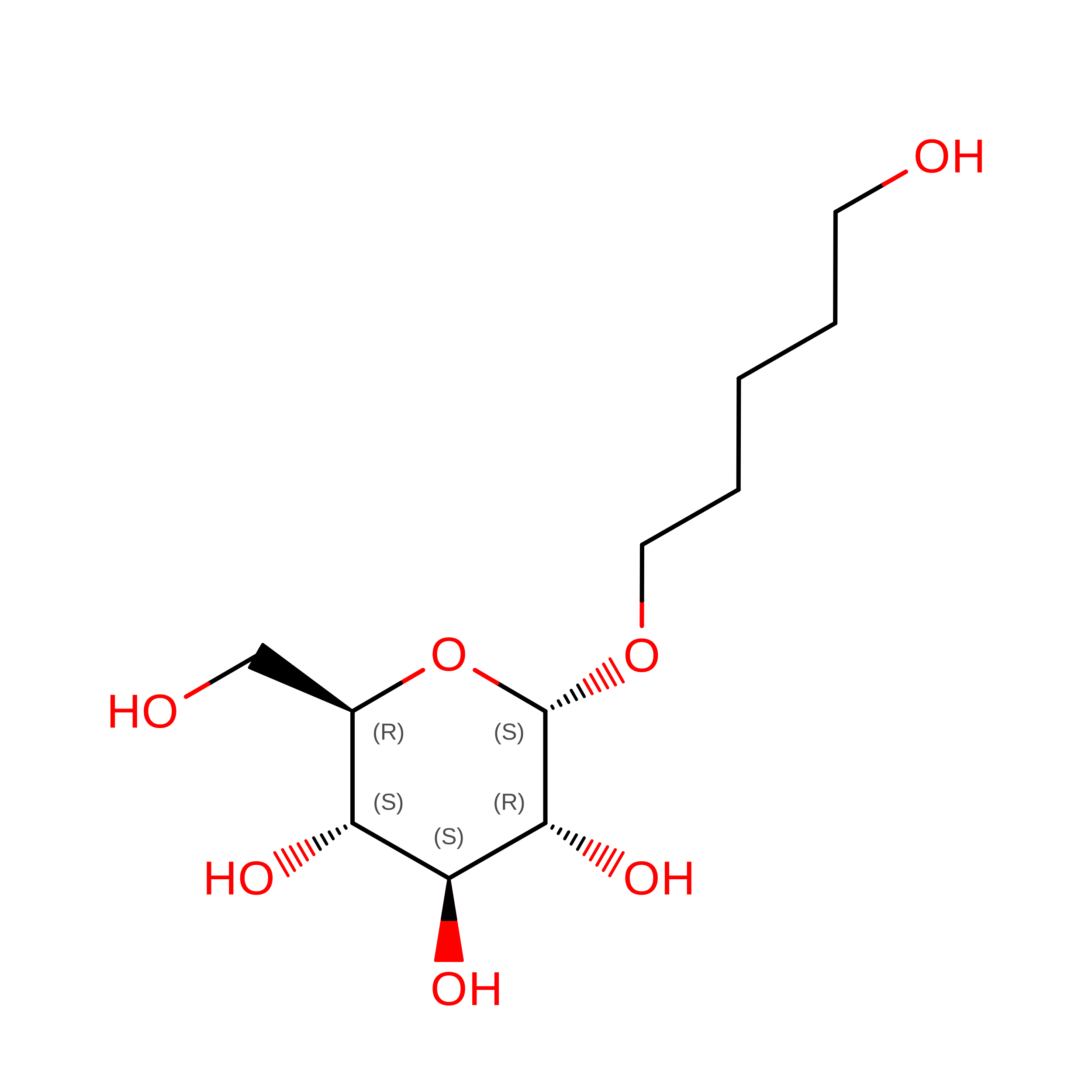
Crystal structure of dextranase from Streptococcus mutans in complex with 4,5-epoxypentyl alpha-D-glucopyranoside


Experimental Data Snapshot

  • Method: X-RAY DIFFRACTION
  • Resolution: 1.88 Å
  • R-Value Free: 
    0.238 (Depositor), 0.237 (DCC) 
  • R-Value Work: 
    0.195 (Depositor), 0.195 (DCC) 
  • R-Value Observed: 
    0.198 (Depositor) 

Starting Model: experimental
View more details

wwPDB Validation 3D Report Full Report

Validation slider image for 3VMP

Ligand Structure Quality Assessment 


This is version 1.3 of the entry. See complete history

Literature

Structural elucidation of dextran degradation mechanism by streptococcus mutans dextranase belonging to glycoside hydrolase family 66

Suzuki, N.Kim, Y.M.Fujimoto, Z.Momma, M.Okuyama, M.Mori, H.Funane, K.Kimura, A.

(2012) J Biological Chem 287: 19916-19926

  • DOI: https://doi.org/10.1074/jbc.M112.342444
  • Primary Citation Related Structures: 
    3VMN, 3VMO, 3VMP

  • PubMed Abstract: 

    Dextranase is an enzyme that hydrolyzes dextran α-1,6 linkages. Streptococcus mutans dextranase belongs to glycoside hydrolase family 66, producing isomaltooligosaccharides of various sizes and consisting of at least five amino acid sequence regions. The crystal structure of the conserved fragment from Gln(100) to Ile(732) of S. mutans dextranase, devoid of its N- and C-terminal variable regions, was determined at 1.6 Å resolution and found to contain three structural domains. Domain N possessed an immunoglobulin-like β-sandwich fold; domain A contained the enzyme's catalytic module, comprising a (β/α)(8)-barrel; and domain C formed a β-sandwich structure containing two Greek key motifs. Two ligand complex structures were also determined, and, in the enzyme-isomaltotriose complex structure, the bound isomaltooligosaccharide with four glucose moieties was observed in the catalytic glycone cleft and considered to be the transglycosylation product of the enzyme, indicating the presence of four subsites, -4 to -1, in the catalytic cleft. The complexed structure with 4',5'-epoxypentyl-α-d-glucopyranoside, a suicide substrate of the enzyme, revealed that the epoxide ring reacted to form a covalent bond with the Asp(385) side chain. These structures collectively indicated that Asp(385) was the catalytic nucleophile and that Glu(453) was the acid/base of the double displacement mechanism, in which the enzyme showed a retaining catalytic character. This is the first structural report for the enzyme belonging to glycoside hydrolase family 66, elucidating the enzyme's catalytic machinery.


  • Organizational Affiliation
    • Biomolecular Research Unit, National Institute of Agrobiological Sciences, 2-1-2 Kannondai, Tsukuba 305-8602, Japan.

Macromolecule Content 

  • Total Structure Weight: 72.96 kDa 
  • Atom Count: 5,408 
  • Modeled Residue Count: 632 
  • Deposited Residue Count: 643 
  • Unique protein chains: 1

Macromolecules

Find similar proteins by:|  3D Structure
Entity ID: 1
MoleculeChains  Sequence LengthOrganismDetailsImage
Dextranase643Streptococcus mutansMutation(s): 0 
EC: 3.2.1.11
UniProt
Find proteins for Q54443 (Streptococcus mutans serotype c (strain ATCC 700610 / UA159))
Explore Q54443 
Go to UniProtKB:  Q54443
Entity Groups
Sequence Clusters30% Identity50% Identity70% Identity90% Identity95% Identity100% Identity
UniProt GroupQ54443
Sequence Annotations
Expand
Reference Sequence

Small Molecules

Experimental Data & Validation

Experimental Data

  • Method: X-RAY DIFFRACTION
  • Resolution: 1.88 Å
  • R-Value Free:  0.238 (Depositor), 0.237 (DCC) 
  • R-Value Work:  0.195 (Depositor), 0.195 (DCC) 
  • R-Value Observed: 0.198 (Depositor) 
Space Group: P 1 21 1
Unit Cell:
Length ( Å )Angle ( ˚ )
a = 53.428α = 90
b = 89.966β = 102.25
c = 62.842γ = 90
Software Package:
Software NamePurpose
ADSCdata collection
MOLREPphasing
REFMACrefinement
HKL-2000data reduction
HKL-2000data scaling

Structure Validation

View Full Validation Report


Ligand Structure Quality Assessment 


Entry History 

Deposition Data

Revision History  (Full details and data files)

  • Version 1.0: 2012-02-15
    Type: Initial release
  • Version 1.1: 2013-06-26
    Changes: Database references
  • Version 1.2: 2020-07-29
    Type: Remediation
    Reason: Carbohydrate remediation
    Changes: Data collection, Database references, Derived calculations
  • Version 1.3: 2023-11-08
    Changes: Data collection, Database references, Refinement description, Structure summary