3PBJ | pdb_00003pbj

Hydrolytic catalysis and structural stabilization in a designed metalloprotein


Experimental Data Snapshot

  • Method: X-RAY DIFFRACTION
  • Resolution: 2.20 Å
  • R-Value Free: 
    0.264 (Depositor), 0.259 (DCC) 
  • R-Value Work: 
    0.205 (Depositor), 0.210 (DCC) 
  • R-Value Observed: 
    0.208 (Depositor) 

wwPDB Validation 3D Report Full Report

Validation slider image for 3PBJ

This is version 1.4 of the entry. See complete history

Literature

Hydrolytic catalysis and structural stabilization in a designed metalloprotein.

Zastrow, M.L.Peacock, A.F.Stuckey, J.A.Pecoraro, V.L.

(2012) Nat Chem 4: 118-123

  • DOI: https://doi.org/10.1038/nchem.1201
  • Primary Citation Related Structures: 
    3PBJ

  • PubMed Abstract: 

    Metal ions are an important part of many natural proteins, providing structural, catalytic and electron transfer functions. Reproducing these functions in a designed protein is the ultimate challenge to our understanding of them. Here, we present an artificial metallohydrolase, which has been shown by X-ray crystallography to contain two different metal ions-a Zn(II) ion, which is important for catalytic activity, and a Hg(II) ion, which provides structural stability. This metallohydrolase displays catalytic activity that compares well with several characteristic reactions of natural enzymes. It catalyses p-nitrophenyl acetate (pNPA) hydrolysis with an efficiency only ~100-fold less than that of human carbonic anhydrase (CA)II and at least 550-fold better than comparable synthetic complexes. Similarly, CO(2) hydration occurs with an efficiency within ~500-fold of CAII. Although histidine residues in the absence of Zn(II) exhibit pNPA hydrolysis, miniscule apopeptide activity is observed for CO(2) hydration. The kinetic and structural analysis of this first de novo designed hydrolytic metalloenzyme reveals necessary design features for future metalloenzymes containing one or more metals.


  • Organizational Affiliation
    • Department of Chemistry, University of Michigan, Ann Arbor, Michigan 48109, USA.

Macromolecule Content 

  • Total Structure Weight: 21.26 kDa 
  • Atom Count: 1,437 
  • Modeled Residue Count: 180 
  • Deposited Residue Count: 186 
  • Unique protein chains: 1

Macromolecules

Find similar proteins by:|  3D Structure
Entity ID: 1
MoleculeChains  Sequence LengthOrganismDetailsImage
COIL SER L9L-Pen L23H
A, B, C, D, E
A, B, C, D, E, F
31synthetic constructMutation(s): 0 

Small Molecules

Ligands 4 Unique
IDChains Name / Formula / InChI Key2D Diagram3D Interactions
HG

Query on HG


Download:Ideal Coordinates CCD File
K [auth B],
O [auth D]
MERCURY (II) ION
Hg
BQPIGGFYSBELGY-UHFFFAOYSA-N
ZN

Query on ZN


Download:Ideal Coordinates CCD File
G [auth A]
H [auth A]
I [auth A]
M [auth D]
N [auth D]
G [auth A],
H [auth A],
I [auth A],
M [auth D],
N [auth D],
P [auth E],
S [auth F]
ZINC ION
Zn
PTFCDOFLOPIGGS-UHFFFAOYSA-N
CL

Query on CL


Download:Ideal Coordinates CCD File
J [auth A],
Q [auth E],
R [auth E]
CHLORIDE ION
Cl
VEXZGXHMUGYJMC-UHFFFAOYSA-M
NA

Query on NA


Download:Ideal Coordinates CCD File
L [auth B]SODIUM ION
Na
FKNQFGJONOIPTF-UHFFFAOYSA-N
Modified Residues  1 Unique
IDChains TypeFormula2D DiagramParent
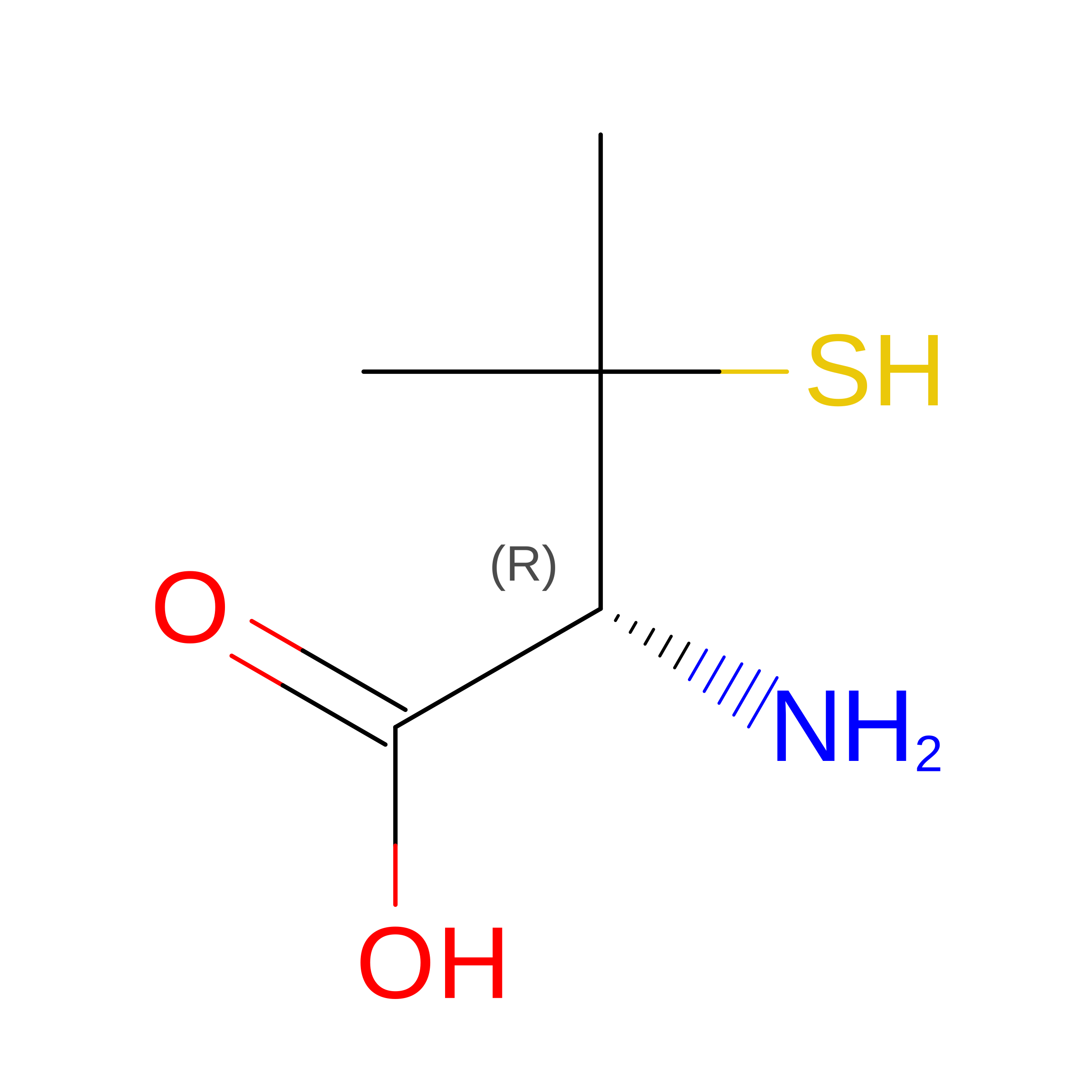
LE1
Query on LE1
A, B, C, D, E
A, B, C, D, E, F
L-PEPTIDE LINKINGC5 H11 N O2 SVAL

Experimental Data & Validation

Experimental Data

  • Method: X-RAY DIFFRACTION
  • Resolution: 2.20 Å
  • R-Value Free:  0.264 (Depositor), 0.259 (DCC) 
  • R-Value Work:  0.205 (Depositor), 0.210 (DCC) 
  • R-Value Observed: 0.208 (Depositor) 
Space Group: P 1 21 1
Unit Cell:
Length ( Å )Angle ( ˚ )
a = 25.877α = 90
b = 38.649β = 95.06
c = 75.659γ = 90
Software Package:
Software NamePurpose
MAR345data collection
PHASERphasing
BUSTERrefinement
HKL-2000data reduction
HKL-2000data scaling

Structure Validation

View Full Validation Report


Entry History 

Deposition Data

Revision History  (Full details and data files)

  • Version 1.0: 2011-11-30
    Type: Initial release
  • Version 1.1: 2011-12-14
    Changes: Database references
  • Version 1.2: 2012-02-29
    Changes: Database references
  • Version 1.3: 2017-11-08
    Changes: Refinement description
  • Version 1.4: 2022-05-04
    Changes: Database references, Derived calculations, Structure summary