3N94 | pdb_00003n94

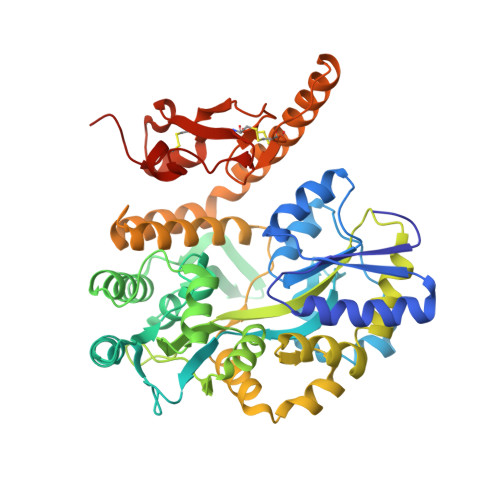
Crystal structure of human pituitary adenylate cyclase 1 Receptor-short N-terminal extracellular domain


Experimental Data Snapshot

  • Method: X-RAY DIFFRACTION
  • Resolution: 1.80 Å
  • R-Value Free: 
    0.216 (Depositor), 0.221 (DCC) 
  • R-Value Work: 
    0.176 (Depositor), 0.186 (DCC) 
  • R-Value Observed: 
    0.178 (Depositor) 

Starting Model: experimental
View more details

wwPDB Validation 3D Report Full Report

Validation slider image for 3N94

This is version 2.2 of the entry. See complete history

Literature

Crystal Structure of the PAC1R Extracellular Domain Unifies a Consensus Fold for Hormone Recognition by Class B G-Protein Coupled Receptors.

Kumar, S.Pioszak, A.Zhang, C.Swaminathan, K.Xu, H.E.

(2011) PLoS One 6: e19682-e19682

  • DOI: https://doi.org/10.1371/journal.pone.0019682
  • Primary Citation Related Structures: 
    3N94

  • PubMed Abstract: 

    Pituitary adenylate cyclase activating polypeptide (PACAP) is a member of the PACAP/glucagon family of peptide hormones, which controls many physiological functions in the immune, nervous, endocrine, and muscular systems. It activates adenylate cyclase by binding to its receptor, PAC1R, a member of class B G-protein coupled receptors (GPCR). Crystal structures of a number of Class B GPCR extracellular domains (ECD) bound to their respective peptide hormones have revealed a consensus mechanism of hormone binding. However, the mechanism of how PACAP binds to its receptor remains controversial as an NMR structure of the PAC1R ECD/PACAP complex reveals a different topology of the ECD and a distinct mode of ligand recognition. Here we report a 1.9 Å crystal structure of the PAC1R ECD, which adopts the same fold as commonly observed for other members of Class B GPCR. Binding studies and cell-based assays with alanine-scanned peptides and mutated receptor support a model that PAC1R uses the same conserved fold of Class B GPCR ECD for PACAP binding, thus unifying the consensus mechanism of hormone binding for this family of receptors.


  • Organizational Affiliation
    • Laboratory of Structural Sciences, Van Andel Research Institute, Grand Rapids, Michigan, United States of America.

Macromolecule Content 

  • Total Structure Weight: 53.18 kDa 
  • Atom Count: 3,948 
  • Modeled Residue Count: 466 
  • Deposited Residue Count: 475 
  • Unique protein chains: 1

Macromolecules

Find similar proteins by:|  3D Structure
Entity ID: 1
MoleculeChains  Sequence LengthOrganismDetailsImage
Fusion protein of Maltose-binding periplasmic protein and pituitary adenylate cyclase 1 Receptor-short475Escherichia coli K-12Homo sapiens
This entity is chimeric
Mutation(s): 0 
Gene Names: malEb4034JW3994ADCYAP1R1
UniProt & NIH Common Fund Data Resources
Find proteins for P0AEX9 (Escherichia coli (strain K12))
Explore P0AEX9 
Go to UniProtKB:  P0AEX9
Find proteins for P41586 (Homo sapiens)
Explore P41586 
Go to UniProtKB:  P41586
PHAROS:  P41586
GTEx:  ENSG00000078549 
Entity Groups
Sequence Clusters30% Identity50% Identity70% Identity90% Identity95% Identity100% Identity
UniProt GroupsP0AEX9P41586
Sequence Annotations
Expand
Reference Sequence

Oligosaccharides

Help  
Entity ID: 2
MoleculeChains Length2D Diagram GlycosylationD Interactions
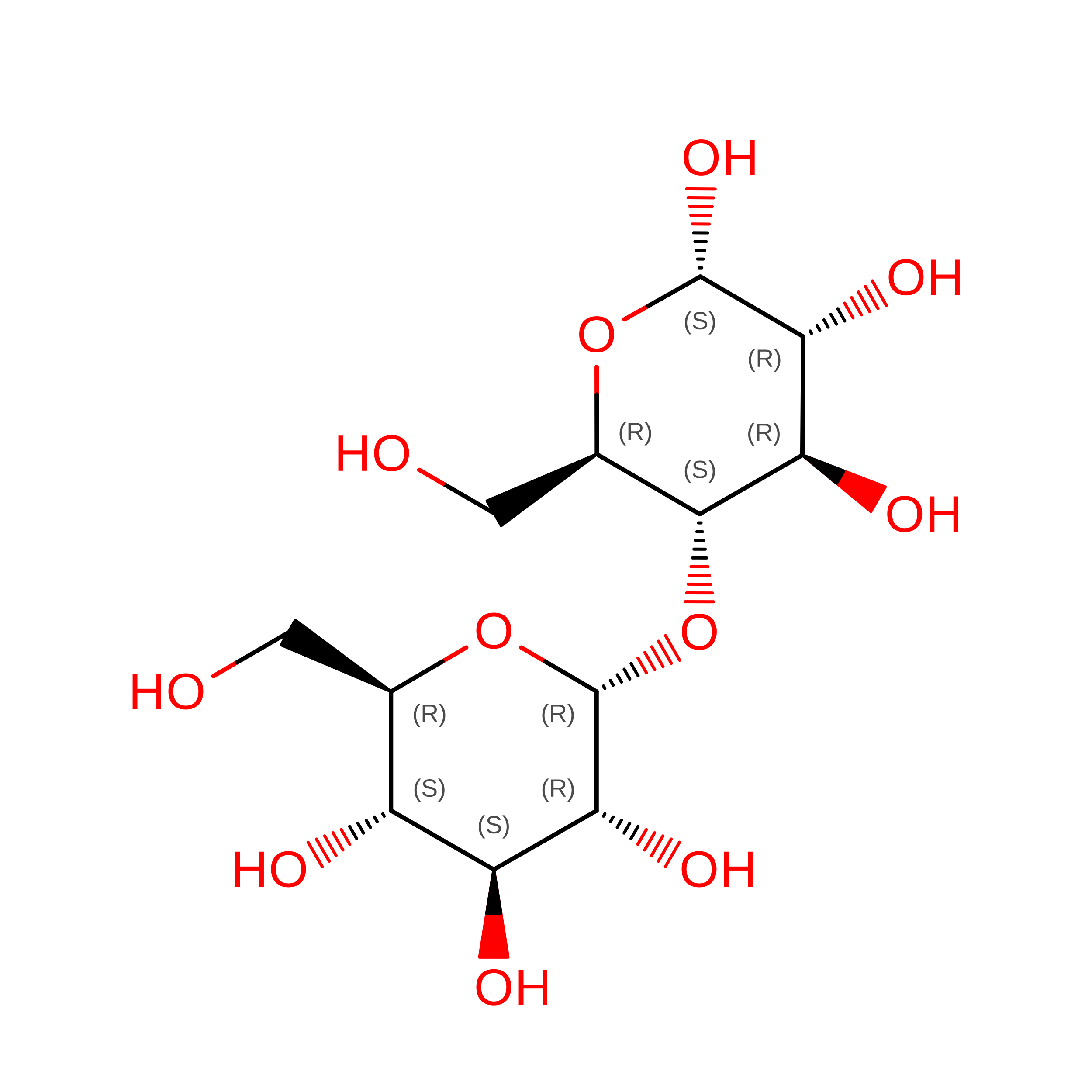
alpha-D-glucopyranose-(1-4)-alpha-D-glucopyranose
B
2N/A
Glycosylation Resources
GlyTouCan: G07411ON
GlyCosmos: G07411ON

Small Molecules

Ligands 1 Unique
IDChains Name / Formula / InChI Key2D Diagram3D Interactions
SO4

Query on SO4


Download:Ideal Coordinates CCD File
C [auth A]SULFATE ION
O4 S
QAOWNCQODCNURD-UHFFFAOYSA-L

Biologically Interesting Molecules (External Reference) 

1 Unique

Experimental Data & Validation

Experimental Data

  • Method: X-RAY DIFFRACTION
  • Resolution: 1.80 Å
  • R-Value Free:  0.216 (Depositor), 0.221 (DCC) 
  • R-Value Work:  0.176 (Depositor), 0.186 (DCC) 
  • R-Value Observed: 0.178 (Depositor) 
Space Group: P 21 21 21
Unit Cell:
Length ( Å )Angle ( ˚ )
a = 45.987α = 90
b = 92.151β = 90
c = 105.418γ = 90
Software Package:
Software NamePurpose
REFMACrefinement
PDB_EXTRACTdata extraction
MAR345dtbdata collection
HKL-2000data reduction
HKL-2000data scaling
PHASERphasing

Structure Validation

View Full Validation Report


Entry History 

Deposition Data

Revision History  (Full details and data files)

  • Version 1.0: 2011-06-08
    Type: Initial release
  • Version 1.1: 2011-07-13
    Changes: Version format compliance
  • Version 1.2: 2017-07-26
    Changes: Refinement description, Source and taxonomy
  • Version 2.0: 2020-07-29
    Type: Remediation
    Reason: Carbohydrate remediation
    Changes: Atomic model, Data collection, Database references, Derived calculations, Non-polymer description, Structure summary
  • Version 2.1: 2023-09-06
    Changes: Data collection, Database references, Refinement description, Structure summary
  • Version 2.2: 2024-10-16
    Changes: Structure summary