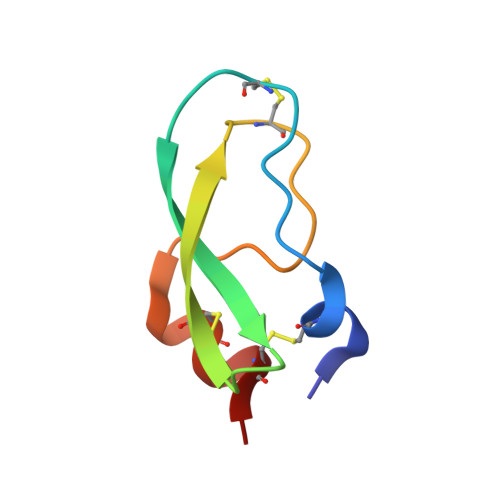
3LDI | pdb_00003ldi

Crystal structure of aprotinin in complex with sucrose octasulfate: unusual interactions and implication for heparin binding


Experimental Data Snapshot

  • Method: X-RAY DIFFRACTION
  • Resolution: 2.20 Å
  • R-Value Free: 
    0.234 (Depositor), 0.236 (DCC) 
  • R-Value Work: 
    0.206 (Depositor), 0.206 (DCC) 
  • R-Value Observed: 
    0.207 (Depositor) 

wwPDB Validation 3D Report Full Report

Validation slider image for 3LDI

This is version 1.3 of the entry. See complete history

Literature

Crystal structures of aprotinin and its complex with sucrose octasulfate reveal multiple modes of interactions with implications for heparin binding

Yang, I.S.Kim, T.G.Park, B.S.Cho, K.J.Lee, J.-H.Park, Y.Kim, K.H.

(2010) Biochem Biophys Res Commun 397: 429-435

  • DOI: https://doi.org/10.1016/j.bbrc.2010.05.113
  • Primary Citation Related Structures: 
    3LDI, 3LDJ, 3LDM

  • PubMed Abstract: 

    The crystal structures of aprotinin and its complex with sucrose octasulfate (SOS), a polysulfated heparin analog, were determined at 1.7-2.6A resolutions. Aprotinin is monomeric in solution, which associates into a decamer at high salt concentrations. Sulfate ions serve to neutralize the basic amino acid residues of aprotinin to stabilize the decameric aprotinin. Whereas SOS interacts with heparin binding proteins at 1:1 molar ratio, SOS was surprisingly found to induce strong agglutination of aprotinins. Five molecules of aprotinin interact with one molecule of the sulfated sugar, which is stabilized by electrostatic interactions between the positively charged residues of aprotinin and sulfate groups of SOS. The multiple binding modes of SOS with five individual aprotinin molecules may represent the diverse patterns of potential heparin binding to aprotinin, reflecting the interactions of densely packed protein molecules along the heparin polymer.


  • Organizational Affiliation
    • Department of Biotechnology & Bioinformatics, Korea University, Chungnam 339-700, Republic of Korea.

Macromolecule Content 

  • Total Structure Weight: 35.55 kDa 
  • Atom Count: 2,575 
  • Modeled Residue Count: 286 
  • Deposited Residue Count: 290 
  • Unique protein chains: 1

Macromolecules

Find similar proteins by:|  3D Structure
Entity ID: 1
MoleculeChains  Sequence LengthOrganismDetailsImage
Pancreatic trypsin inhibitor
A, B, C, D, E
58Bos taurusMutation(s): 0 
UniProt
Find proteins for P00974 (Bos taurus)
Explore P00974 
Go to UniProtKB:  P00974
Entity Groups
Sequence Clusters30% Identity50% Identity70% Identity90% Identity95% Identity100% Identity
UniProt GroupP00974
Sequence Annotations
Expand
Reference Sequence

Small Molecules

Ligands 3 Unique
IDChains Name / Formula / InChI Key2D Diagram3D Interactions
HG

Query on HG


Download:Ideal Coordinates CCD File
DA [auth E],
J [auth A],
P [auth B],
T [auth C],
Y [auth D]
MERCURY (II) ION
Hg
BQPIGGFYSBELGY-UHFFFAOYSA-N
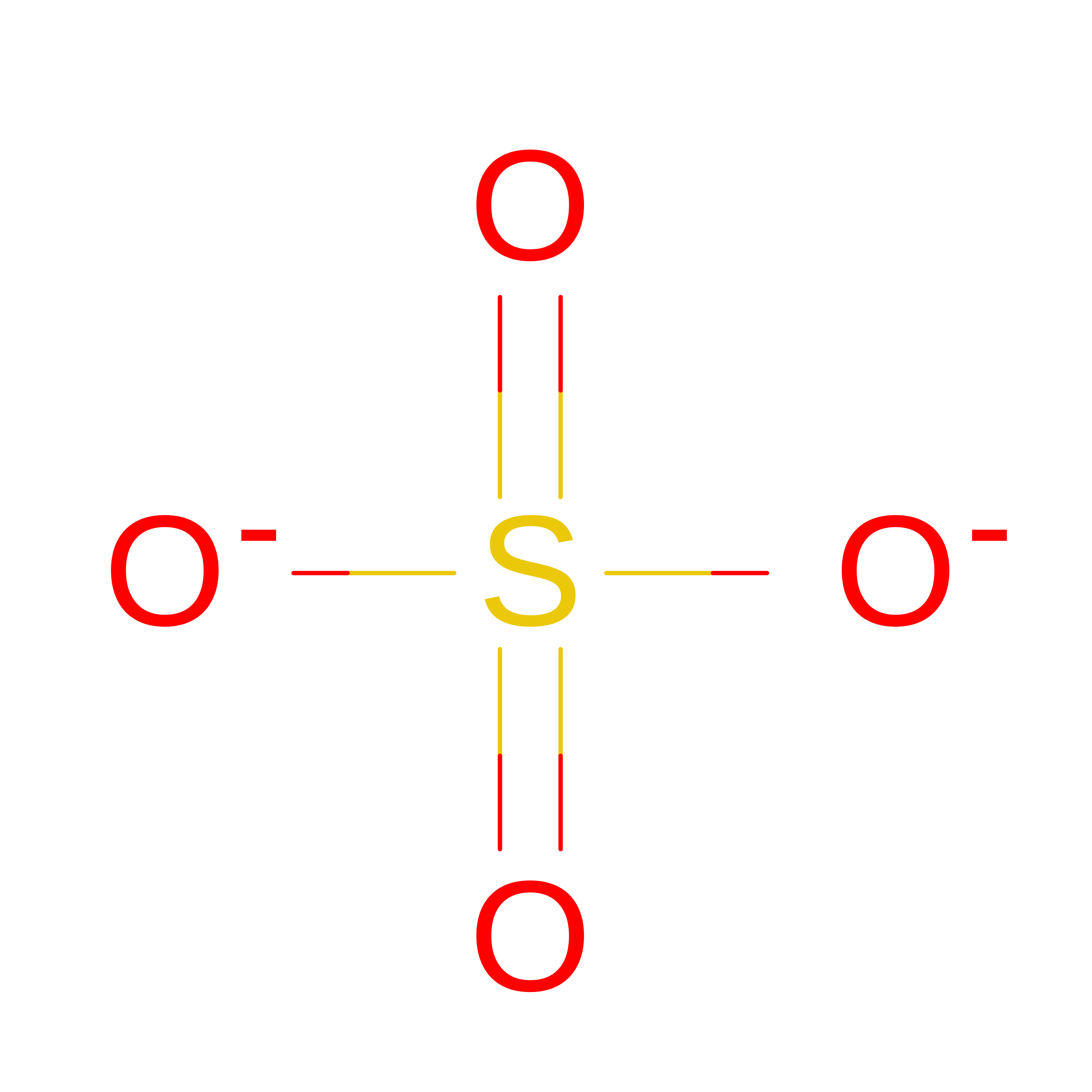
SO4

Query on SO4


Download:Ideal Coordinates CCD File
AA [auth E]
BA [auth E]
CA [auth E]
F [auth A]
G [auth A]
AA [auth E],
BA [auth E],
CA [auth E],
F [auth A],
G [auth A],
H [auth A],
I [auth A],
K [auth B],
L [auth B],
M [auth B],
N [auth B],
Q [auth C],
R [auth C],
U [auth D],
V [auth D],
W [auth D],
X [auth D],
Z [auth E]
SULFATE ION
O4 S
QAOWNCQODCNURD-UHFFFAOYSA-L
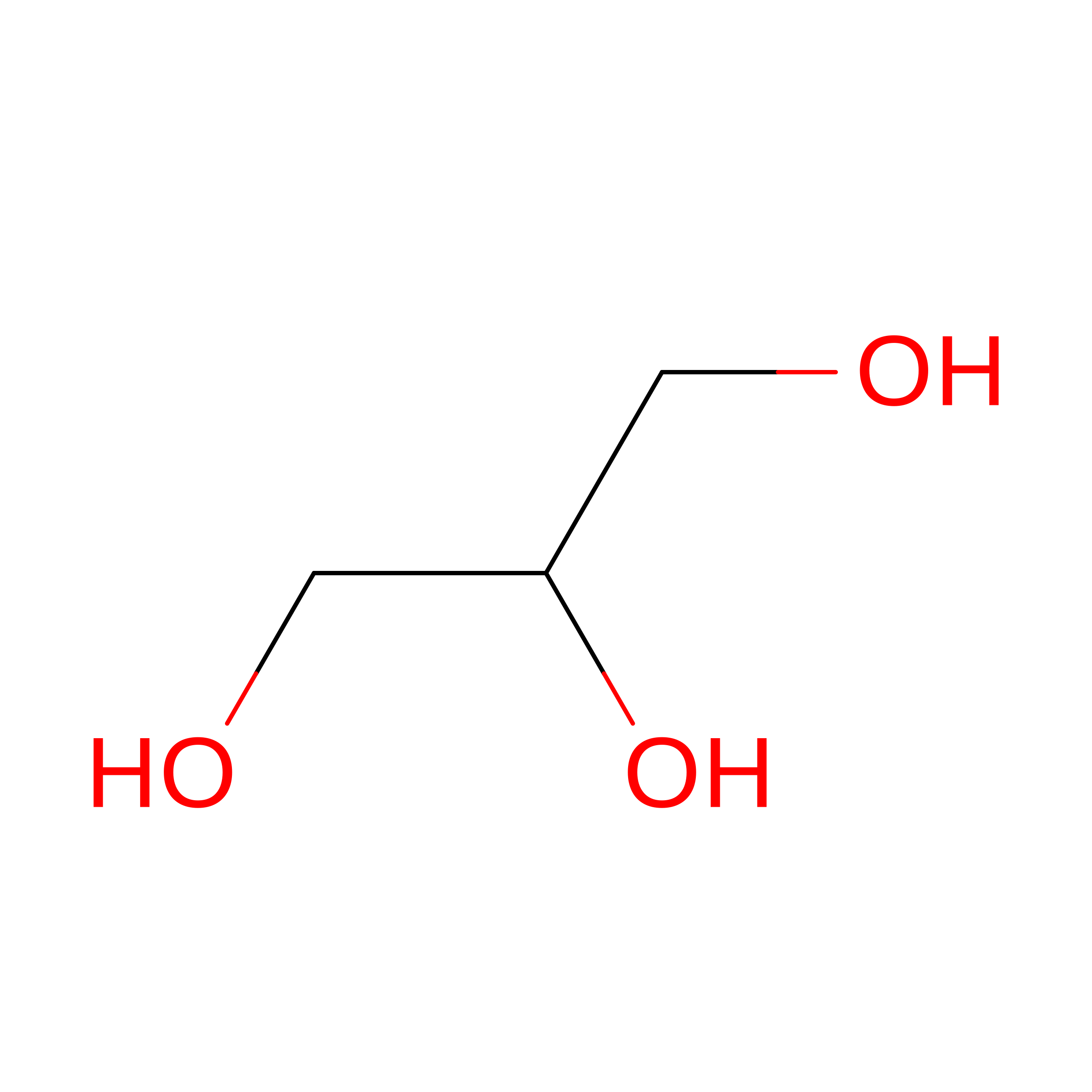
GOL

Query on GOL


Download:Ideal Coordinates CCD File
O [auth B],
S [auth C]
GLYCEROL
C3 H8 O3
PEDCQBHIVMGVHV-UHFFFAOYSA-N

Experimental Data & Validation

Experimental Data

  • Method: X-RAY DIFFRACTION
  • Resolution: 2.20 Å
  • R-Value Free:  0.234 (Depositor), 0.236 (DCC) 
  • R-Value Work:  0.206 (Depositor), 0.206 (DCC) 
  • R-Value Observed: 0.207 (Depositor) 
Space Group: P 63 2 2
Unit Cell:
Length ( Å )Angle ( ˚ )
a = 119.08α = 90
b = 119.08β = 90
c = 110.794γ = 120
Software Package:
Software NamePurpose
MOLREPphasing
REFMACrefinement
PDB_EXTRACTdata extraction
HKL-2000data collection
HKL-2000data reduction
HKL-2000data scaling

Structure Validation

View Full Validation Report


Entry History 

Deposition Data

Revision History  (Full details and data files)

  • Version 1.0: 2010-06-23
    Type: Initial release
  • Version 1.1: 2011-07-13
    Changes: Version format compliance
  • Version 1.2: 2014-02-12
    Changes: Database references
  • Version 1.3: 2024-10-30
    Changes: Data collection, Database references, Derived calculations, Structure summary