Download Mendeley
Adaptive evolution of threonine deaminase in plant defense against insect herbivores.
Gonzales-Vigil, E., Bianchetti, C.M., Phillips, G.N., Howe, G.A.(2011) Proc Natl Acad Sci U S A 108: 5897-5902
- PubMed: 21436043 Search on PubMedSearch on PubMed Central
- DOI: https://doi.org/10.1073/pnas.1016157108
- Primary Citation Related Structures:
3IAU - PubMed Abstract:
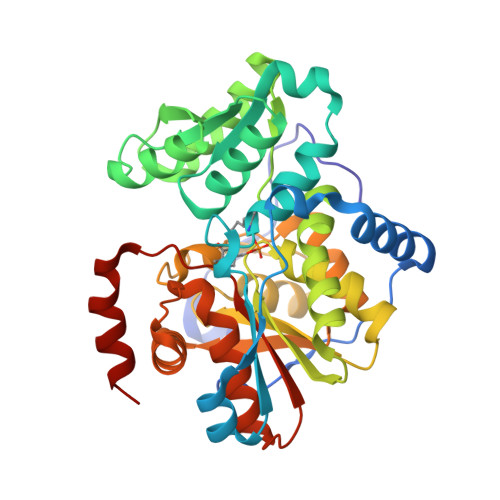
Gene duplication is a major source of plant chemical diversity that mediates plant-herbivore interactions. There is little direct evidence, however, that novel chemical traits arising from gene duplication reduce herbivory. Higher plants use threonine deaminase (TD) to catalyze the dehydration of threonine (Thr) to α-ketobutyrate and ammonia as the committed step in the biosynthesis of isoleucine (Ile). Cultivated tomato and related Solanum species contain a duplicated TD paralog (TD2) that is coexpressed with a suite of genes involved in herbivore resistance. Analysis of TD2-deficient tomato lines showed that TD2 has a defensive function related to Thr catabolism in the gut of lepidopteran herbivores. During herbivory, the regulatory domain of TD2 is removed by proteolysis to generate a truncated protein (pTD2) that efficiently degrades Thr without being inhibited by Ile. We show that this proteolytic activation step occurs in the gut of lepidopteran but not coleopteran herbivores, and is catalyzed by a chymotrypsin-like protease of insect origin. Analysis of purified recombinant enzymes showed that TD2 is remarkably more resistant to proteolysis and high temperature than the ancestral TD1 isoform. The crystal structure of pTD2 provided evidence that electrostatic interactions constitute a stabilizing feature associated with adaptation of TD2 to the extreme environment of the lepidopteran gut. These findings demonstrate a role for gene duplication in the evolution of a plant defense that targets and co-opts herbivore digestive physiology.
- Department of Energy-Plant Research Laboratory, Michigan State University, East Lansing, MI 48824, USA.
Organizational Affiliation: