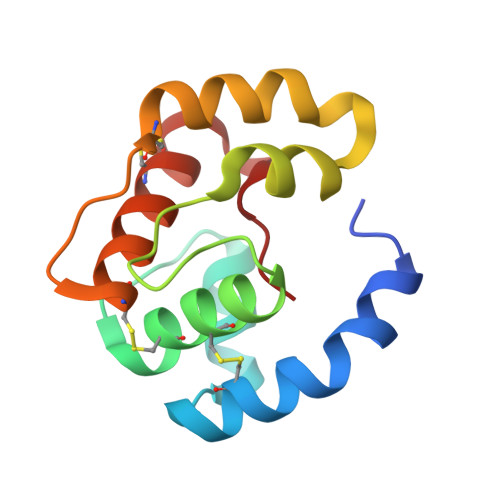
3CDN | pdb_00003cdn

Crystal structure of a pheromone binding protein from Apis mellifera soaked at pH 4.0


Experimental Data Snapshot

  • Method: X-RAY DIFFRACTION
  • Resolution: 2.00 Å
  • R-Value Free: 
    0.203 (Depositor), 0.220 (DCC) 
  • R-Value Work: 
    0.171 (Depositor), 0.183 (DCC) 
  • R-Value Observed: 
    0.174 (Depositor) 

Starting Model: experimental
View more details

wwPDB Validation 3D Report Full Report

Validation slider image for 3CDN

This is version 1.4 of the entry. See complete history

Literature

Structural basis of the honey bee PBP pheromone and pH-induced conformational change

Pesenti, M.E.Spinelli, S.Bezirard, V.Briand, L.Pernollet, J.C.Tegoni, M.Cambillau, C.

(2008) J Mol Biology 380: 158-169

  • DOI: https://doi.org/10.1016/j.jmb.2008.04.048
  • Primary Citation Related Structures: 
    3BFA, 3BFB, 3BFH, 3CAB, 3CDN

  • PubMed Abstract: 

    The behavior of insects and their perception of their surroundings are driven, in a large part, by odorants and pheromones. This is especially true for social insects, such as the honey bee, where the queen controls the development and the caste status of the other individuals. Pheromone perception is a complex phenomenon relying on a cascade of recognition events, initiated in antennae by pheromone recognition by a pheromone-binding protein and finishing with signal transduction at the axon membrane level. With to the objective of deciphering this initial step, we have determined the structures of the bee antennal pheromone-binding protein (ASP1) in the apo form and in complex with the main component of the queen mandibular pheromonal mixture, 9-keto-2(E)-decenoic acid (9-ODA) and with nonpheromonal components. In the apo protein, the C terminus obstructs the binding site. In contrast, ASP1 complexes have different open conformations, depending on the ligand shape, leading to different volumes of the binding cavity. The binding site integrity depends on the C terminus (111-119) conformation, which involves the interplay of two factors; i.e. the presence of a ligand and a low pH. Ligand binding to ASP1 is favored by low pH, opposite to what is observed with other pheromone-binding proteins, such as those of Bombyx mori and Anopheles gambiae.


  • Organizational Affiliation
    • Architecture et Fonction des Macromolécules Biologiques, UMR 6098 CNRS and Universités de Marseille, Marseille, France.

Macromolecule Content 

  • Total Structure Weight: 13.51 kDa 
  • Atom Count: 998 
  • Modeled Residue Count: 116 
  • Deposited Residue Count: 119 
  • Unique protein chains: 1

Macromolecules

Find similar proteins by:|  3D Structure
Entity ID: 1
MoleculeChains  Sequence LengthOrganismDetailsImage
Pheromone-binding protein ASP1119Apis melliferaMutation(s): 0 
UniProt
Find proteins for Q9U9J6 (Apis mellifera)
Explore Q9U9J6 
Go to UniProtKB:  Q9U9J6
Entity Groups
Sequence Clusters30% Identity50% Identity70% Identity90% Identity95% Identity100% Identity
UniProt GroupQ9U9J6
Sequence Annotations
Expand
Reference Sequence

Experimental Data & Validation

Experimental Data

  • Method: X-RAY DIFFRACTION
  • Resolution: 2.00 Å
  • R-Value Free:  0.203 (Depositor), 0.220 (DCC) 
  • R-Value Work:  0.171 (Depositor), 0.183 (DCC) 
  • R-Value Observed: 0.174 (Depositor) 
Space Group: C 2 2 21
Unit Cell:
Length ( Å )Angle ( ˚ )
a = 79.146α = 90
b = 83.53β = 90
c = 47.361γ = 90
Software Package:
Software NamePurpose
REFMACrefinement
ADSCdata collection
MOSFLMdata reduction
SCALAdata scaling
REFMACphasing

Structure Validation

View Full Validation Report


Entry History 

Deposition Data

Revision History  (Full details and data files)

  • Version 1.0: 2008-06-10
    Type: Initial release
  • Version 1.1: 2011-07-13
    Changes: Advisory, Version format compliance
  • Version 1.2: 2019-12-25
    Changes: Data collection, Source and taxonomy
  • Version 1.3: 2023-11-01
    Changes: Data collection, Database references, Derived calculations, Refinement description
  • Version 1.4: 2024-10-30
    Changes: Structure summary