3BPC | pdb_00003bpc

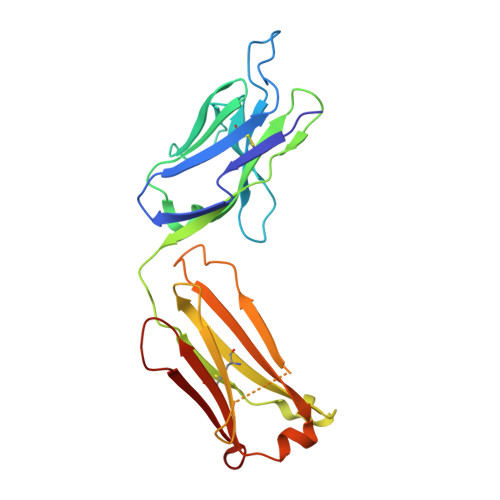
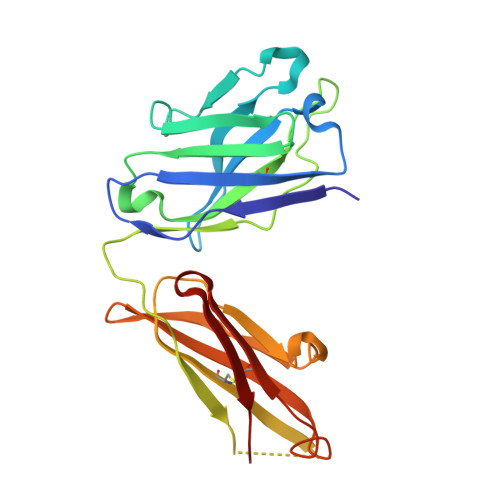
co-crystal structure of S25-2 Fab in complex with 5-deoxy-4-epi-2,3-dehydro Kdo (4.8) Kdo


Experimental Data Snapshot

  • Method: X-RAY DIFFRACTION
  • Resolution: 1.85 Å
  • R-Value Free: 
    0.273 (Depositor), 0.270 (DCC) 
  • R-Value Work: 
    0.224 (Depositor), 0.222 (DCC) 
  • R-Value Observed: 
    0.226 (Depositor) 

wwPDB Validation 3D Report Full Report

Validation slider image for 3BPC

This is version 3.1 of the entry. See complete history

Literature

Exploration of specificity in germline monoclonal antibody recognition of a range of natural and synthetic epitopes.

Brooks, C.L.Muller-Loennies, S.Brade, L.Kosma, P.Hirama, T.MacKenzie, C.R.Brade, H.Evans, S.V.

(2008) J Mol Biology 377: 450-468

  • DOI: https://doi.org/10.1016/j.jmb.2008.01.018
  • Primary Citation Related Structures: 
    2R1W, 2R1X, 2R1Y, 2R23, 2R2B, 2R2E, 2R2H, 3BPC

  • PubMed Abstract: 

    To explore the molecular basis of antigen recognition by germline antibodies, we have determined to high resolution the structures of the near-germline monoclonal antibody S25-2 in complex with seven distinct carbohydrate antigens based on the bacterial sugar 3-deoxy-alpha-D-manno-oct-2-ulosonic acid (Kdo). In contrast to previous findings, the inherited germline Kdo monosaccharide binding site is not restricted to this bacterial sugar but is able to accommodate an array of substitutions and chemical modifications of Kdo, including naturally occurring antigens containing the related monosaccharide d-glycero-alpha-d-talo-oct-2-ulosonic acid as well as nonterminal Kdo residues. However, we show by surface plasmon resonance and ELISA how antibody S25-2 specificity is so dependent on the context in which the antigen is presented that a free disaccharide displays strong binding while the same lipid-A-bound disaccharide does not bind. These structures provide insight into how inherited germline genes code for immunoglobulins of limited flexibility that are capable of binding a range of epitopes from which affinity-matured antibodies are generated.


  • Organizational Affiliation
    • Department of Biochemistry and Microbiology, University of Victoria, PO Box 3055 STN CSC, Victoria, BC, Canada.

Macromolecule Content 

  • Total Structure Weight: 49 kDa 
  • Atom Count: 3,812 
  • Modeled Residue Count: 430 
  • Deposited Residue Count: 441 
  • Unique protein chains: 2

Macromolecules

Find similar proteins by:|  3D Structure
Entity ID: 1
MoleculeChains  Sequence LengthOrganismDetailsImage
Fab, antibody fragment (IgG1k), light chain219Mus musculusMutation(s): 0 
UniProt
Find proteins for P01837 (Mus musculus)
Explore P01837 
Go to UniProtKB:  P01837
Entity Groups
Sequence Clusters30% Identity50% Identity70% Identity90% Identity95% Identity100% Identity
UniProt GroupP01837
Sequence Annotations
Expand
Reference Sequence
Find similar proteins by:|  3D Structure
Entity ID: 2
MoleculeChains  Sequence LengthOrganismDetailsImage
Fab, antibody fragment (IgG1k), heavy chain222Mus musculusMutation(s): 0 

Oligosaccharides

Help  
Entity ID: 3
MoleculeChains Length2D Diagram GlycosylationD Interactions
3,4,5-trideoxy-alpha-D-erythro-oct-3-en-2-ulopyranosonic acid-(2-8)-prop-2-en-1-yl 3-deoxy-alpha-D-manno-oct-2-ulopyranosidonic acid
C
2N/AN/A
Glycosylation Resources
GlyTouCan: G24132FI
GlyCosmos: G24132FI

Experimental Data & Validation

Experimental Data

  • Method: X-RAY DIFFRACTION
  • Resolution: 1.85 Å
  • R-Value Free:  0.273 (Depositor), 0.270 (DCC) 
  • R-Value Work:  0.224 (Depositor), 0.222 (DCC) 
  • R-Value Observed: 0.226 (Depositor) 
Space Group: P 21 21 21
Unit Cell:
Length ( Å )Angle ( ˚ )
a = 45.85α = 90
b = 81.29β = 90
c = 132.34γ = 90
Software Package:
Software NamePurpose
d*TREKdata scaling
PHASERphasing
REFMACrefinement
PDB_EXTRACTdata extraction

Structure Validation

View Full Validation Report


Entry History 

Deposition Data

Revision History  (Full details and data files)

  • Version 1.0: 2009-01-13
    Type: Initial release
  • Version 1.1: 2011-07-13
    Changes: Version format compliance
  • Version 1.2: 2018-03-07
    Changes: Data collection
  • Version 2.0: 2020-06-24
    Changes: Atomic model, Data collection, Database references, Derived calculations, Source and taxonomy, Structure summary
  • Version 3.0: 2020-07-29
    Type: Remediation
    Reason: Carbohydrate remediation
    Changes: Atomic model, Data collection, Derived calculations, Structure summary
  • Version 3.1: 2024-10-30
    Changes: Data collection, Database references, Derived calculations, Structure summary