Download Mendeley
Crystal Structure of the Polyextremophilic alpha-Amylase AmyB from Halothermothrix orenii: Details of a Productive Enzyme-Substrate Complex and an N Domain with a Role in Binding Raw Starch
Tan, T.-C., Mijts, B.N., Swaminathan, K., Patel, B.K.C., Divne, C.(2008) J Mol Biol 378: 850-868
- PubMed: 18387632 Search on PubMed
- DOI: https://doi.org/10.1016/j.jmb.2008.02.041
- Primary Citation Related Structures:
3BC9, 3BCD, 3BCF - PubMed Abstract:
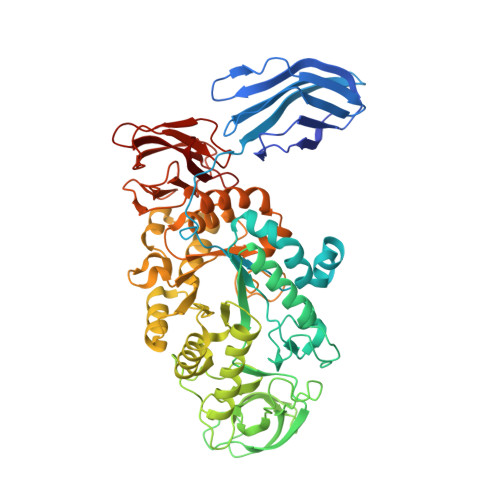
The gene for a membrane-bound, halophilic, and thermostable alpha-amylase, AmyB, from Halothermothrix orenii was cloned and sequenced. The crystal structure shows that, in addition to the typical domain organization of family 13 glycoside hydrolases, AmyB carries an additional N-terminal domain (N domain) that forms a large groove--the N-C groove--some 30 A away from the active site. The structure of AmyB with the inhibitor acarbose at 1.35 A resolution shows that a nonasaccharide has been synthesized through successive transglycosylation reactions of acarbose. Unexpectedly, in a complex of wild-type AmyB with alpha-cyclodextrin and maltoheptaose at 2.2 A resolution, a maltotetraose molecule is bound in subsites -1 to +3, spanning the cleavage point at -1/+1, with the -1 glucosyl residue present as a (2)S(o) skew boat. This wild-type AmyB complex was obtained in the presence of a large excess of substrate, a condition under which it is possible to capture Michaelis complexes, which may explain the observed binding across -1/+1 and ring distortion. We observe three methionine side chains that serve as "binding platforms" for glucosyl rings in AmyB, a seemingly rare occurrence in carbohydrate-binding proteins. The structures and results from the biochemical characterization of AmyB and AmyB lacking the N domain show that the N domain increases binding of the enzyme to raw starch. Furthermore, theoretical modeling suggests that the N-C groove can accommodate, spatially and chemically, large substrates such as A-starch.
- KTH School of Biotechnology, AlbaNova University Center, Roslagstullsbacken 21, SE-106 91 Stockholm, Sweden.
Organizational Affiliation: