Download Mendeley
Catalytic hydrogen bonds in alcalase-CI2A complexes revealed by ultra-high-resolution crystallography.
Raczynska, J.E., Jedrzejczak, R., Dauter, M., Ostergaard, P.R., Wilson, K.S., Rypniewski, W.(2026) J Struct Biol : 108377-108377
- PubMed: 42790760 Search on PubMed
- DOI: https://doi.org/10.1016/j.jsb.2026.108377
- Primary Citation Related Structures:
31VH, 31VI, 31VJ - PubMed Abstract:
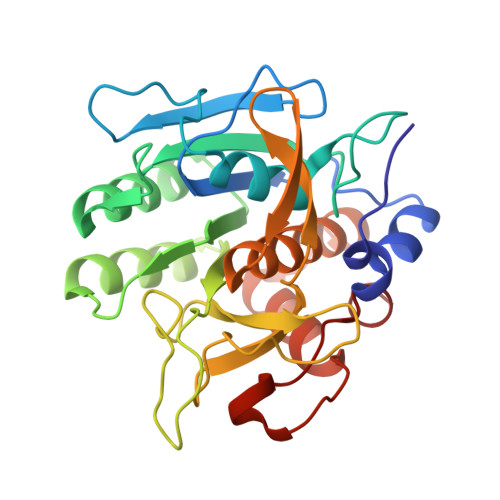
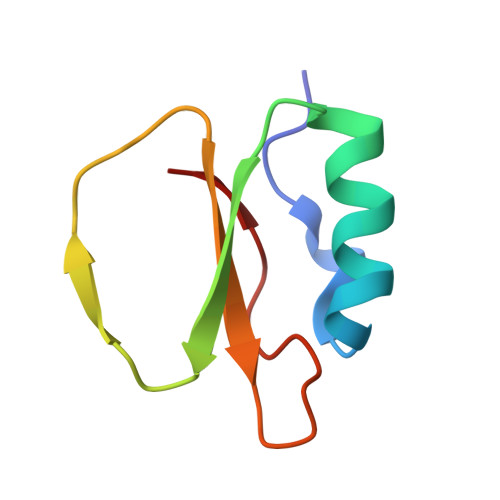
Serine proteases catalyze peptide-bond hydrolysis through a conserved catalytic triad and an extensive network of hydrogen bonds that facilitate proton transfer and stabilization of reaction intermediates. Despite decades of study, the nature of the hydrogen-bonding interactions within the catalytic machinery remains incompletely understood. Here, we report ultra-high-resolution crystal structures of alcalase, a subtilisin-family serine protease, in complex with native chymotrypsin inhibitor 2A (CI-2 A) and with a low-affinity M59P inhibitor variant. The cryogenic structures were determined at 0.74 Å resolution, while an additional 4 °C (277 K) structure of the native complex was determined at 1.05 Å resolution. The data allowed visualization and refinement of numerous hydrogen atoms within the active site and at the enzyme-inhibitor interface. Comparison of the 4 °C and cryogenic structures revealed a systematic shortening of hydrogen-bond donor-acceptor distances upon cooling, consistent with the global lattice contraction. A notable exception was the hydrogen bond between the catalytic residues Ser221 and His64, which remained unusually short at both temperatures. In the 4 °C structure, the corresponding hydrogen atom is associated with weak and diffuse electron density, suggesting increased proton mobility within this interaction. The structures further reveal temperature-dependent differences in interactions involving the scissile peptide bond of the inhibitor and the conserved backbone carbonyl oxygen of Ser125. These observations support a model in which Ser125 participates in a concerted hydrogen-bond network coupled to proton transfer within the catalytic triad. Together, the results provide atomic-level insights into hydrogen bonding, protonation equilibria, and catalytic mechanism in subtilisin-like serine proteases.
- Institute of Bioorganic Chemistry, Polish Academy of Sciences, Noskowskiego 12/14, 61-704 Poznan, Poland.
Organizational Affiliation: