2ZX4 | pdb_00002zx4

Rhamnose-binding lectin CSL3


Experimental Data Snapshot

  • Method: X-RAY DIFFRACTION
  • Resolution: 2.70 Å
  • R-Value Free: 
    0.260 (Depositor), 0.261 (DCC) 
  • R-Value Work: 
    0.192 (Depositor), 0.191 (DCC) 
  • R-Value Observed: 
    0.195 (Depositor) 

Starting Model: experimental
View more details

wwPDB Validation 3D Report Full Report

Validation slider image for 2ZX4

This is version 2.2 of the entry. See complete history

Literature

Structure of rhamnose-binding lectin CSL3: unique pseudo-tetrameric architecture of a pattern recognition protein

Shirai, T.Watanabe, Y.Lee, M.S.Ogawa, T.Muramoto, K.

(2009) J Mol Biology 391: 390-403

  • DOI: https://doi.org/10.1016/j.jmb.2009.06.027
  • Primary Citation Related Structures: 
    2ZX0, 2ZX1, 2ZX2, 2ZX3, 2ZX4

  • PubMed Abstract: 

    The crystal structure of the L-rhamnose-binding lectin CSL3 was determined to 1.8 A resolution. This protein is a component of the germline-encoded pattern recognition proteins in innate immunity. CSL3 is a homodimer of two 20 kDa subunits with a dumbbell-like shape overall, in which the N- and C-terminal domains of different subunits form lobe structures connected with flexible linker peptides. The complex structures of the protein with specific carbohydrates demonstrated the importance of the most variable loop region among homologues for the specificity toward oligosaccharides. CSL3 and Shiga-like toxin both use Gb(3) as a cellular receptor to evoke apoptosis. They have very different overall architecture but share the separation distance between carbohydrate-binding sites. An inspection of the structure database suggested that the pseudo-tetrameric structure of CSL3 was unique among the known lectins. This architecture implies this protein might provide a unique tool for further investigations into the relationships between architecture and function of pattern recognition proteins.


  • Organizational Affiliation
    • Department of Bioscience, Nagahama Institute of Bio-science and Technology, and JST-BIRD, Tamura, Nagahama, Japan. t_shirai@nagahama-i-bio.ac.jp

Macromolecule Content 

  • Total Structure Weight: 44.97 kDa 
  • Atom Count: 3,155 
  • Modeled Residue Count: 390 
  • Deposited Residue Count: 390 
  • Unique protein chains: 1

Macromolecules

Find similar proteins by:|  3D Structure
Entity ID: 1
MoleculeChains  Sequence LengthOrganismDetailsImage
CSL3
A, B
195Oncorhynchus ketaMutation(s): 0 
UniProt
Find proteins for P86179 (Oncorhynchus keta)
Explore P86179 
Go to UniProtKB:  P86179
Entity Groups
Sequence Clusters30% Identity50% Identity70% Identity90% Identity95% Identity100% Identity
UniProt GroupP86179
Sequence Annotations
Expand
Reference Sequence

Oligosaccharides

Help  
Entity ID: 2
MoleculeChains Length2D Diagram GlycosylationD Interactions
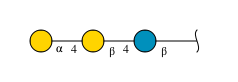
alpha-D-galactopyranose-(1-4)-beta-D-galactopyranose-(1-4)-beta-D-glucopyranose
C, D
3N/A
Glycosylation Resources
GlyTouCan: G00059MO
GlyCosmos: G00059MO
GlyGen: G00059MO
Entity ID: 3
MoleculeChains Length2D Diagram GlycosylationD Interactions
alpha-D-galactopyranose-(1-4)-beta-D-galactopyranose
E, F
2N/A
Glycosylation Resources
GlyTouCan: G67988RO
GlyCosmos: G67988RO
GlyGen: G67988RO

Experimental Data & Validation

Experimental Data

  • Method: X-RAY DIFFRACTION
  • Resolution: 2.70 Å
  • R-Value Free:  0.260 (Depositor), 0.261 (DCC) 
  • R-Value Work:  0.192 (Depositor), 0.191 (DCC) 
  • R-Value Observed: 0.195 (Depositor) 
Space Group: P 21 21 21
Unit Cell:
Length ( Å )Angle ( ˚ )
a = 56.861α = 90
b = 74.914β = 90
c = 93.355γ = 90
Software Package:
Software NamePurpose
REFMACrefinement
HKL-2000data collection
DENZOdata reduction
HKL-2000data scaling
MOLREPphasing

Structure Validation

View Full Validation Report


Entry History 

Deposition Data

Revision History  (Full details and data files)

  • Version 1.0: 2009-06-30
    Type: Initial release
  • Version 1.1: 2011-07-13
    Changes: Version format compliance
  • Version 2.0: 2020-07-29
    Type: Remediation
    Reason: Carbohydrate remediation
    Changes: Advisory, Atomic model, Data collection, Derived calculations, Structure summary
  • Version 2.1: 2023-11-01
    Changes: Data collection, Database references, Refinement description, Structure summary
  • Version 2.2: 2024-10-16
    Changes: Structure summary