2V8L | pdb_00002v8l

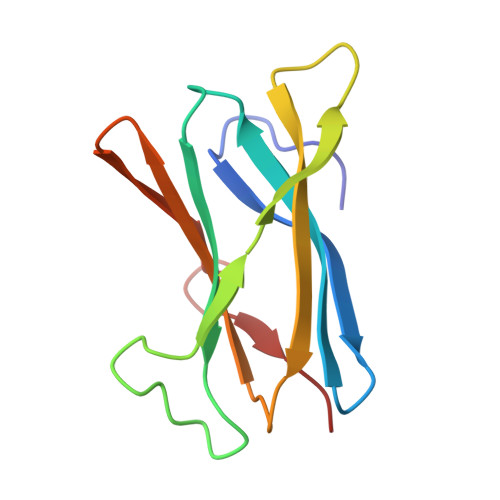
Carbohydrate-binding of the starch binding domain of Rhizopus oryzae glucoamylase in complex with beta-cyclodextrin and maltoheptaose


Experimental Data Snapshot

  • Method: X-RAY DIFFRACTION
  • Resolution: 1.80 Å
  • R-Value Free: 
    0.236 (Depositor), 0.237 (DCC) 
  • R-Value Work: 
    0.222 (Depositor), 0.226 (DCC) 
  • R-Value Observed: 
    0.222 (Depositor) 

Starting Model: experimental
View more details

wwPDB Validation 3D Report Full Report

Validation slider image for 2V8L

This is version 2.1 of the entry. See complete history

Literature

Crystal Structures of the Starch-Binding Domain from Rhizopus Oryzae Glucoamylase Reveal a Polysaccharide-Binding Path.

Tung, J.-Y.Chang, M.D.-T.Chou, W.-I.Liu, Y.-Y.Yeh, Y.Chang, F.Lin, S.Qiu, Z.Sun, Y.-J.

(2008) Biochem J 416: 27

  • DOI: https://doi.org/10.1042/BJ20080580
  • Primary Citation Related Structures: 
    2V8L, 2V8M, 2VQ4

  • PubMed Abstract: 

    GA (glucoamylase) hydrolyses starch and polysaccharides to beta-D-glucose. RoGA (Rhizopus oryzae GA) consists of two functional domains, an N-terminal SBD (starch-binding domain) and a C-terminal catalytic domain, which are connected by an O-glycosylated linker. In the present study, the crystal structures of the SBD from RoGA (RoGACBM21) and the complexes with beta-cyclodextrin (SBD-betaCD) and maltoheptaose (SBD-G7) were determined. Two carbohydrate binding sites, I (Trp(47)) and II (Tyr(32)), were resolved and their binding was co-operative. Besides the hydrophobic interaction, two unique polyN loops comprising consecutive asparagine residues also participate in the sugar binding. A conformational change in Tyr(32) was observed between unliganded and liganded SBDs. To elucidate the mechanism of polysaccharide binding, a number of mutants were constructed and characterized by a quantitative binding isotherm and Scatchard analysis. A possible binding path for long-chain polysaccharides in RoGACBM21 was proposed.


  • Organizational Affiliation
    • Institute of Bioinformatics and Structural Biology, National Tsing Hua University, Hsinchu 30013, Taiwan.

Macromolecule Content 

  • Total Structure Weight: 12.88 kDa 
  • Atom Count: 1,030 
  • Modeled Residue Count: 106 
  • Deposited Residue Count: 106 
  • Unique protein chains: 1

Macromolecules

Find similar proteins by:|  3D Structure
Entity ID: 1
MoleculeChains  Sequence LengthOrganismDetailsImage
GLUCOAMYLASE A106Rhizopus arrhizusMutation(s): 0 
EC: 3.2.1.3
UniProt
Find proteins for B7XC04 (Rhizopus oryzae)
Explore B7XC04 
Go to UniProtKB:  B7XC04
Entity Groups
Sequence Clusters30% Identity50% Identity70% Identity90% Identity95% Identity100% Identity
UniProt GroupB7XC04
Sequence Annotations
Expand
Reference Sequence

Oligosaccharides

Help  
Entity ID: 2
MoleculeChains Length2D Diagram GlycosylationD Interactions
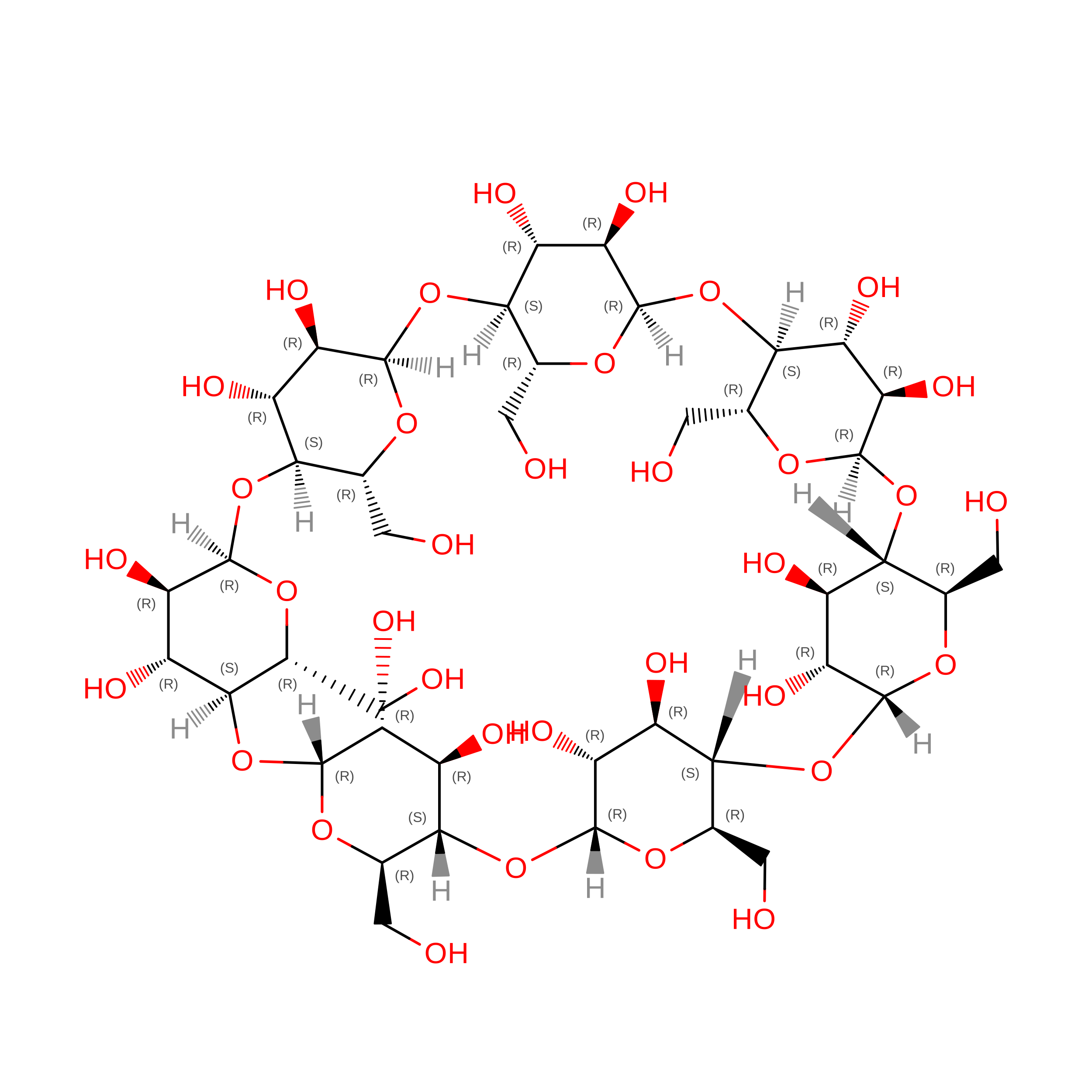
Cycloheptakis-(1-4)-(alpha-D-glucopyranose)
B
7N/A
Glycosylation Resources
GlyTouCan: G01435GL
GlyCosmos: G01435GL

Small Molecules

Ligands 1 Unique
IDChains Name / Formula / InChI Key2D Diagram3D Interactions
ZN

Query on ZN


Download:Ideal Coordinates CCD File
C [auth A]ZINC ION
Zn
PTFCDOFLOPIGGS-UHFFFAOYSA-N

Biologically Interesting Molecules (External Reference) 

1 Unique

Experimental Data & Validation

Experimental Data

  • Method: X-RAY DIFFRACTION
  • Resolution: 1.80 Å
  • R-Value Free:  0.236 (Depositor), 0.237 (DCC) 
  • R-Value Work:  0.222 (Depositor), 0.226 (DCC) 
  • R-Value Observed: 0.222 (Depositor) 
Space Group: P 21 21 21
Unit Cell:
Length ( Å )Angle ( ˚ )
a = 42.591α = 90
b = 42.725β = 90
c = 70.064γ = 90
Software Package:
Software NamePurpose
CNSrefinement
HKL-2000data reduction
HKL-2000data scaling
MOLREPphasing

Structure Validation

View Full Validation Report


Entry History 

Deposition Data

Revision History  (Full details and data files)

  • Version 1.0: 2008-08-19
    Type: Initial release
  • Version 1.1: 2012-02-22
    Changes: Database references, Other, Version format compliance
  • Version 2.0: 2020-07-29
    Type: Remediation
    Reason: Carbohydrate remediation
    Changes: Atomic model, Data collection, Derived calculations, Other, Structure summary
  • Version 2.1: 2023-12-13
    Changes: Data collection, Database references, Refinement description, Structure summary