2R6F | pdb_00002r6f

Crystal Structure of Bacillus stearothermophilus UvrA


Experimental Data Snapshot

  • Method: X-RAY DIFFRACTION
  • Resolution: 3.20 Å
  • R-Value Free: 
    0.292 (Depositor) 
  • R-Value Work: 
    0.253 (Depositor), 0.255 (DCC) 
  • R-Value Observed: 
    0.257 (Depositor) 

wwPDB Validation 3D Report Full Report

Validation slider image for 2R6F

Ligand Structure Quality Assessment 


This is version 1.3 of the entry. See complete history

Literature

Crystal Structure of Bacillus stearothermophilus UvrA Provides Insight into ATP-Modulated Dimerization, UvrB Interaction, and DNA Binding.

Pakotiprapha, D.Inuzuka, Y.Bowman, B.R.Moolenaar, G.F.Goosen, N.Jeruzalmi, D.Verdine, G.L.

(2008) Mol Cell 29: 122-133

  • DOI: https://doi.org/10.1016/j.molcel.2007.10.026
  • Primary Citation Related Structures: 
    2R6F

  • PubMed Abstract: 

    The nucleotide excision repair pathway corrects many structurally unrelated DNA lesions. Damage recognition in bacteria is performed by UvrA, a member of the ABC ATPase superfamily whose functional form is a dimer with four nucleotide-binding domains (NBDs), two per protomer. In the 3.2 A structure of UvrA from Bacillus stearothermophilus, we observe that the nucleotide-binding sites are formed in an intramolecular fashion and are not at the dimer interface as is typically found in other ABC ATPases. UvrA also harbors two unique domains; we show that one of these is required for interaction with UvrB, its partner in lesion recognition. In addition, UvrA contains three zinc modules, the number and ligand sphere of which differ from previously published models. Structural analysis, biochemical experiments, surface electrostatics, and sequence conservation form the basis for models of ATP-modulated dimerization, UvrA-UvrB interaction, and DNA binding during the search for lesions.


  • Organizational Affiliation
    • Department of Molecular and Cellular Biology, Harvard University, 7 Divinity Avenue, Cambridge, MA 02138, USA.

Macromolecule Content 

  • Total Structure Weight: 219.67 kDa 
  • Atom Count: 13,986 
  • Modeled Residue Count: 1,778 
  • Deposited Residue Count: 1,944 
  • Unique protein chains: 1

Macromolecules

Find similar proteins by:|  3D Structure
Entity ID: 1
MoleculeChains  Sequence LengthOrganismDetailsImage
Excinuclease ABC subunit A
A, B
972Geobacillus stearothermophilus 10Mutation(s): 0 
Gene Names: uvrA
UniProt
Find proteins for Q5KVB6 (Geobacillus kaustophilus (strain HTA426))
Explore Q5KVB6 
Go to UniProtKB:  Q5KVB6
Entity Groups
Sequence Clusters30% Identity50% Identity70% Identity90% Identity95% Identity100% Identity
UniProt GroupQ5KVB6
Sequence Annotations
Expand
Reference Sequence

Small Molecules

Ligands 2 Unique
IDChains Name / Formula / InChI Key2D Diagram3D Interactions
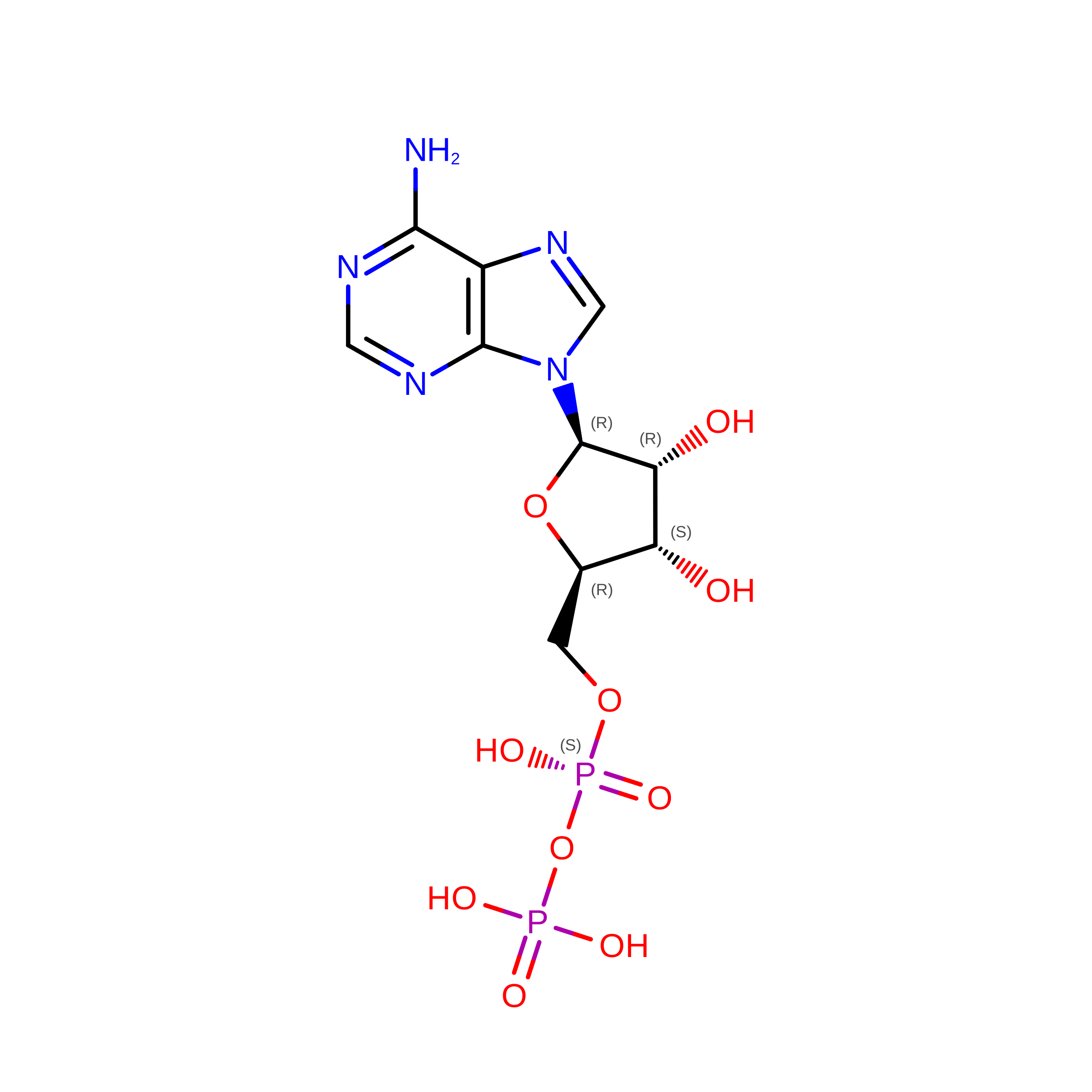
ADP

Query on ADP


Download:Ideal Coordinates CCD File
C [auth A],
D [auth A],
H [auth B],
I [auth B]
ADENOSINE-5'-DIPHOSPHATE
C10 H15 N5 O10 P2
XTWYTFMLZFPYCI-KQYNXXCUSA-N
ZN

Query on ZN


Download:Ideal Coordinates CCD File
E [auth A]
F [auth A]
G [auth A]
J [auth B]
K [auth B]
E [auth A],
F [auth A],
G [auth A],
J [auth B],
K [auth B],
L [auth B]
ZINC ION
Zn
PTFCDOFLOPIGGS-UHFFFAOYSA-N
Modified Residues  1 Unique
IDChains TypeFormula2D DiagramParent
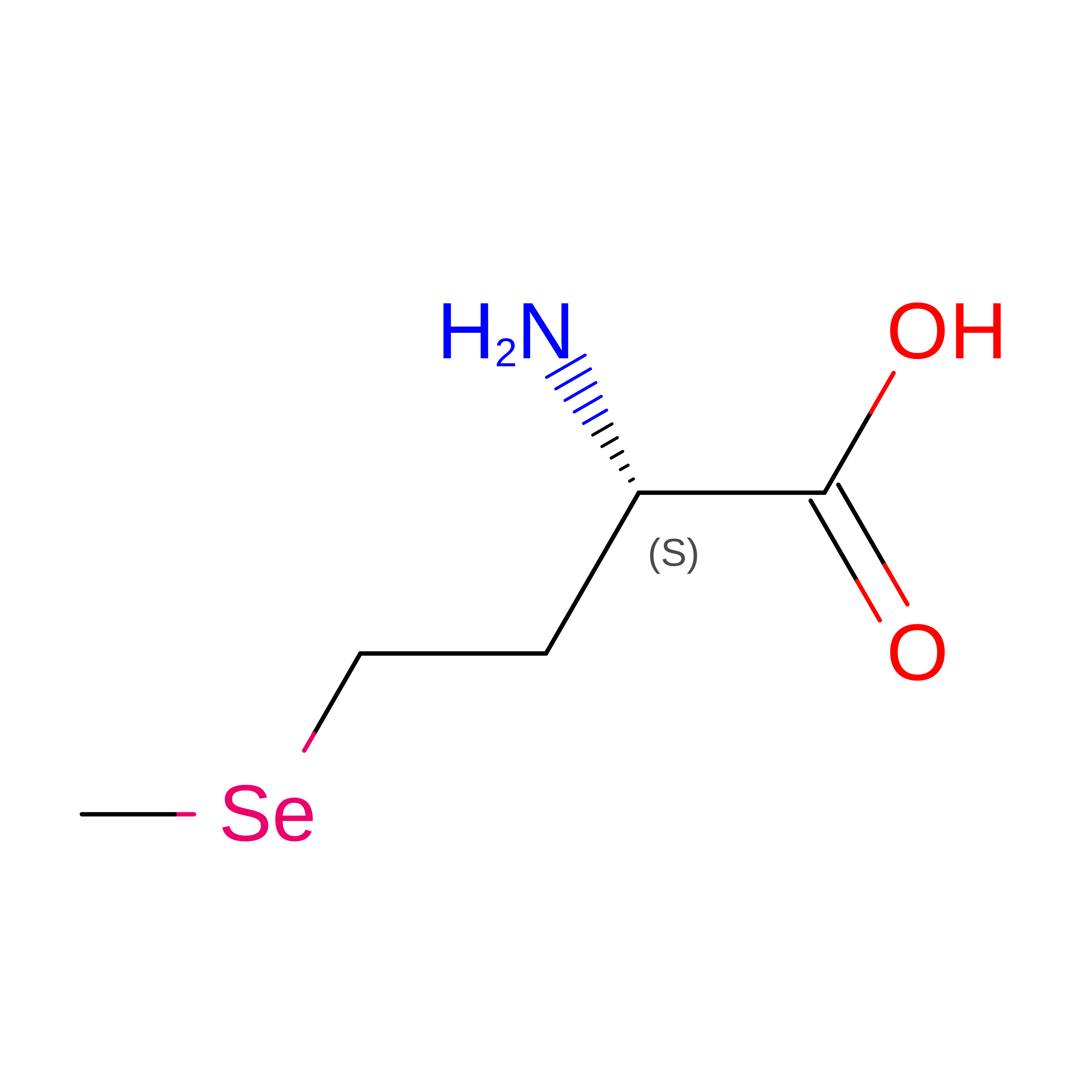
MSE
Query on MSE
A, B
L-PEPTIDE LINKINGC5 H11 N O2 SeMET

Experimental Data & Validation

Experimental Data

  • Method: X-RAY DIFFRACTION
  • Resolution: 3.20 Å
  • R-Value Free:  0.292 (Depositor) 
  • R-Value Work:  0.253 (Depositor), 0.255 (DCC) 
  • R-Value Observed: 0.257 (Depositor) 
Space Group: P 1 21 1
Unit Cell:
Length ( Å )Angle ( ˚ )
a = 102.713α = 90
b = 94.72β = 108.8
c = 130.481γ = 90
Software Package:
Software NamePurpose
DENZOdata reduction
SCALEPACKdata scaling
SHARPphasing
REFMACrefinement
PDB_EXTRACTdata extraction
ADSCdata collection
HKL-2000data reduction

Structure Validation

View Full Validation Report


Ligand Structure Quality Assessment 


Entry History 

Deposition Data

Revision History  (Full details and data files)

  • Version 1.0: 2008-01-08
    Type: Initial release
  • Version 1.1: 2011-07-13
    Changes: Source and taxonomy, Version format compliance
  • Version 1.2: 2017-10-25
    Changes: Refinement description
  • Version 1.3: 2024-11-06
    Changes: Data collection, Database references, Derived calculations, Refinement description, Structure summary