2QC9 | pdb_00002qc9

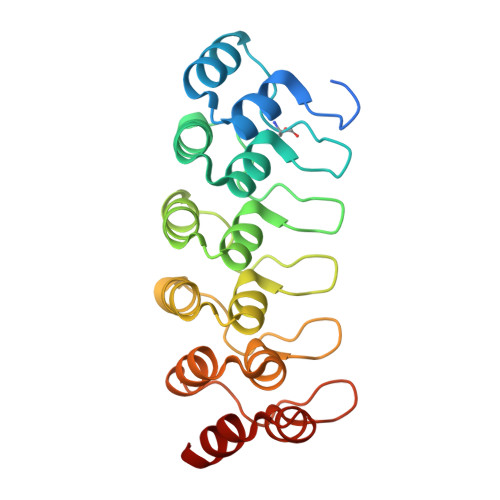
Mouse Notch 1 Ankyrin Repeat Intracellular Domain


Experimental Data Snapshot

  • Method: X-RAY DIFFRACTION
  • Resolution: 2.35 Å
  • R-Value Free: 
    0.228 (Depositor), 0.222 (DCC) 
  • R-Value Work: 
    0.173 (Depositor), 0.174 (DCC) 

Starting Model: experimental
View more details

wwPDB Validation 3D Report Full Report

Validation slider image for 2QC9

This is version 1.2 of the entry. See complete history

Literature

Asparaginyl hydroxylation of the Notch ankyrin repeat domain by factor inhibiting hypoxia-inducible factor.

Coleman, M.L.McDonough, M.A.Hewitson, K.S.Coles, C.Mecinovic, J.Edelmann, M.Cook, K.M.Cockman, M.E.Lancaster, D.E.Kessler, B.M.Oldham, N.J.Ratcliffe, P.J.Schofield, C.J.

(2007) J Biological Chem 282: 24027-24038

  • DOI: https://doi.org/10.1074/jbc.M704102200
  • Primary Citation Related Structures: 
    2QC9, 3P3N, 3P3P

  • PubMed Abstract: 

    The stability and activity of hypoxia-inducible factor (HIF) are regulated by the post-translational hydroxylation of specific prolyl and asparaginyl residues. We show that the HIF asparaginyl hydroxylase, factor inhibiting HIF (FIH), also catalyzes hydroxylation of highly conserved asparaginyl residues within ankyrin repeat (AR) domains (ARDs) of endogenous Notch receptors. AR hydroxylation decreases the extent of ARD binding to FIH while not affecting signaling through the canonical Notch pathway. ARD proteins were found to efficiently compete with HIF for FIH-dependent hydroxylation. Crystallographic analyses of the hydroxylated Notch ARD (2.35A) and of Notch peptides bound to FIH (2.4-2.6A) reveal the stereochemistry of hydroxylation on the AR and imply that significant conformational changes are required in the ARD fold in order to enable hydroxylation at the FIH active site. We propose that ARD proteins function as natural inhibitors of FIH and that the hydroxylation status of these proteins provides another oxygen-dependent interface that modulates HIF signaling.


  • Organizational Affiliation
    • Henry Wellcome Building for Molecular Physiology, University of Oxford, Oxford, OX3 7BN, United Kingdom.

Macromolecule Content 

  • Total Structure Weight: 46.27 kDa 
  • Atom Count: 3,464 
  • Modeled Residue Count: 390 
  • Deposited Residue Count: 420 
  • Unique protein chains: 1

Macromolecules

Find similar proteins by:|  3D Structure
Entity ID: 1
MoleculeChains  Sequence LengthOrganismDetailsImage
Notch 1 protein
A, B
210Mus musculusMutation(s): 0 
Gene Names: Notch1
UniProt & NIH Common Fund Data Resources
Find proteins for Q01705 (Mus musculus)
Explore Q01705 
Go to UniProtKB:  Q01705
IMPC:  MGI:97363
Entity Groups
Sequence Clusters30% Identity50% Identity70% Identity90% Identity95% Identity100% Identity
UniProt GroupQ01705
Sequence Annotations
Expand
Reference Sequence

Small Molecules

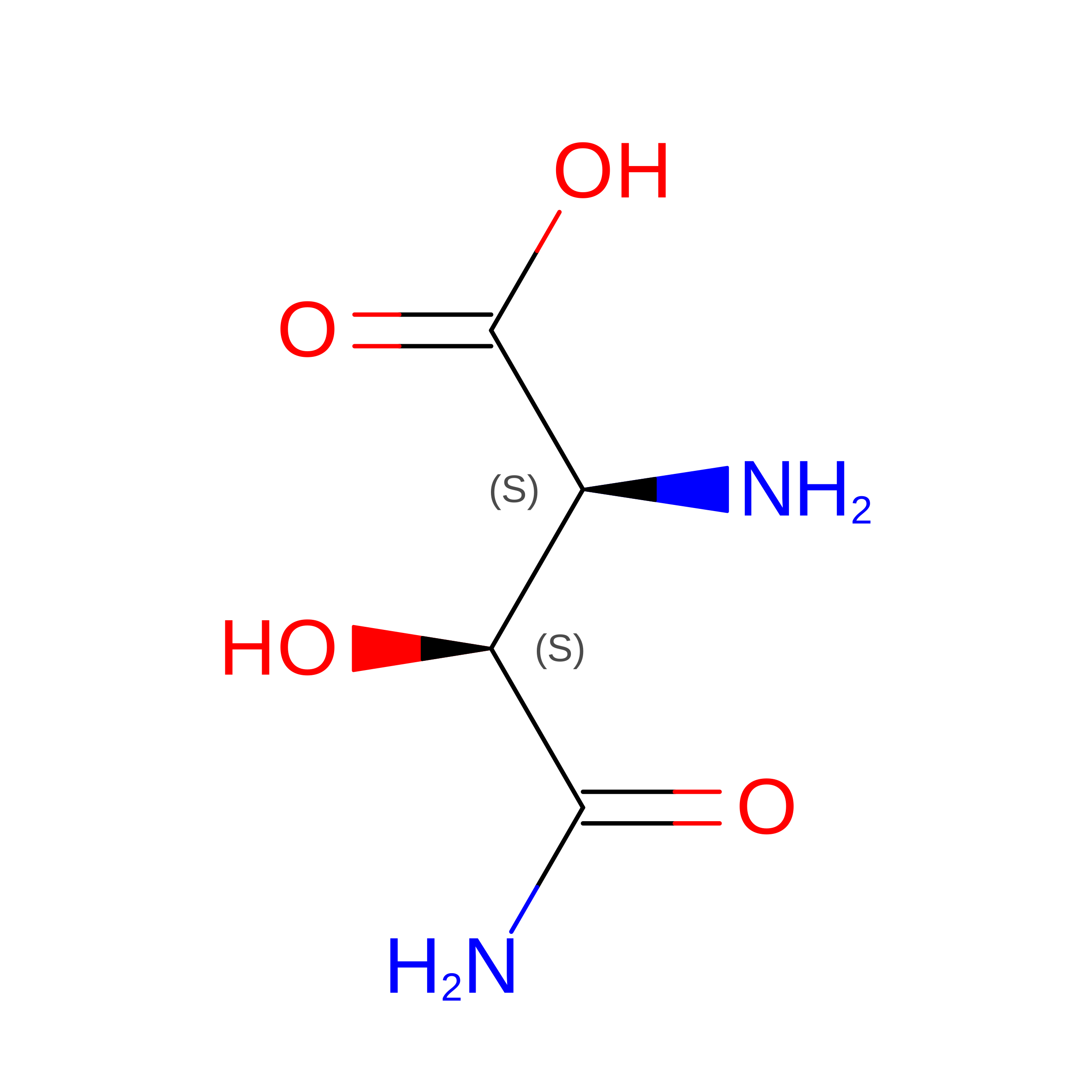
Modified Residues  1 Unique
IDChains TypeFormula2D DiagramParent
AHB
Query on AHB
A, B
L-PEPTIDE LINKINGC4 H8 N2 O4ASN

Experimental Data & Validation

Experimental Data

  • Method: X-RAY DIFFRACTION
  • Resolution: 2.35 Å
  • R-Value Free:  0.228 (Depositor), 0.222 (DCC) 
  • R-Value Work:  0.173 (Depositor), 0.174 (DCC) 
Space Group: P 65
Unit Cell:
Length ( Å )Angle ( ˚ )
a = 98.203α = 90
b = 98.203β = 90
c = 108.703γ = 120
Software Package:
Software NamePurpose
SAINTdata scaling
PHASERphasing
CNSrefinement
PDB_EXTRACTdata extraction
PROTEUM PLUSdata collection
SAINTdata reduction
SADABSdata scaling

Structure Validation

View Full Validation Report


Entry History 

Deposition Data

Revision History  (Full details and data files)

  • Version 1.0: 2008-03-04
    Type: Initial release
  • Version 1.1: 2011-07-13
    Changes: Version format compliance
  • Version 1.2: 2023-08-30
    Changes: Data collection, Database references, Derived calculations, Refinement description