2NDG | pdb_00002ndg

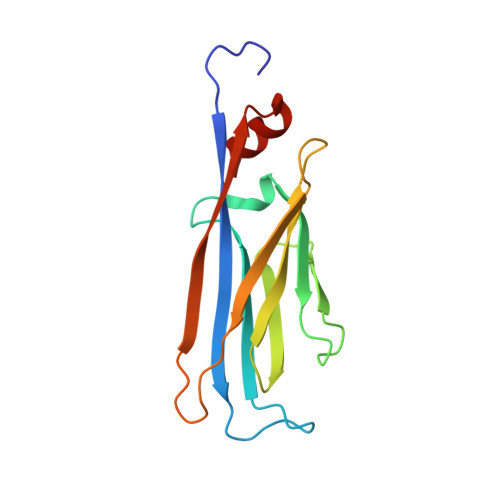
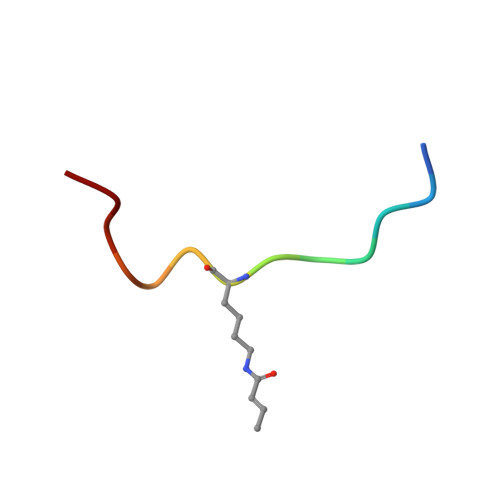
Solution NMR structures of AF9 yeats domain in complex with histone H3 crotonylation at K18


Experimental Data Snapshot

  • Method: SOLUTION NMR
  • Conformers Calculated: 200 
  • Conformers Submitted: 20 
  • Selection Criteria: structures with the lowest energy 

wwPDB Validation 3D Report Full Report

Validation slider image for 2NDG

This is version 2.0 of the entry. See complete history

Literature

Structural Insights into Histone Crotonyl-Lysine Recognition by the AF9 YEATS Domain.

Zhang, Q.Zeng, L.Zhao, C.Ju, Y.Konuma, T.Zhou, M.M.

(2016) Structure 24: 1606-1612

  • DOI: https://doi.org/10.1016/j.str.2016.05.023
  • Primary Citation Related Structures: 
    2NDF, 2NDG

  • PubMed Abstract: 

    Histone lysine acylations play an important role in the regulation of gene transcription in chromatin. Unlike histone acetyl-lysine, molecular recognition of a recently identified crotonyl-lysine mark is much less understood. Here, we report that the YEATS domain of AF9 preferentially binds crotonyl-lysine over acetyl-lysine in histone H3. Nuclear magnetic resonance structural analysis reveals that crotonyl-lysine of histone H3 lysine 18 is engulfed deep in an aromatic cage of the YEATS domain where the carbonyl oxygen of crotonyl-lysine forms a hydrogen bond with the backbone amide of protein residue Tyr78. The crotonyl-lysine, through its unique electron-rich double-bond side chain, engages π-π aromatic stacking and extended hydrophobic/aromatic interactions with the YEATS domain compared with acetyl-lysine. Our mutational analysis confirmed key protein residues Phe59 and Tyr78 for crotonyl-lysine recognition. Importantly, our findings present a new structural mechanism of protein-protein interactions mediated by histone lysine crotonylation, and show how the cells interpret acyl-lysine marks in different biological contexts.


  • Organizational Affiliation
    • The First Hospital and Institute of Epigenetic Medicine, Jilin University, Changchun 130061, China; Department of Structural and Chemical Biology, Icahn School of Medicine at Mount Sinai, New York, NY 10029, USA. Electronic address: qiang.zhang@mssm.edu.

Macromolecule Content 

  • Total Structure Weight: 18.01 kDa 
  • Atom Count: 1,271 
  • Modeled Residue Count: 154 
  • Deposited Residue Count: 154 
  • Unique protein chains: 2

Macromolecules

Find similar proteins by:|  3D Structure
Entity ID: 1
MoleculeChains  Sequence LengthOrganismDetailsImage
Protein AF-9141Homo sapiensMutation(s): 0 
Gene Names: MLLT3AF9YEATS3
UniProt & NIH Common Fund Data Resources
Find proteins for P42568 (Homo sapiens)
Explore P42568 
Go to UniProtKB:  P42568
PHAROS:  P42568
GTEx:  ENSG00000171843 
Entity Groups
Sequence Clusters30% Identity50% Identity70% Identity90% Identity95% Identity100% Identity
UniProt GroupP42568
Sequence Annotations
Expand
Reference Sequence
Find similar proteins by:  Sequence   |   3D Structure  
Entity ID: 2
MoleculeChains  Sequence LengthOrganismDetailsImage
Histone H3 peptide13Homo sapiensMutation(s): 0 
Gene Names: H3C1H3C2H3C3H3C4H3C6H3C7H3C8H3C10H3C11H3C12
UniProt & NIH Common Fund Data Resources
Find proteins for P68431 (Homo sapiens)
Explore P68431 
Go to UniProtKB:  P68431
Entity Groups
Sequence Clusters30% Identity50% Identity70% Identity90% Identity95% Identity100% Identity
UniProt GroupP68431
Sequence Annotations
Expand
Reference Sequence

Small Molecules

Modified Residues  1 Unique
IDChains TypeFormula2D DiagramParent
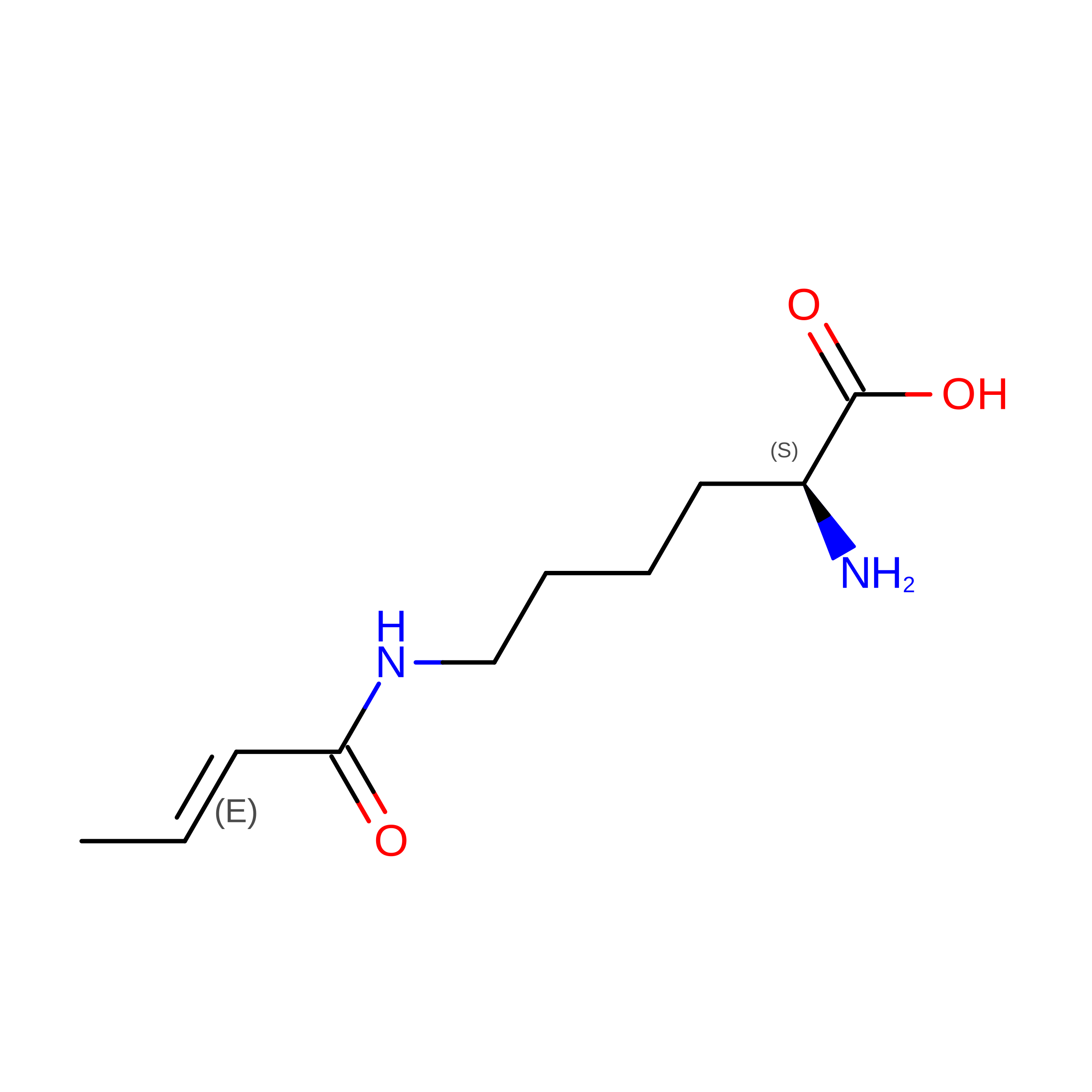
KCR
Query on KCR
B
L-PEPTIDE LINKINGC10 H18 N2 O3LYS

Experimental Data & Validation

Experimental Data

  • Method: SOLUTION NMR
  • Conformers Calculated: 200 
  • Conformers Submitted: 20 
  • Selection Criteria: structures with the lowest energy 

Structure Validation

View Full Validation Report


Entry History 

Deposition Data

Revision History  (Full details and data files)

  • Version 1.0: 2016-09-07
    Type: Initial release
  • Version 1.1: 2016-09-21
    Changes: Database references
  • Version 2.0: 2023-11-15
    Changes: Atomic model, Data collection, Database references, Derived calculations