2J6G | pdb_00002j6g

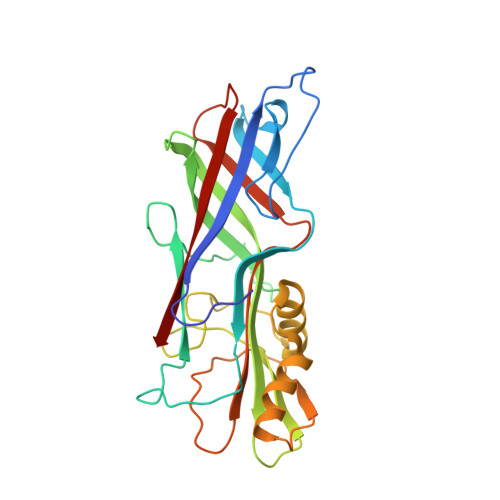
FaeG from F4ac ETEC strain 5_95, produced in tobacco plant chloroplast


Experimental Data Snapshot

  • Method: X-RAY DIFFRACTION
  • Resolution: 1.55 Å
  • R-Value Free: 
    0.205 (Depositor), 0.205 (DCC) 
  • R-Value Work: 
    0.184 (Depositor), 0.184 (DCC) 
  • R-Value Observed: 
    0.185 (Depositor) 

wwPDB Validation 3D Report Full Report

Validation slider image for 2J6G

This is version 1.5 of the entry. See complete history

Literature

Chloroplasts Assemble the Major Subunit Faeg of Escherichia Coli F4 (K88) Fimbriae Into Strand-Swapped Dimers

Van Molle, I.Joensuu, J.J.Buts, L.Panjikar, S.Kotiaho, M.Bouckaert, J.Wyns, L.Niklander-Teeri, V.De Greve, H.

(2007) J Mol Biology 368: 791

  • DOI: https://doi.org/10.1016/j.jmb.2007.02.051
  • Primary Citation Related Structures: 
    2J6G, 2J6R

  • PubMed Abstract: 

    F4 fimbriae encoded by the fae operon are the major colonization factors associated with porcine neonatal and postweaning diarrhoea caused by enterotoxigenic Escherichia coli (ETEC). Via the chaperone/usher pathway, the F4 fimbriae are assembled as long polymers of the major subunit FaeG, which also possesses the adhesive properties of the fimbriae. Intrinsically, the incomplete fold of fimbrial subunits renders them unstable and susceptible to aggregation and/or proteolytic degradation in the absence of a specific periplasmic chaperone. In order to test the possibility of producing FaeG in plants, FaeG expression was studied in transgenic tobacco plants. FaeG was directed to different subcellular compartments by specific targeting signals. Targeting of FaeG to the chloroplast results in much higher yields than FaeG targeting to the endoplasmic reticulum or the apoplast. Two chloroplast-targeted FaeG variants were purified from tobacco plants and crystallized. The crystal structures show that chloroplasts circumvent the absence of the fimbrial assembly machinery by assembling FaeG into strand-swapped dimers. Furthermore, the structures reveal how FaeG combines the structural requirements of a major fimbrial subunit with its adhesive role by grafting an additional domain on its Ig-like core.


  • Organizational Affiliation
    • Department of Molecular and Cellular Interactions, Flanders Institute for Biotechnology (VIB), Brussels, Belgium.

Macromolecule Content 

  • Total Structure Weight: 27.87 kDa 
  • Atom Count: 2,130 
  • Modeled Residue Count: 260 
  • Deposited Residue Count: 266 
  • Unique protein chains: 1

Macromolecules

Find similar proteins by:|  3D Structure
Entity ID: 1
MoleculeChains  Sequence LengthOrganismDetailsImage
FAEG266Escherichia coliMutation(s): 0 
UniProt
Find proteins for Q6T3W5 (Escherichia coli)
Explore Q6T3W5 
Go to UniProtKB:  Q6T3W5
Entity Groups
Sequence Clusters30% Identity50% Identity70% Identity90% Identity95% Identity100% Identity
UniProt GroupQ6T3W5
Sequence Annotations
Expand
Reference Sequence

Small Molecules

Ligands 1 Unique
IDChains Name / Formula / InChI Key2D Diagram3D Interactions
ACT

Query on ACT


Download:Ideal Coordinates CCD File
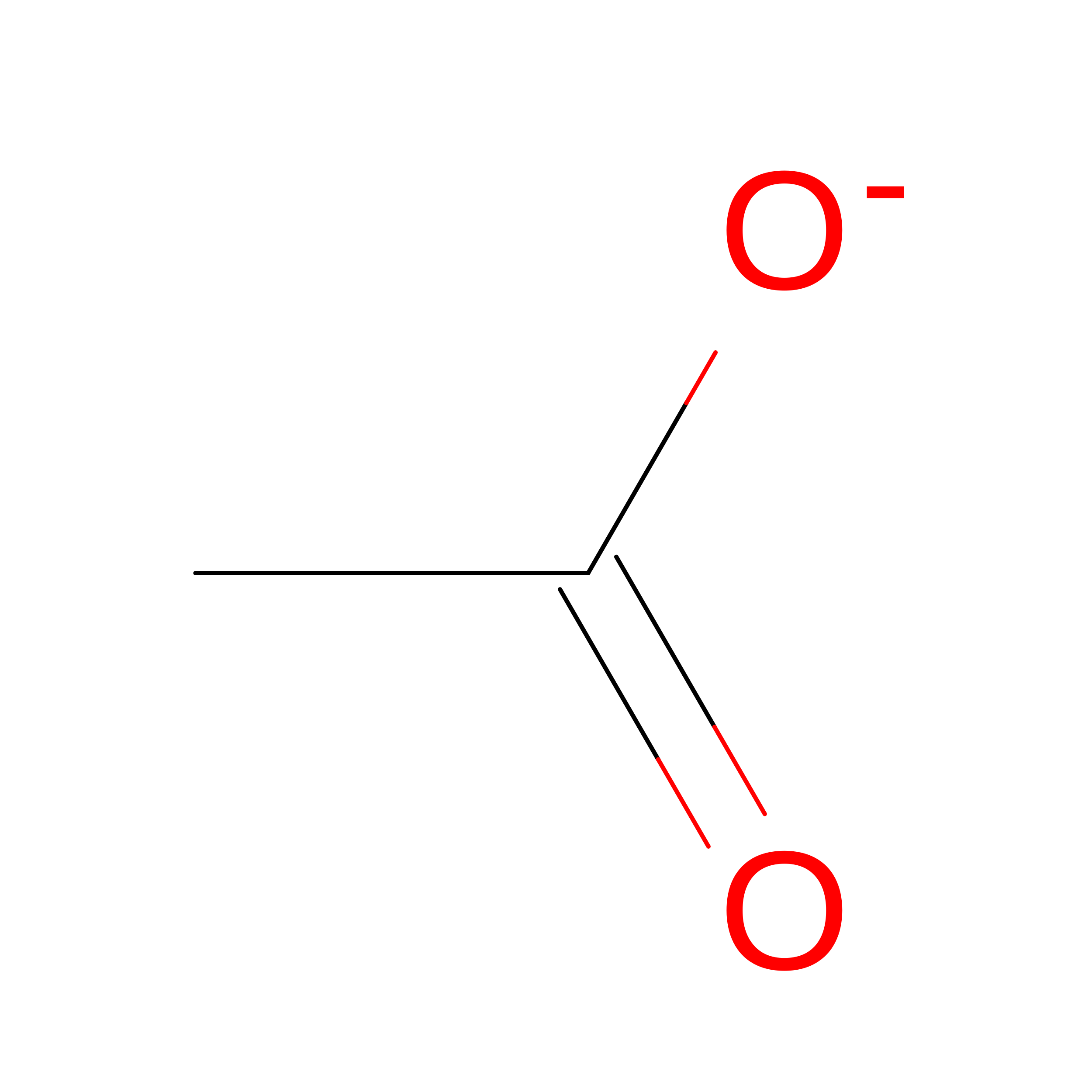
B [auth A]ACETATE ION
C2 H3 O2
QTBSBXVTEAMEQO-UHFFFAOYSA-M

Experimental Data & Validation

Experimental Data

  • Method: X-RAY DIFFRACTION
  • Resolution: 1.55 Å
  • R-Value Free:  0.205 (Depositor), 0.205 (DCC) 
  • R-Value Work:  0.184 (Depositor), 0.184 (DCC) 
  • R-Value Observed: 0.185 (Depositor) 
Space Group: C 1 2 1
Unit Cell:
Length ( Å )Angle ( ˚ )
a = 77.335α = 90
b = 57.575β = 112.55
c = 69.9γ = 90
Software Package:
Software NamePurpose
REFMACrefinement
DENZOdata reduction
SCALEPACKdata scaling
Auto-Rickshawphasing

Structure Validation

View Full Validation Report


Entry History 

Deposition Data

Revision History  (Full details and data files)

  • Version 1.0: 2007-04-10
    Type: Initial release
  • Version 1.1: 2011-05-08
    Changes: Version format compliance
  • Version 1.2: 2011-07-13
    Changes: Version format compliance
  • Version 1.3: 2019-07-24
    Changes: Data collection
  • Version 1.4: 2019-10-16
    Changes: Data collection, Experimental preparation, Other
  • Version 1.5: 2024-05-08
    Changes: Data collection, Database references