2ID5 | pdb_00002id5

Crystal Structure of the Lingo-1 Ectodomain


Experimental Data Snapshot

  • Method: X-RAY DIFFRACTION
  • Resolution: 2.70 Å
  • R-Value Free: 
    0.255 (Depositor) 
  • R-Value Work: 
    0.214 (Depositor) 
  • R-Value Observed: 
    0.216 (Depositor) 

wwPDB Validation 3D Report Full Report

Validation slider image for 2ID5

This is version 3.0 of the entry. See complete history

Literature

The structure of the Lingo-1 ectodomain, a module implicated in central nervous system repair inhibition.

Mosyak, L.Wood, A.Dwyer, B.Buddha, M.Johnson, M.Aulabaugh, A.Zhong, X.Presman, E.Benard, S.Kelleher, K.Wilhelm, J.Stahl, M.L.Kriz, R.Gao, Y.Cao, Z.Ling, H.P.Pangalos, M.N.Walsh, F.S.Somers, W.S.

(2006) J Biological Chem 281: 36378-36390

  • DOI: https://doi.org/10.1074/jbc.M607314200
  • Primary Citation Related Structures: 
    2ID5

  • PubMed Abstract: 

    Nogo receptor (NgR)-mediated control of axon growth relies on the central nervous system-specific type I transmembrane protein Lingo-1. Interactions between Lingo-1 and NgR, along with a complementary co-receptor, result in neurite and axonal collapse. In addition, the inhibitory role of Lingo-1 is particularly important in regulation of oligodendrocyte differentiation and myelination, suggesting that pharmacological modulation of Lingo-1 function could be a novel approach for nerve repair and remyelination therapies. Here we report on the crystal structure of the ligand-binding ectodomain of human Lingo-1 and show it has a bimodular, kinked structure composed of leucine-rich repeat (LRR) and immunoglobulin (Ig)-like modules. The structure, together with biophysical analysis of its solution properties, reveals that in the crystals and in solution Lingo-1 persistently associates with itself to form a stable tetramer and that it is its LRR-Ig-composite fold that drives such assembly. Specifically, in the crystal structure protomers of Lingo-1 associate in a ring-shaped tetramer, with each LRR domain filling an open cleft in an adjacent protomer. The tetramer buries a large surface area (9,200 A2) and may serve as an efficient scaffold to simultaneously bind and assemble the NgR complex components during activation on a membrane. Potential functional binding sites that can be identified on the ectodomain surface, including the site of self-recognition, suggest a model for protein assembly on the membrane.


  • Organizational Affiliation
    • Department of Chemical and Screening sciences, Wyeth Research, Cambridge, Massachusetts 02140, USA. lmosyak@wyeth.com

Macromolecule Content 

  • Total Structure Weight: 227.59 kDa 
  • Atom Count: 16,119 
  • Modeled Residue Count: 1,886 
  • Deposited Residue Count: 1,908 
  • Unique protein chains: 1

Macromolecules

Find similar proteins by:|  3D Structure
Entity ID: 1
MoleculeChains  Sequence LengthOrganismDetailsImage
Leucine rich repeat neuronal 6A
A, B, C, D
477Homo sapiensMutation(s): 0 
Gene Names: LRRN6A
UniProt & NIH Common Fund Data Resources
Find proteins for Q96FE5 (Homo sapiens)
Explore Q96FE5 
Go to UniProtKB:  Q96FE5
PHAROS:  Q96FE5
GTEx:  ENSG00000169783 
Entity Groups
Sequence Clusters30% Identity50% Identity70% Identity90% Identity95% Identity100% Identity
UniProt GroupQ96FE5
Glycosylation
Glycosylation Sites: 5Go to GlyGen: Q96FE5-1
Sequence Annotations
Expand
Reference Sequence

Oligosaccharides

Help  
Entity ID: 2
MoleculeChains Length2D Diagram GlycosylationD Interactions
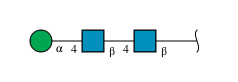
alpha-D-mannopyranose-(1-4)-2-acetamido-2-deoxy-beta-D-glucopyranose-(1-4)-2-acetamido-2-deoxy-beta-D-glucopyranose
E, F, H, J, K
E, F, H, J, K, L, M, N, Q
3N-Glycosylation
Glycosylation Resources
GlyTouCan: G62182OO
GlyCosmos: G62182OO
GlyGen: G62182OO
Entity ID: 3
MoleculeChains Length2D Diagram GlycosylationD Interactions
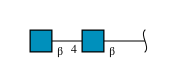
2-acetamido-2-deoxy-beta-D-glucopyranose-(1-4)-2-acetamido-2-deoxy-beta-D-glucopyranose
G, P
2N-Glycosylation
Glycosylation Resources
GlyTouCan: G42666HT
GlyCosmos: G42666HT
GlyGen: G42666HT
Entity ID: 4
MoleculeChains Length2D Diagram GlycosylationD Interactions
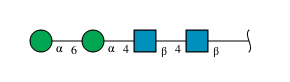
alpha-D-mannopyranose-(1-6)-alpha-D-mannopyranose-(1-4)-2-acetamido-2-deoxy-beta-D-glucopyranose-(1-4)-2-acetamido-2-deoxy-beta-D-glucopyranose
I, O
4N-Glycosylation
Glycosylation Resources
GlyTouCan: G04854NQ
GlyCosmos: G04854NQ
GlyGen: G04854NQ

Small Molecules

Ligands 1 Unique
IDChains Name / Formula / InChI Key2D Diagram3D Interactions
NAG

Query on NAG


Download:Ideal Coordinates CCD File
AA [auth C]
BA [auth C]
CA [auth D]
DA [auth D]
R [auth A]
AA [auth C],
BA [auth C],
CA [auth D],
DA [auth D],
R [auth A],
S [auth A],
T [auth A],
U [auth B],
V [auth B],
W [auth B],
X [auth B],
Y [auth C],
Z [auth C]
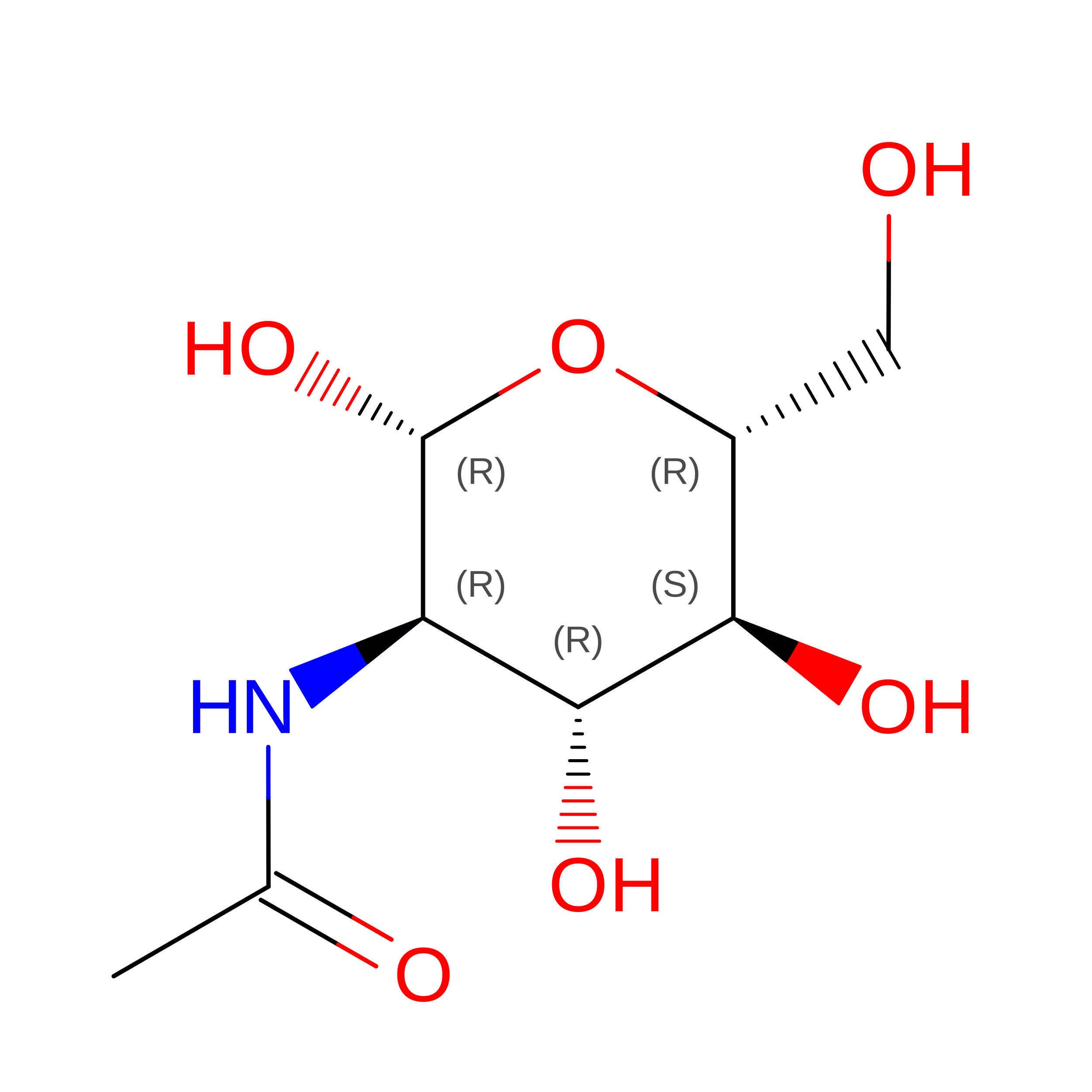
2-acetamido-2-deoxy-beta-D-glucopyranose
C8 H15 N O6
OVRNDRQMDRJTHS-FMDGEEDCSA-N

Experimental Data & Validation

Experimental Data

  • Method: X-RAY DIFFRACTION
  • Resolution: 2.70 Å
  • R-Value Free:  0.255 (Depositor) 
  • R-Value Work:  0.214 (Depositor) 
  • R-Value Observed: 0.216 (Depositor) 
Space Group: P 21 21 2
Unit Cell:
Length ( Å )Angle ( ˚ )
a = 201.517α = 90
b = 149.72β = 90
c = 157.486γ = 90
Software Package:
Software NamePurpose
ADSCdata collection
SHARPphasing
REFMACrefinement
HKL-2000data reduction
HKL-2000data scaling

Structure Validation

View Full Validation Report


Entry History 

Deposition Data

Revision History  (Full details and data files)

  • Version 1.0: 2006-09-26
    Type: Initial release
  • Version 1.1: 2008-05-01
    Changes: Version format compliance
  • Version 1.2: 2011-07-13
    Changes: Non-polymer description, Version format compliance
  • Version 1.3: 2018-03-07
    Changes: Experimental preparation
  • Version 2.0: 2020-07-29
    Type: Remediation
    Reason: Carbohydrate remediation
    Changes: Advisory, Atomic model, Data collection, Derived calculations, Structure summary
  • Version 3.0: 2024-12-25
    Changes: Advisory, Atomic model, Data collection, Database references, Derived calculations, Structure summary