2HIX | pdb_00002hix

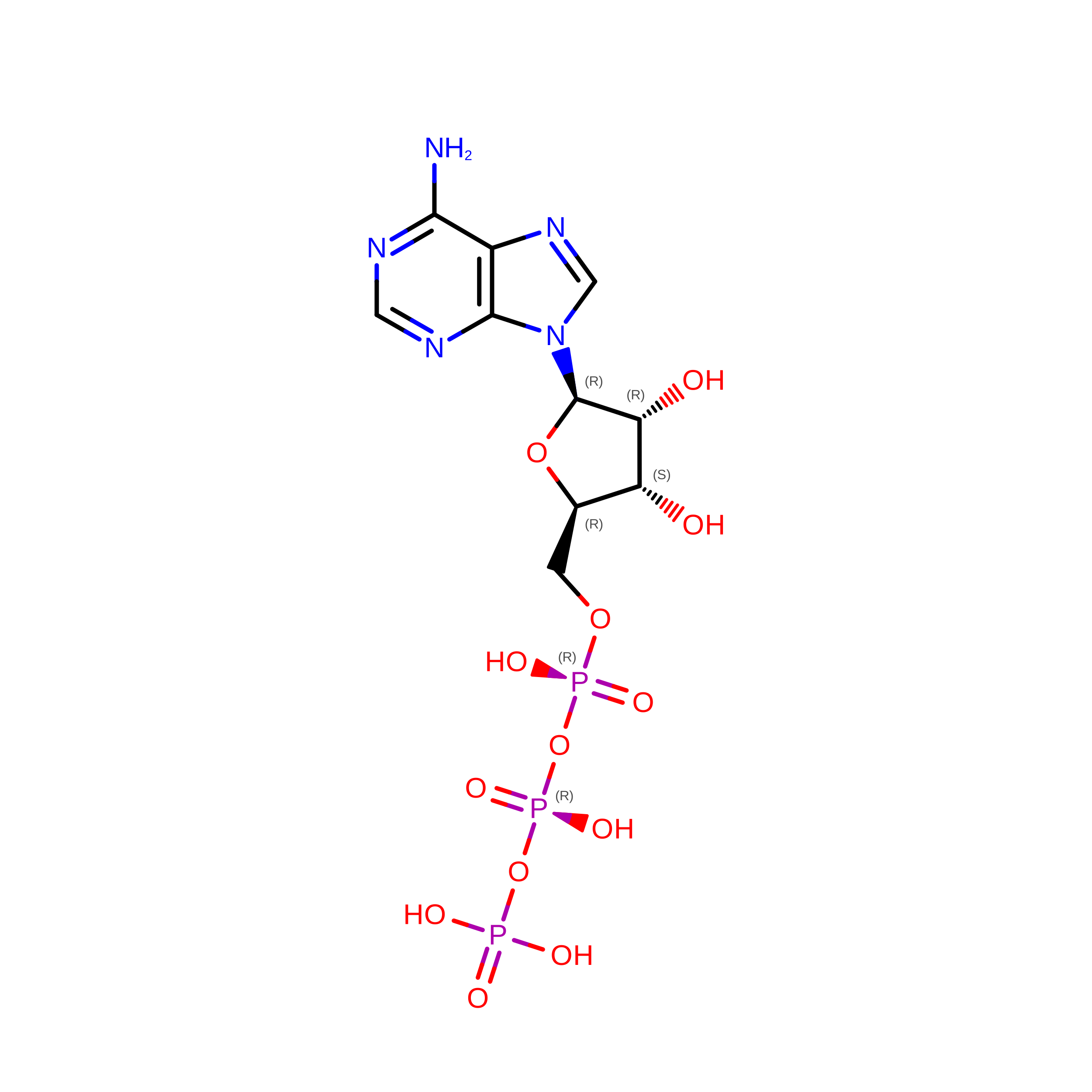
ATP dependent DNA ligase from S. solfataricus bound to ATP


Experimental Data Snapshot

  • Method: X-RAY DIFFRACTION
  • Resolution: 2.87 Å
  • R-Value Free: 
    0.279 (Depositor), 0.255 (DCC) 
  • R-Value Work: 
    0.217 (Depositor), 0.204 (DCC) 
  • R-Value Observed: 
    0.217 (Depositor) 

wwPDB Validation 3D Report Full Report

Validation slider image for 2HIX

Ligand Structure Quality Assessment 


This is version 1.4 of the entry. See complete history

Literature

A Flexible Interface between DNA Ligase and PCNA Supports Conformational Switching and Efficient Ligation of DNA.

Pascal, J.M.Tsodikov, O.V.Hura, G.L.Song, W.Cotner, E.A.Classen, S.Tomkinson, A.E.Tainer, J.A.Ellenberger, T.

(2006) Mol Cell 24: 279-291

  • DOI: https://doi.org/10.1016/j.molcel.2006.08.015
  • Primary Citation Related Structures: 
    2HII, 2HIK, 2HIV, 2HIX

  • PubMed Abstract: 

    DNA sliding clamps encircle DNA and provide binding sites for many DNA-processing enzymes. However, it is largely unknown how sliding clamps like proliferating cell nuclear antigen (PCNA) coordinate multistep DNA transactions. We have determined structures of Sulfolobus solfataricus DNA ligase and heterotrimeric PCNA separately by X-ray diffraction and in complex by small-angle X-ray scattering (SAXS). Three distinct PCNA subunits assemble into a protein ring resembling the homotrimeric PCNA of humans but with three unique protein-binding sites. In the absence of nicked DNA, the Sulfolobus solfataricus DNA ligase has an open, extended conformation. When complexed with heterotrimeric PCNA, the DNA ligase binds to the PCNA3 subunit and ligase retains an open, extended conformation. A closed, ring-shaped conformation of ligase catalyzes a DNA end-joining reaction that is strongly stimulated by PCNA. This open-to-closed switch in the conformation of DNA ligase is accommodated by a malleable interface with PCNA that serves as an efficient platform for DNA ligation.


  • Organizational Affiliation
    • Department of Biological Chemistry and Molecular Pharmacology, Harvard Medical School, Boston, Massachusetts 02115, USA.

Macromolecule Content 

  • Total Structure Weight: 70.51 kDa 
  • Atom Count: 4,606 
  • Modeled Residue Count: 577 
  • Deposited Residue Count: 621 
  • Unique protein chains: 1

Macromolecules

Find similar proteins by:|  3D Structure
Entity ID: 1
MoleculeChains  Sequence LengthOrganismDetailsImage
Thermostable DNA ligase621Saccharolobus solfataricusMutation(s): 0 
Gene Names: lig
EC: 6.5.1.1
UniProt
Find proteins for Q980T8 (Saccharolobus solfataricus (strain ATCC 35092 / DSM 1617 / JCM 11322 / P2))
Explore Q980T8 
Go to UniProtKB:  Q980T8
Entity Groups
Sequence Clusters30% Identity50% Identity70% Identity90% Identity95% Identity100% Identity
UniProt GroupQ980T8
Sequence Annotations
Expand
Reference Sequence

Small Molecules

Ligands 1 Unique
IDChains Name / Formula / InChI Key2D Diagram3D Interactions
ATP

Query on ATP


Download:Ideal Coordinates CCD File
B [auth A]ADENOSINE-5'-TRIPHOSPHATE
C10 H16 N5 O13 P3
ZKHQWZAMYRWXGA-KQYNXXCUSA-N

Experimental Data & Validation

Experimental Data

  • Method: X-RAY DIFFRACTION
  • Resolution: 2.87 Å
  • R-Value Free:  0.279 (Depositor), 0.255 (DCC) 
  • R-Value Work:  0.217 (Depositor), 0.204 (DCC) 
  • R-Value Observed: 0.217 (Depositor) 
Space Group: C 2 2 21
Unit Cell:
Length ( Å )Angle ( ˚ )
a = 119.324α = 90
b = 171.65β = 90
c = 78.686γ = 90
Software Package:
Software NamePurpose
DENZOdata reduction
SCALEPACKdata scaling
REFMACrefinement
PDB_EXTRACTdata extraction

Structure Validation

View Full Validation Report


Ligand Structure Quality Assessment 


Entry History 

Deposition Data

Revision History  (Full details and data files)

  • Version 1.0: 2006-11-07
    Type: Initial release
  • Version 1.1: 2008-05-01
    Changes: Version format compliance
  • Version 1.2: 2011-07-13
    Changes: Advisory, Version format compliance
  • Version 1.3: 2017-10-18
    Changes: Refinement description
  • Version 1.4: 2024-02-14
    Changes: Data collection, Database references, Derived calculations