2FOY | pdb_00002foy

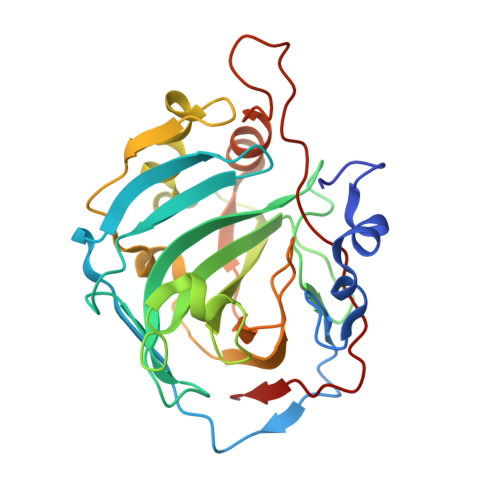
Human Carbonic Anhydrase I complexed with a two-prong inhibitor


Experimental Data Snapshot

  • Method: X-RAY DIFFRACTION
  • Resolution: 1.55 Å
  • R-Value Free: 
    0.243 (Depositor), 0.236 (DCC) 
  • R-Value Work: 
    0.220 (Depositor), 0.211 (DCC) 
  • R-Value Observed: 
    0.220 (Depositor) 

Starting Model: experimental
View more details

wwPDB Validation 3D Report Full Report

Validation slider image for 2FOY

Ligand Structure Quality Assessment 


This is version 1.4 of the entry. See complete history

Literature

Ultrahigh resolution crystal structures of human carbonic anhydrases I and II complexed with two-prong inhibitors reveal the molecular basis of high affinity.

Jude, K.M.Banerjee, A.L.Haldar, M.K.Manokaran, S.Roy, B.Mallik, S.Srivastava, D.K.Christianson, D.W.

(2006) J Am Chem Soc 128: 3011-3018

  • DOI: https://doi.org/10.1021/ja057257n
  • Primary Citation Related Structures: 
    2FOQ, 2FOS, 2FOU, 2FOV, 2FOY

  • PubMed Abstract: 

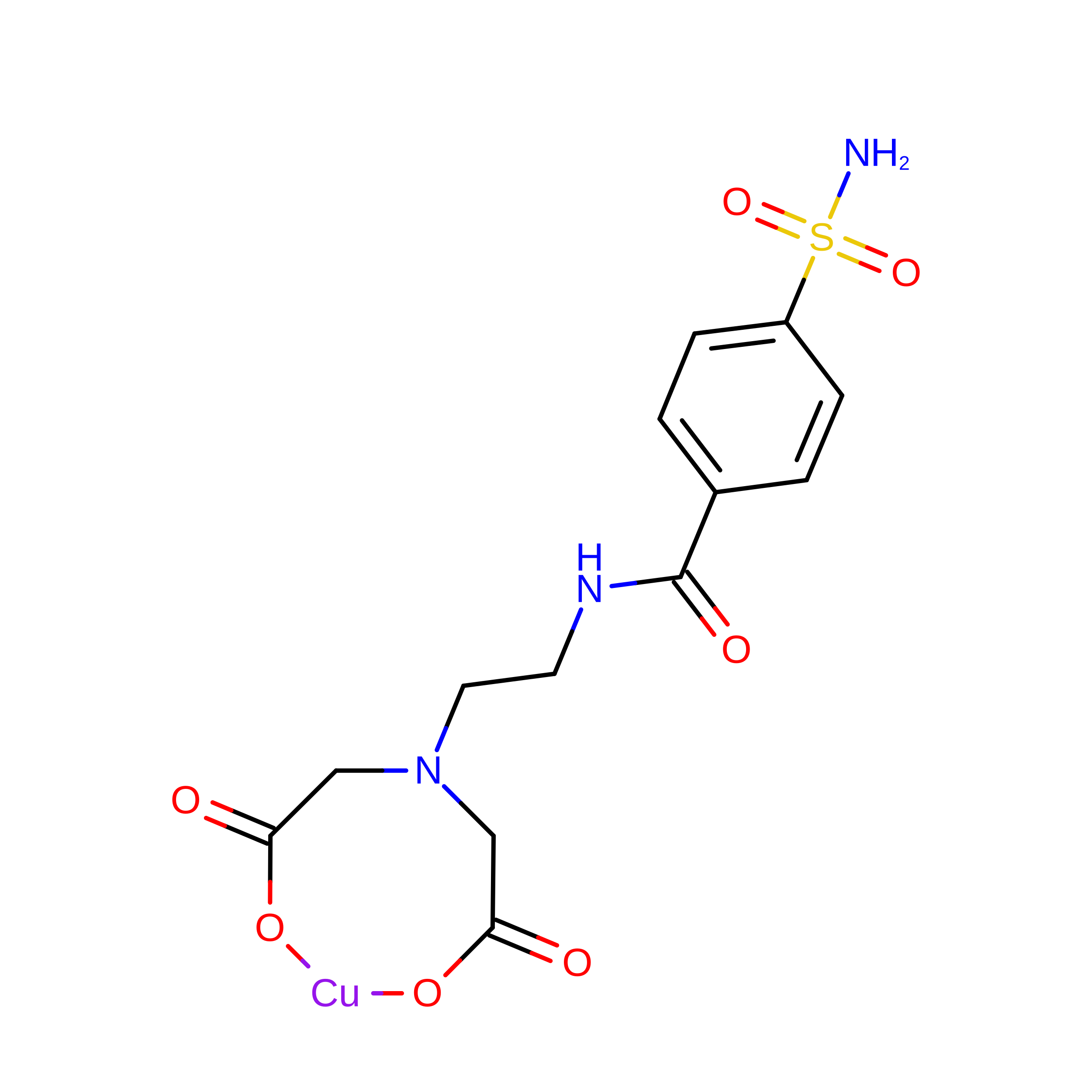
    The atomic-resolution crystal structures of human carbonic anhydrases I and II complexed with "two-prong" inhibitors are reported. Each inhibitor contains a benzenesulfonamide prong and a cupric iminodiacetate (IDA-Cu(2+)) prong separated by linkers of different lengths and compositions. The ionized NH(-) group of each benzenesulfonamide coordinates to the active site Zn(2+) ion; the IDA-Cu(2+) prong of the tightest-binding inhibitor, BR30, binds to H64 of CAII and H200 of CAI. This work provides the first evidence verifying the structural basis of nanomolar affinity measured for two-prong inhibitors targeting the carbonic anhydrases.


  • Organizational Affiliation
    • Roy and Diana Vagelos Laboratories, Department of Chemistry, University of Pennsylvania, Philadelphia, PA 19104, USA.

Macromolecule Content 

  • Total Structure Weight: 60.21 kDa 
  • Atom Count: 4,750 
  • Modeled Residue Count: 513 
  • Deposited Residue Count: 520 
  • Unique protein chains: 1

Macromolecules

Find similar proteins by:|  3D Structure
Entity ID: 1
MoleculeChains  Sequence LengthOrganismDetailsImage
Carbonic anhydrase 1
A, B
260Homo sapiensMutation(s): 0 
Gene Names: CA1
EC: 4.2.1.1 (PDB Primary Data), 4.2.1.69 (UniProt)
UniProt & NIH Common Fund Data Resources
Find proteins for P00915 (Homo sapiens)
Explore P00915 
Go to UniProtKB:  P00915
PHAROS:  P00915
GTEx:  ENSG00000133742 
Entity Groups
Sequence Clusters30% Identity50% Identity70% Identity90% Identity95% Identity100% Identity
UniProt GroupP00915
Sequence Annotations
Expand
Reference Sequence

Small Molecules

Ligands 2 Unique
IDChains Name / Formula / InChI Key2D Diagram3D Interactions
B30

Query on B30


Download:Ideal Coordinates CCD File
D [auth A]
E [auth A]
F [auth A]
H [auth B]
I [auth B]
D [auth A],
E [auth A],
F [auth A],
H [auth B],
I [auth B],
J [auth B]
{2,2'-[(2-{[4-(AMINOSULFONYL)BENZOYL]AMINO}ETHYL)IMINO]DIACETATO(2-)-KAPPAO}COPPER
C13 H15 Cu N3 O7 S
IZSCVVCMRVDVFM-UHFFFAOYSA-L
ZN

Query on ZN


Download:Ideal Coordinates CCD File
C [auth A],
G [auth B]
ZINC ION
Zn
PTFCDOFLOPIGGS-UHFFFAOYSA-N

Experimental Data & Validation

Experimental Data

  • Method: X-RAY DIFFRACTION
  • Resolution: 1.55 Å
  • R-Value Free:  0.243 (Depositor), 0.236 (DCC) 
  • R-Value Work:  0.220 (Depositor), 0.211 (DCC) 
  • R-Value Observed: 0.220 (Depositor) 
Space Group: P 21 21 21
Unit Cell:
Length ( Å )Angle ( ˚ )
a = 63.219α = 90
b = 72.608β = 90
c = 121.949γ = 90
Software Package:
Software NamePurpose
DENZOdata reduction
SCALEPACKdata scaling
PHASERphasing
CNSrefinement
PDB_EXTRACTdata extraction
HKL-2000data reduction

Structure Validation

View Full Validation Report


Ligand Structure Quality Assessment 


Entry History 

Deposition Data

Revision History  (Full details and data files)

  • Version 1.0: 2006-04-04
    Type: Initial release
  • Version 1.1: 2008-05-01
    Changes: Version format compliance
  • Version 1.2: 2011-07-13
    Changes: Version format compliance
  • Version 1.3: 2017-10-18
    Changes: Refinement description
  • Version 1.4: 2023-08-30
    Changes: Data collection, Database references, Derived calculations, Refinement description