2FAW | pdb_00002faw

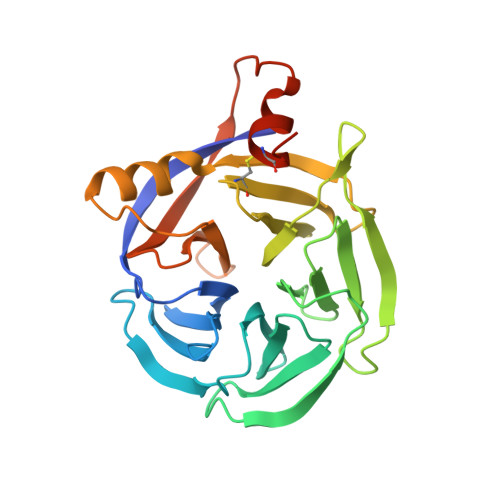
crystal structure of papaya glutaminyl cyclase


Experimental Data Snapshot

  • Method: X-RAY DIFFRACTION
  • Resolution: 1.70 Å
  • R-Value Free: 
    0.208 (Depositor), 0.205 (DCC) 
  • R-Value Work: 
    0.165 (Depositor), 0.165 (DCC) 

wwPDB Validation 3D Report Full Report

Validation slider image for 2FAW

This is version 2.1 of the entry. See complete history

Literature

Crystal structure of papaya glutaminyl cyclase, an archetype for plant and bacterial glutaminyl cyclases.

Wintjens, R.Belrhali, H.Clantin, B.Azarkan, M.Bompard, C.Baeyens-Volant, D.Looze, Y.Villeret, V.

(2006) J Mol Biology 357: 457-470

  • DOI: https://doi.org/10.1016/j.jmb.2005.12.029
  • Primary Citation Related Structures: 
    2FAW

  • PubMed Abstract: 

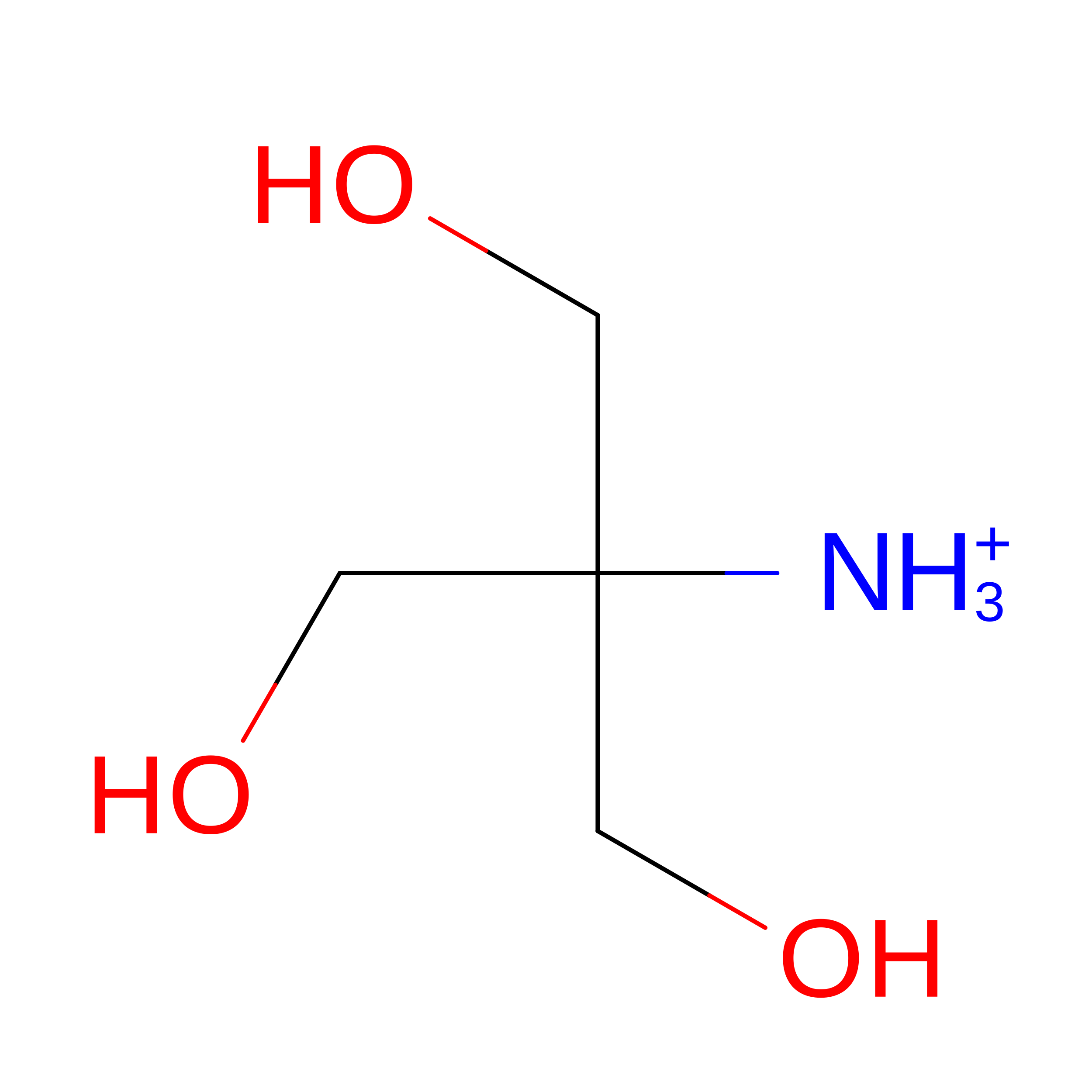
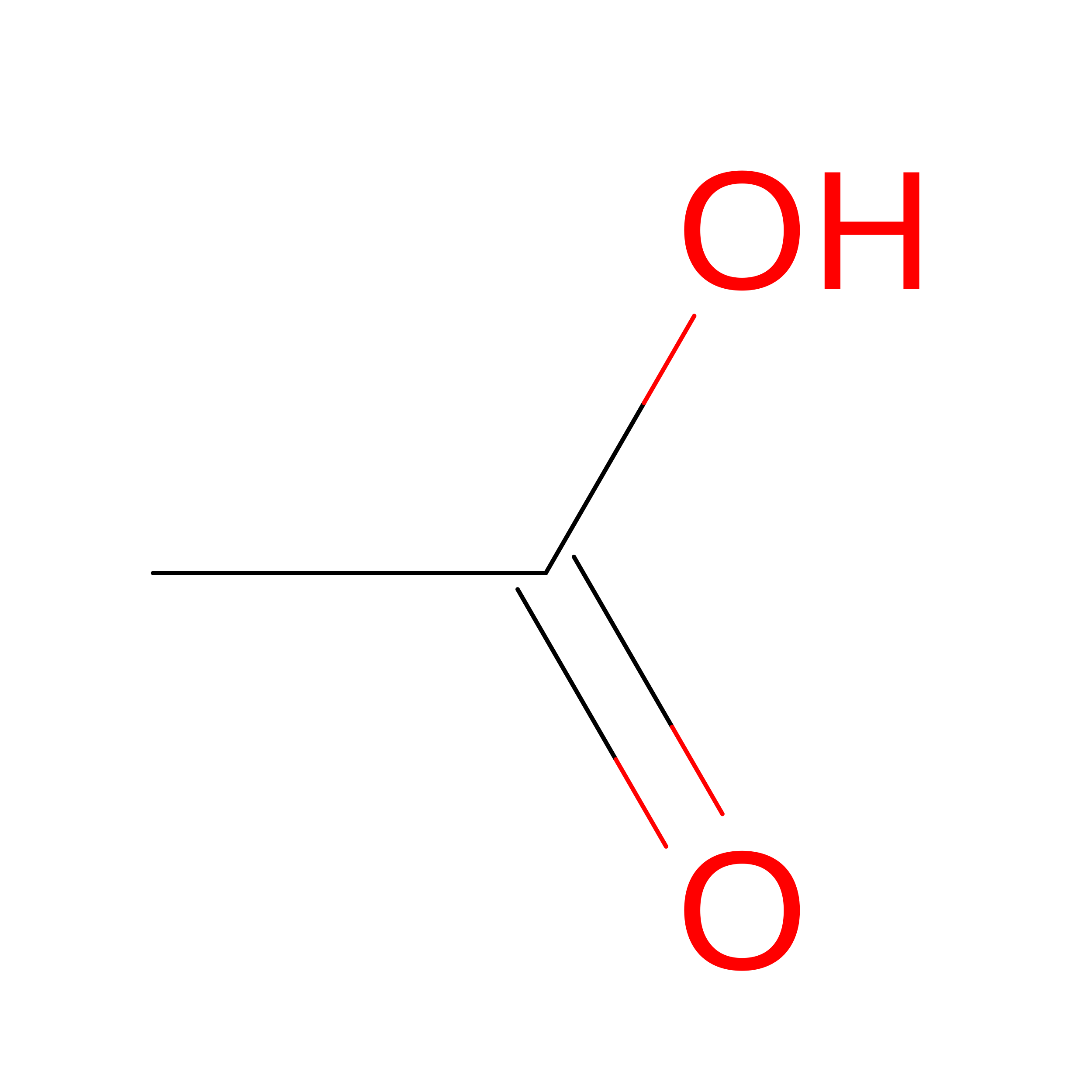
    Glutaminyl cyclases (QCs) (EC 2.3.2.5) catalyze the intramolecular cyclization of protein N-terminal glutamine residues into pyroglutamic acid with the concomitant liberation of ammonia. QCs may be classified in two groups containing, respectively, the mammalian enzymes, and the enzymes from plants, bacteria, and parasites. The crystal structure of the QC from the latex of Carica papaya (PQC) has been determined at 1.7A resolution. The structure was solved by the single wavelength anomalous diffraction technique using sulfur and zinc as anomalous scatterers. The enzyme folds into a five-bladed beta-propeller, with two additional alpha-helices and one beta hairpin. The propeller closure is achieved via an original molecular velcro, which links the last two blades into a large eight stranded beta-sheet. The zinc ion present in the PQC is bound via an octahedral coordination into an elongated cavity located along the pseudo 5-fold axis of the beta-propeller fold. This zinc ion presumably plays a structural role and may contribute to the exceptional stability of PQC, along with an extended hydrophobic packing, the absence of long loops, the three-joint molecular velcro and the overall folding itself. Multiple sequence alignments combined with structural analyses have allowed us to tentatively locate the active site, which is filled in the crystal structure either by a Tris molecule or an acetate ion. These analyses are further supported by the experimental evidence that Tris is a competitive inhibitor of PQC. The active site is located at the C-terminal entrance of the PQC central tunnel. W83, W110, W169, Q24, E69, N155, K225, F22 and F67 are highly conserved residues in the C-terminal entrance, and their putative role in catalysis is discussed. The PQC structure is representative of the plants, bacterial and parasite enzymes and contrasts with that of mammalian enzymes, that may possibly share a conserved scaffold of the bacterial aminopeptidase.


  • Organizational Affiliation
    • Laboratoire de Chimie Générale, Institut de Pharmacie-U.L.B. CP 206/04, Boulevard du Triomphe, B-1050 Brussels, Belgium.

Macromolecule Content 

  • Total Structure Weight: 63.55 kDa 
  • Atom Count: 5,122 
  • Modeled Residue Count: 500 
  • Deposited Residue Count: 532 
  • Unique protein chains: 1

Macromolecules

Find similar proteins by:|  3D Structure
Entity ID: 1
MoleculeChains  Sequence LengthOrganismDetailsImage
glutamine cyclotransferase
A, B
266Carica papayaMutation(s): 0 
EC: 2.3.2.5
UniProt
Find proteins for O81226 (Carica papaya)
Explore O81226 
Go to UniProtKB:  O81226
Entity Groups
Sequence Clusters30% Identity50% Identity70% Identity90% Identity95% Identity100% Identity
UniProt GroupO81226
Glycosylation
Glycosylation Sites: 1
Sequence Annotations
Expand
Reference Sequence

Oligosaccharides

Help  
Entity ID: 2
MoleculeChains Length2D Diagram GlycosylationD Interactions
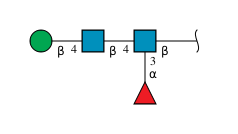
beta-D-mannopyranose-(1-4)-2-acetamido-2-deoxy-beta-D-glucopyranose-(1-4)-[alpha-L-fucopyranose-(1-3)]2-acetamido-2-deoxy-beta-D-glucopyranose
C
4N-Glycosylation
Glycosylation Resources
GlyTouCan: G18638YB
GlyCosmos: G18638YB
GlyGen: G18638YB
Entity ID: 3
MoleculeChains Length2D Diagram GlycosylationD Interactions
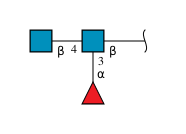
alpha-L-fucopyranose-(1-3)-[2-acetamido-2-deoxy-beta-D-glucopyranose-(1-4)]2-acetamido-2-deoxy-beta-D-glucopyranose
D
3N-Glycosylation
Glycosylation Resources
GlyTouCan: G11971MR
GlyCosmos: G11971MR
GlyGen: G11971MR

Experimental Data & Validation

Experimental Data

  • Method: X-RAY DIFFRACTION
  • Resolution: 1.70 Å
  • R-Value Free:  0.208 (Depositor), 0.205 (DCC) 
  • R-Value Work:  0.165 (Depositor), 0.165 (DCC) 
Space Group: P 21 21 21
Unit Cell:
Length ( Å )Angle ( ˚ )
a = 62.82α = 90
b = 81.2β = 90
c = 108.17γ = 90
Software Package:
Software NamePurpose
REFMACrefinement
PDB_EXTRACTdata extraction
SCALEdata reduction
XDSdata scaling
SHARPphasing

Structure Validation

View Full Validation Report


Entry History 

Deposition Data

Revision History  (Full details and data files)

  • Version 1.0: 2006-10-03
    Type: Initial release
  • Version 1.1: 2008-04-01
    Changes: Version format compliance
  • Version 1.2: 2011-07-13
    Changes: Non-polymer description, Version format compliance
  • Version 2.0: 2020-07-29
    Type: Remediation
    Reason: Carbohydrate remediation
    Changes: Advisory, Atomic model, Data collection, Derived calculations, Structure summary
  • Version 2.1: 2024-11-20
    Changes: Data collection, Database references, Structure summary