2F57 | pdb_00002f57

Crystal Structure Of The Human P21-Activated Kinase 5


Experimental Data Snapshot

  • Method: X-RAY DIFFRACTION
  • Resolution: 1.80 Å
  • R-Value Free: 
    0.185 (Depositor), 0.192 (DCC) 
  • R-Value Work: 
    0.154 (Depositor), 0.163 (DCC) 
  • R-Value Observed: 
    0.155 (Depositor) 

Starting Model: experimental
View more details

wwPDB Validation 3D Report Full Report

Validation slider image for 2F57

Ligand Structure Quality Assessment 


This is version 1.5 of the entry. See complete history

Literature

Crystal Structures of the p21-activated kinases PAK4, PAK5, and PAK6 reveal catalytic domain plasticity of active group II PAKs.

Eswaran, J.Lee, W.H.Debreczeni, J.E.Filippakopoulos, P.Turnbull, A.Fedorov, O.Deacon, S.W.Peterson, J.R.Knapp, S.

(2007) Structure 15: 201-213

  • DOI: https://doi.org/10.1016/j.str.2007.01.001
  • Primary Citation Related Structures: 
    2BVA, 2C30, 2CDZ, 2F57

  • PubMed Abstract: 

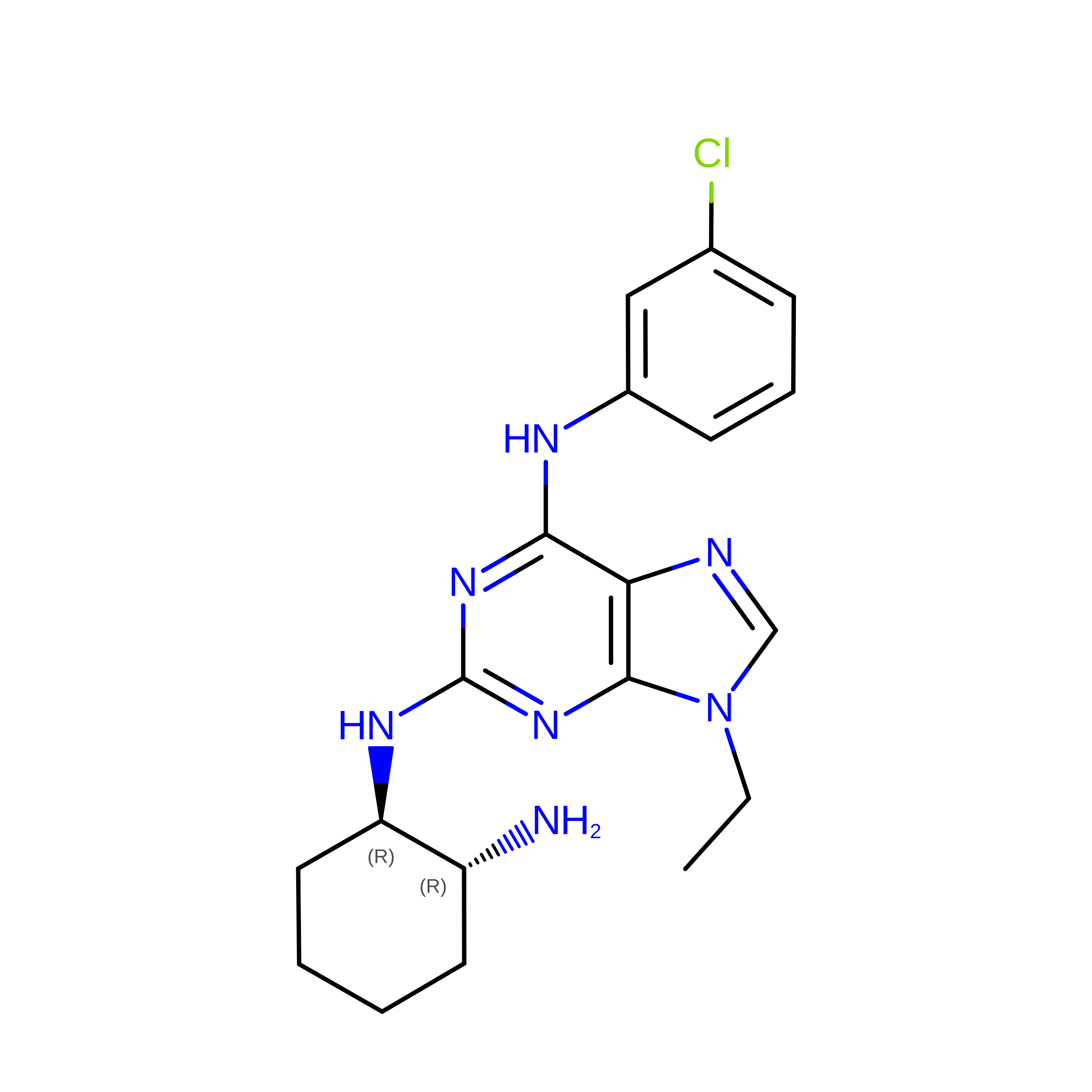
    p21-activated kinases have been classified into two groups based on their domain architecture. Group II PAKs (PAK4-6) regulate a wide variety of cellular functions, and PAK deregulation has been linked to tumor development. Structural comparison of five high-resolution structures comprising all active, monophosphorylated group II catalytic domains revealed a surprising degree of domain plasticity, including a number of catalytically productive and nonproductive conformers. Rearrangements of helix alphaC, a key regulatory element of kinase function, resulted in an additional helical turn at the alphaC N terminus and a distortion of its C terminus, a movement hitherto unseen in protein kinases. The observed structural changes led to the formation of interactions between conserved residues that structurally link the glycine-rich loop, alphaC, and the activation segment and firmly anchor alphaC in an active conformation. Inhibitor screening identified six potent PAK inhibitors from which a tri-substituted purine inhibitor was cocrystallized with PAK4 and PAK5.


  • Organizational Affiliation
    • University of Oxford, Structural Genomics Consortium, Botnar Research Centre, Oxford OX3 7LD, United Kingdom. jeyanthy.eswaran@sgc.ox.ac.uk <jeyanthy.eswaran@sgc.ox.ac.uk>

Macromolecule Content 

  • Total Structure Weight: 73.13 kDa 
  • Atom Count: 5,389 
  • Modeled Residue Count: 598 
  • Deposited Residue Count: 634 
  • Unique protein chains: 1

Macromolecules

Find similar proteins by:|  3D Structure
Entity ID: 1
MoleculeChains  Sequence LengthOrganismDetailsImage
Serine/threonine-protein kinase PAK 7
A, B
317Homo sapiensMutation(s): 1 
EC: 2.7.1.37 (PDB Primary Data), 2.7.11.1 (UniProt)
UniProt & NIH Common Fund Data Resources
Find proteins for Q9P286 (Homo sapiens)
Explore Q9P286 
Go to UniProtKB:  Q9P286
PHAROS:  Q9P286
GTEx:  ENSG00000101349 
Entity Groups
Sequence Clusters30% Identity50% Identity70% Identity90% Identity95% Identity100% Identity
UniProt GroupQ9P286
Sequence Annotations
Expand
Reference Sequence

Small Molecules

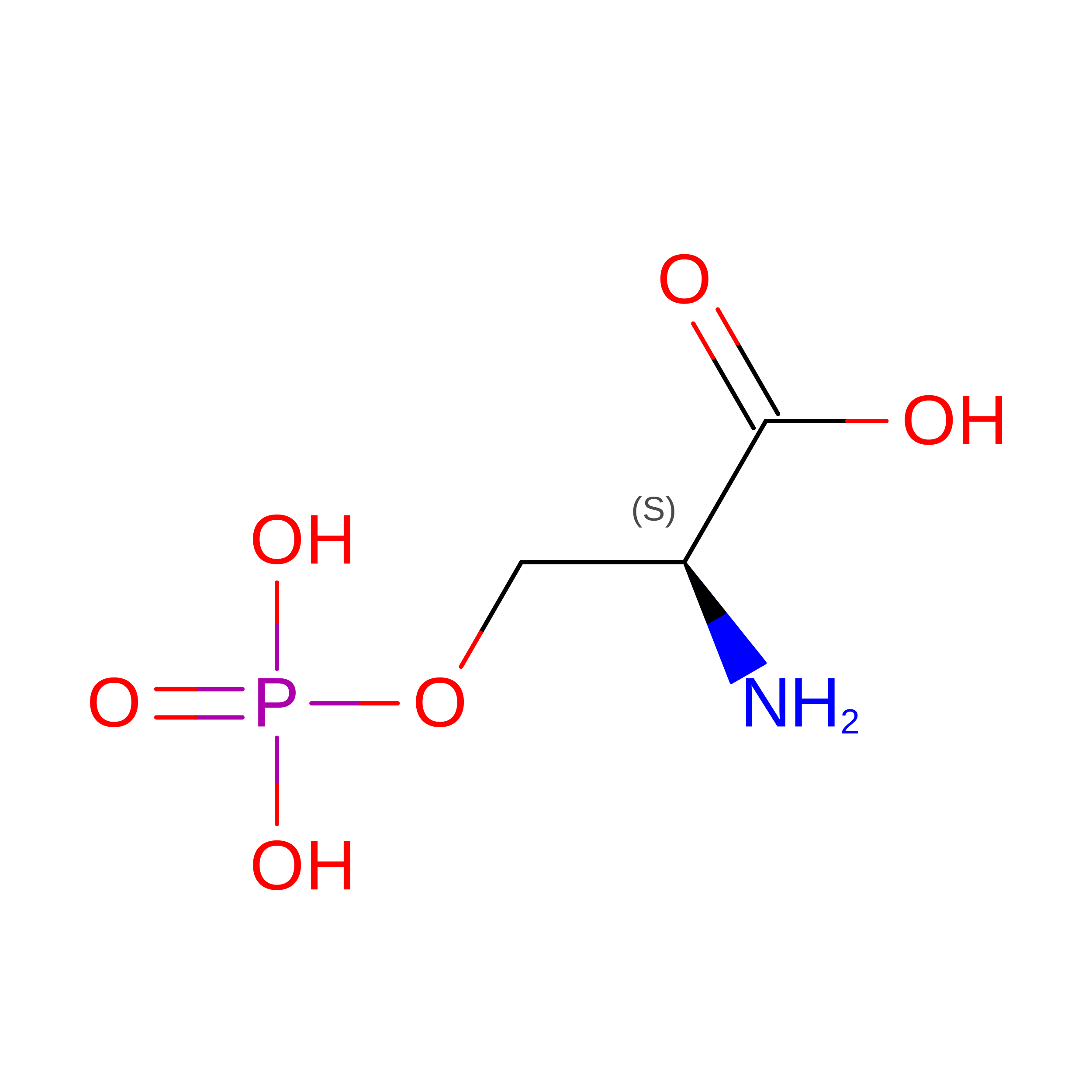
Modified Residues  1 Unique
IDChains TypeFormula2D DiagramParent
SEP
Query on SEP
A, B
L-PEPTIDE LINKINGC3 H8 N O6 PSER

Experimental Data & Validation

Experimental Data

  • Method: X-RAY DIFFRACTION
  • Resolution: 1.80 Å
  • R-Value Free:  0.185 (Depositor), 0.192 (DCC) 
  • R-Value Work:  0.154 (Depositor), 0.163 (DCC) 
  • R-Value Observed: 0.155 (Depositor) 
Space Group: C 1 2 1
Unit Cell:
Length ( Å )Angle ( ˚ )
a = 98.661α = 90
b = 56.599β = 103.13
c = 120.764γ = 90
Software Package:
Software NamePurpose
REFMACrefinement
HKL-2000data reduction
SCALEPACKdata scaling
PHASERphasing

Structure Validation

View Full Validation Report


Ligand Structure Quality Assessment 


Entry History 

Revision History  (Full details and data files)

  • Version 1.0: 2005-12-13
    Type: Initial release
  • Version 1.1: 2008-05-01
    Changes: Version format compliance
  • Version 1.2: 2011-07-13
    Changes: Advisory, Version format compliance
  • Version 1.3: 2018-01-31
    Changes: Structure summary
  • Version 1.4: 2023-08-23
    Changes: Data collection, Database references, Derived calculations, Refinement description
  • Version 1.5: 2024-11-20
    Changes: Structure summary