2EBF | pdb_00002ebf

Crystal structures reveal a thiol-protease like catalytic triad in the C-terminal region of Pasteurella multocida toxin


Experimental Data Snapshot

  • Method: X-RAY DIFFRACTION
  • Resolution: 1.90 Å
  • R-Value Free: 
    0.233 (Depositor), 0.234 (DCC) 
  • R-Value Work: 
    0.205 (Depositor), 0.205 (DCC) 
  • R-Value Observed: 
    0.205 (Depositor) 

wwPDB Validation 3D Report Full Report

Validation slider image for 2EBF

This is version 2.1 of the entry. See complete history

Literature

Crystal structures reveal a thiol protease-like catalytic triad in the C-terminal region of Pasteurella multocida toxin

Kitadokoro, K.Kamitani, S.Miyazawa, M.Hanajima-Ozawa, M.Fukui, A.Miyake, M.Horiguchi, Y.

(2007) Proc Natl Acad Sci U S A 104: 5139-5144

  • DOI: https://doi.org/10.1073/pnas.0608197104
  • Primary Citation Related Structures: 
    2EBF, 2EBH, 2EC5

  • PubMed Abstract: 

    Pasteurella multocida toxin (PMT), one of the virulence factors produced by the bacteria, exerts its toxicity by up-regulating various signaling cascades downstream of the heterotrimeric GTPases Gq and G12/13 in an unknown fashion. Here, we present the crystal structure of the C-terminal region (residues 575-1,285) of PMT, which carries an intracellularly active moiety. The overall structure of C-terminal region of PMT displays a Trojan horse-like shape, composed of three domains with a "feet"-,"body"-, and "head"-type arrangement, which were designated C1, C2, and C3 from the N to the C terminus, respectively. The C1 domain, showing marked similarity in steric structure to the N-terminal domain of Clostridium difficile toxin B, was found to lead the toxin molecule to the plasma membrane. The C3 domain possesses the Cys-His-Asp catalytic triad that is organized only when the Cys is released from a disulfide bond. The steric alignment of the triad corresponded well to that of papain or other enzymes carrying Cys-His-Asp. PMT toxicities on target cells were completely abrogated when one of the amino acids constituting the triad was mutated. Our results indicate that PMT is an enzyme toxin carrying the cysteine protease-like catalytic triad dependent on the redox state and functions on the cytoplasmic face of the plasma membrane of target cells.


  • Organizational Affiliation
    • Research Center for Low Temperature and Materials Sciences, Kyoto University, Sakyo-ku, Kyoto 606-8502, Japan.

Macromolecule Content 

  • Total Structure Weight: 85.06 kDa 
  • Atom Count: 6,450 
  • Modeled Residue Count: 711 
  • Deposited Residue Count: 746 
  • Unique protein chains: 1

Macromolecules

Find similar proteins by:|  3D Structure
Entity ID: 1
MoleculeChains  Sequence LengthOrganismDetailsImage
Dermonecrotic toxinA [auth X]746Pasteurella multocidaMutation(s): 0 
Gene Names: toxA
UniProt
Find proteins for P17452 (Pasteurella multocida)
Explore P17452 
Go to UniProtKB:  P17452
Entity Groups
Sequence Clusters30% Identity50% Identity70% Identity90% Identity95% Identity100% Identity
UniProt GroupP17452
Sequence Annotations
Expand
Reference Sequence

Oligosaccharides

Help  
Entity ID: 2
MoleculeChains Length2D Diagram GlycosylationD Interactions
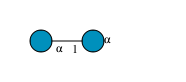
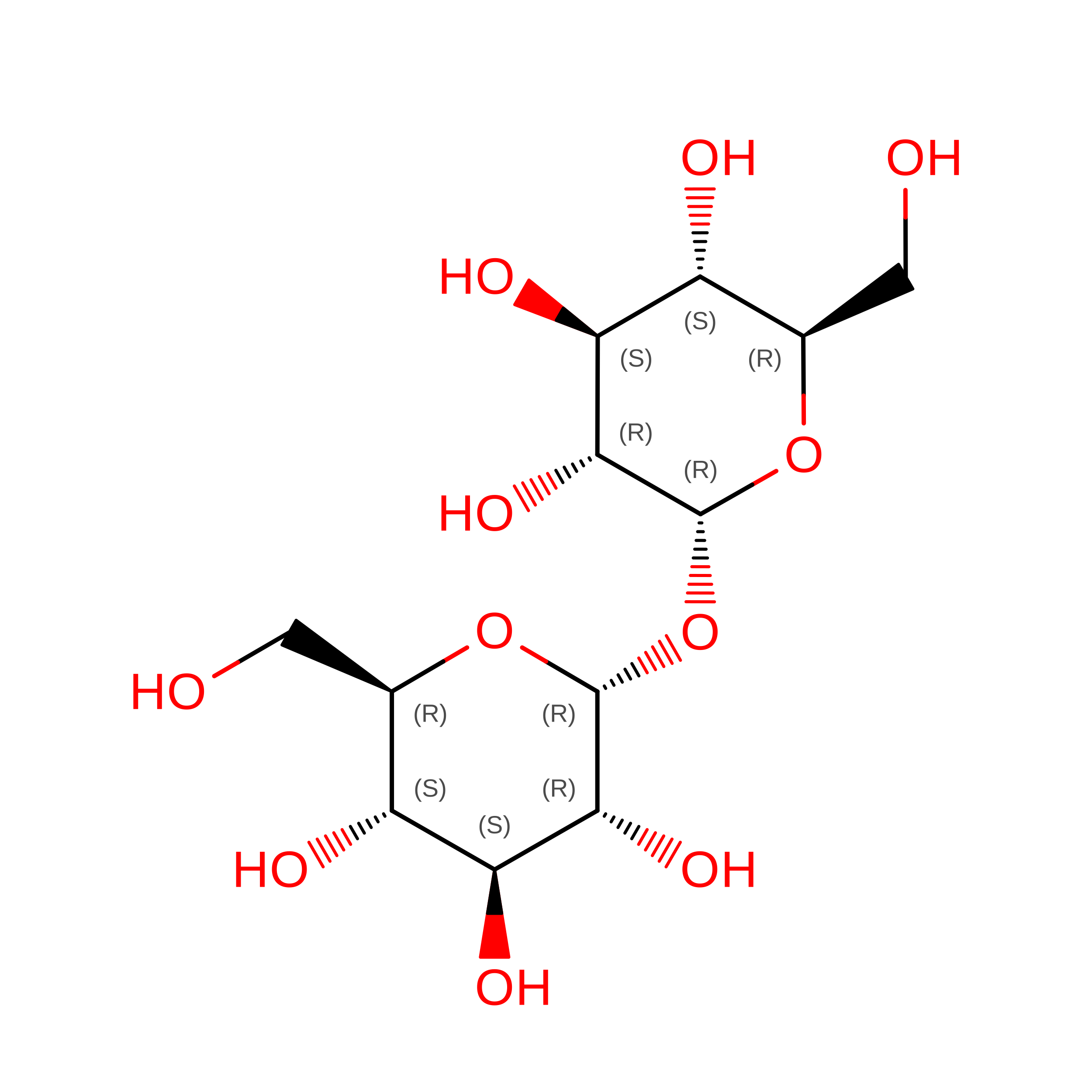
alpha-D-glucopyranose-(1-1)-alpha-D-glucopyranoseB [auth A],
C [auth B]
2N/A
Glycosylation Resources
GlyTouCan: G92130SN
GlyCosmos: G92130SN

Small Molecules

Ligands 1 Unique
IDChains Name / Formula / InChI Key2D Diagram3D Interactions
2PO

Query on 2PO


Download:Ideal Coordinates CCD File
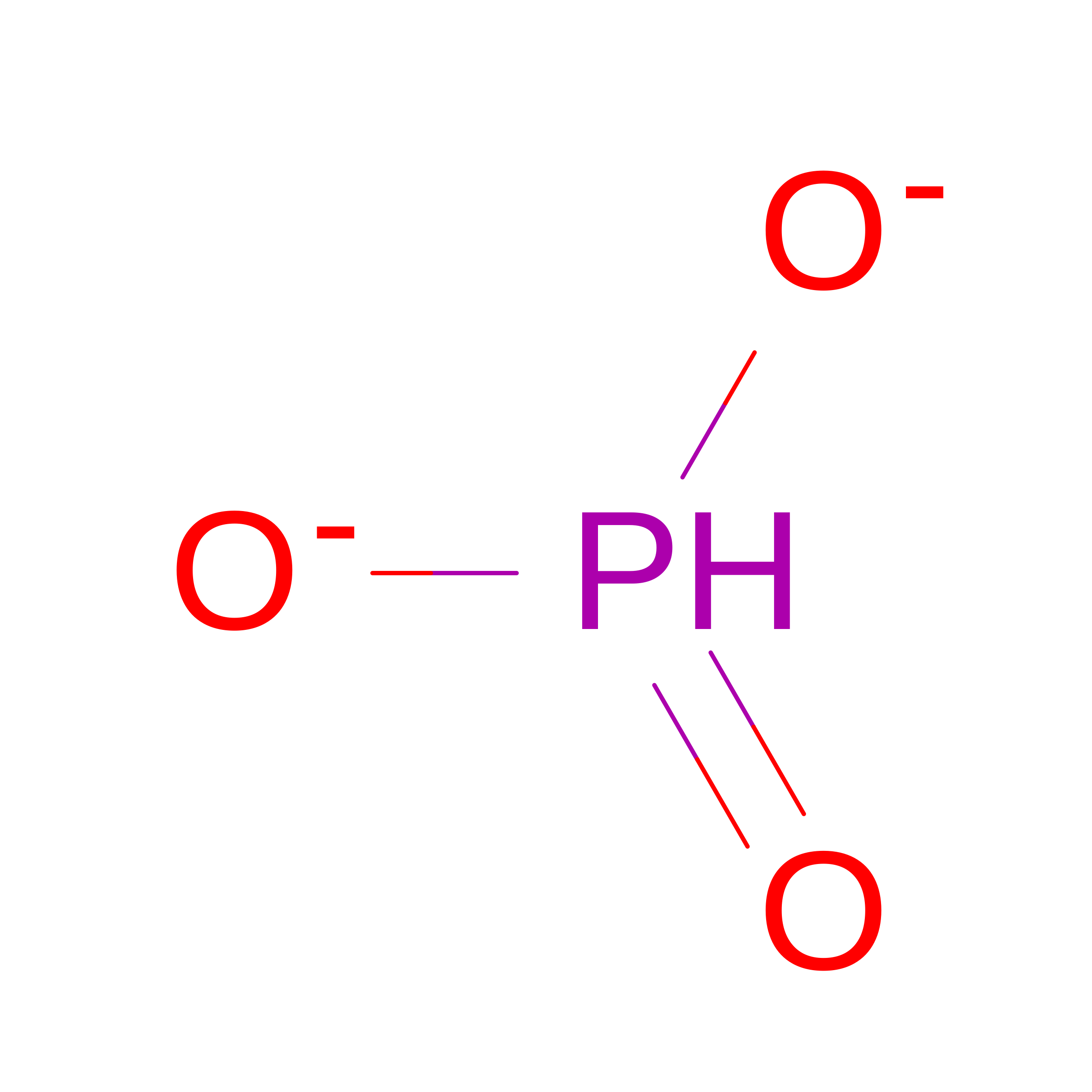
D [auth X]PHOSPHONATE
H O3 P
ABLZXFCXXLZCGV-UHFFFAOYSA-L

Biologically Interesting Molecules (External Reference) 

1 Unique

Experimental Data & Validation

Experimental Data

  • Method: X-RAY DIFFRACTION
  • Resolution: 1.90 Å
  • R-Value Free:  0.233 (Depositor), 0.234 (DCC) 
  • R-Value Work:  0.205 (Depositor), 0.205 (DCC) 
  • R-Value Observed: 0.205 (Depositor) 
Space Group: C 1 2 1
Unit Cell:
Length ( Å )Angle ( ˚ )
a = 110.971α = 90
b = 150.406β = 105.46
c = 77.139γ = 90
Software Package:
Software NamePurpose
REFMACrefinement
HKL-2000data collection
HKL-2000data reduction
HKL-2000data scaling
SHARPphasing

Structure Validation

View Full Validation Report


Entry History 

Deposition Data

Revision History  (Full details and data files)

  • Version 1.0: 2007-03-06
    Type: Initial release
  • Version 1.1: 2008-04-30
    Changes: Version format compliance
  • Version 1.2: 2011-07-13
    Changes: Advisory, Version format compliance
  • Version 2.0: 2020-07-29
    Type: Remediation
    Reason: Carbohydrate remediation
    Changes: Atomic model, Data collection, Database references, Derived calculations, Non-polymer description, Structure summary
  • Version 2.1: 2024-11-13
    Changes: Data collection, Database references, Structure summary