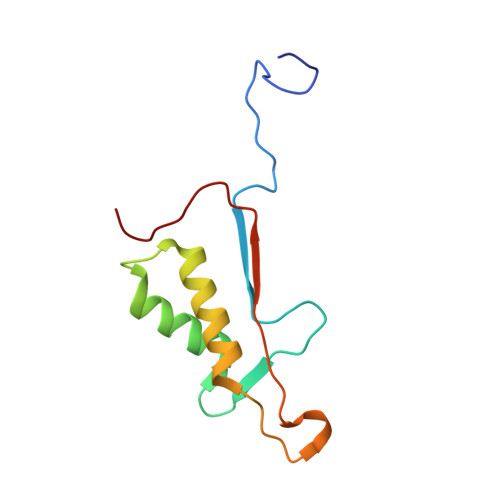
2DKO | pdb_00002dko

Extended substrate recognition in caspase-3 revealed by high resolution X-ray structure analysis


Experimental Data Snapshot

  • Method: X-RAY DIFFRACTION
  • Resolution: 1.06 Å
  • R-Value Free: 
    0.175 (Depositor), 0.177 (DCC) 
  • R-Value Work: 
    0.142 (Depositor), 0.143 (DCC) 
  • R-Value Observed: 
    0.142 (Depositor) 

Starting Model: experimental
View more details

wwPDB Validation 3D Report Full Report

Validation slider image for 2DKO

This is version 1.6 of the entry. See complete history

Literature

Extended Substrate Recognition in Caspase-3 Revealed by High Resolution X-ray Structure Analysis

Ganesan, R.Mittl, P.R.E.Jelakovic, S.Grutter, M.G.

(2006) J Mol Biology 359: 1378-1388

  • DOI: https://doi.org/10.1016/j.jmb.2006.04.051
  • Primary Citation Related Structures: 
    2CJX, 2CJY, 2DKO

  • PubMed Abstract: 

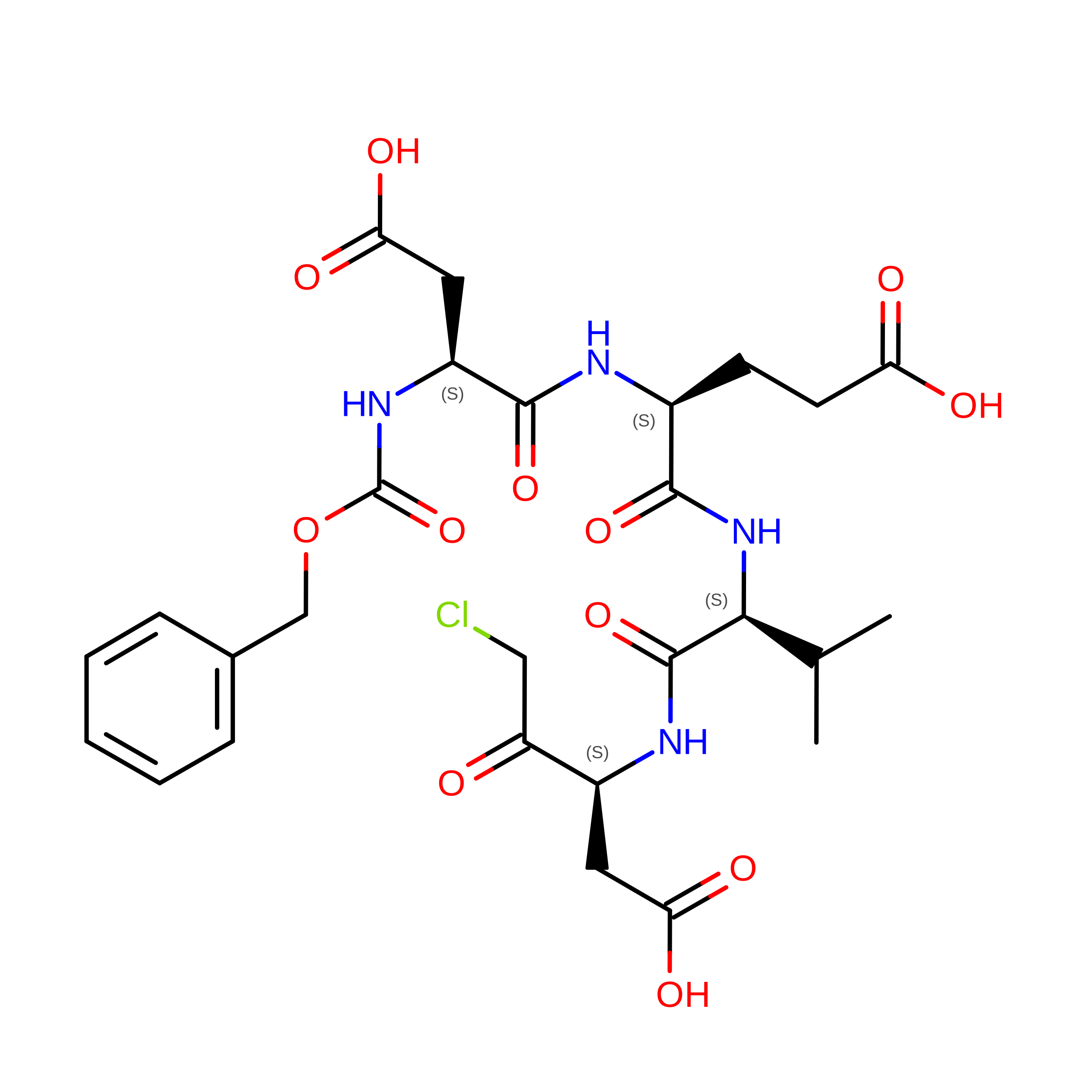
    Caspases are cysteine proteases involved in the signalling cascades of programmed cell death in which caspase-3 plays a central role, since it propagates death signals from intrinsic and extrinsic stimuli to downstream targets. The atomic resolution (1.06 Angstroms) crystal structure of the caspase-3 DEVD-cmk complex reveals the structural basis for substrate selectivity in the S4 pocket. A low-barrier hydrogen bond is observed between the side-chains of the P4 inhibitor aspartic acid and Asp179 of the N-terminal tail of the symmetry related p12 subunit. Site-directed mutagenesis of Asp179 confirmed the significance of this residue in substrate recognition. In the 1.06 Angstroms crystal structure, a radiation damage induced rearrangement of the inhibitor methylketone moiety was observed. The carbon atom that in a substrate would represent the scissile peptide bond carbonyl carbon clearly shows a tetrahedral coordination and resembles the postulated tetrahedral intermediate of the acylation reaction.


  • Organizational Affiliation
    • Biochemisches Institut, Universität Zürich, Switzerland.

Macromolecule Content 

  • Total Structure Weight: 29.17 kDa 
  • Atom Count: 2,427 
  • Modeled Residue Count: 254 
  • Deposited Residue Count: 255 
  • Unique protein chains: 3

Macromolecules

Find similar proteins by:|  3D Structure
Entity ID: 1
MoleculeChains  Sequence LengthOrganismDetailsImage
Caspase-3146Homo sapiensMutation(s): 0 
EC: 3.4.22 (PDB Primary Data), 3.4.22.56 (UniProt)
UniProt & NIH Common Fund Data Resources
Find proteins for P42574 (Homo sapiens)
Explore P42574 
Go to UniProtKB:  P42574
PHAROS:  P42574
GTEx:  ENSG00000164305 
Entity Groups
Sequence Clusters30% Identity50% Identity70% Identity90% Identity95% Identity100% Identity
UniProt GroupP42574
Sequence Annotations
Expand
Reference Sequence
Find similar proteins by:|  3D Structure
Entity ID: 2
MoleculeChains  Sequence LengthOrganismDetailsImage
Caspase-3103Homo sapiensMutation(s): 1 
EC: 3.4.22 (PDB Primary Data), 3.4.22.56 (UniProt)
UniProt & NIH Common Fund Data Resources
Find proteins for P42574 (Homo sapiens)
Explore P42574 
Go to UniProtKB:  P42574
PHAROS:  P42574
GTEx:  ENSG00000164305 
Entity Groups
Sequence Clusters30% Identity50% Identity70% Identity90% Identity95% Identity100% Identity
UniProt GroupP42574
Sequence Annotations
Expand
Reference Sequence
Find similar proteins by:  Sequence   |   3D Structure  
Entity ID: 3
MoleculeChains  Sequence LengthOrganismDetailsImage
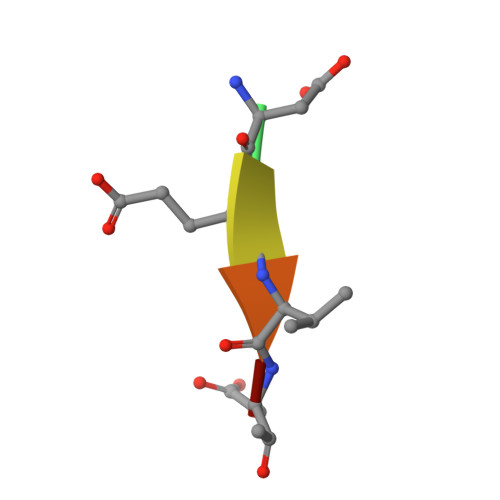
PHQ-ASP-GLU-VAL-ASP-CHLOROMETHYLKETONEC [auth I]6N/AMutation(s): 0 

Experimental Data & Validation

Experimental Data

  • Method: X-RAY DIFFRACTION
  • Resolution: 1.06 Å
  • R-Value Free:  0.175 (Depositor), 0.177 (DCC) 
  • R-Value Work:  0.142 (Depositor), 0.143 (DCC) 
  • R-Value Observed: 0.142 (Depositor) 
Space Group: I 2 2 2
Unit Cell:
Length ( Å )Angle ( ˚ )
a = 67.65α = 90
b = 83.89β = 90
c = 96.16γ = 90
Software Package:
Software NamePurpose
XDSdata scaling
XSCALEdata scaling
AMoREphasing
SHELXL-97refinement
XDSdata reduction

Structure Validation

View Full Validation Report


Entry History 

Deposition Data

Revision History  (Full details and data files)

  • Version 1.0: 2006-07-04
    Type: Initial release
  • Version 1.1: 2008-04-30
    Changes: Version format compliance
  • Version 1.2: 2011-07-13
    Changes: Atomic model, Database references, Derived calculations, Non-polymer description, Structure summary, Version format compliance
  • Version 1.3: 2012-12-12
    Changes: Other
  • Version 1.4: 2014-04-02
    Changes: Structure summary
  • Version 1.5: 2023-10-25
    Changes: Data collection, Database references, Derived calculations, Refinement description
  • Version 1.6: 2024-10-30
    Changes: Structure summary