1Z1Q | pdb_00001z1q

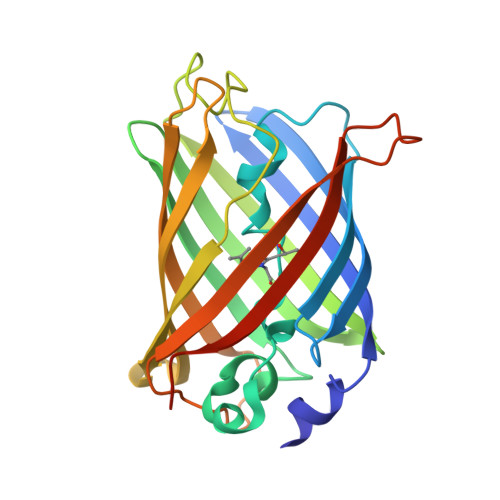
Y66L Variant of Enhanced Green Fluorescent Protein with 374-nm Absorbing Chromophore


Experimental Data Snapshot

  • Method: X-RAY DIFFRACTION
  • Resolution: 1.50 Å
  • R-Value Free: 
    0.206 (Depositor), 0.188 (DCC) 
  • R-Value Work: 
    0.175 (Depositor), 0.174 (DCC) 

Starting Model: experimental
View more details

wwPDB Validation 3D Report Full Report

Validation slider image for 1Z1Q

This is version 3.0 of the entry. See complete history

Literature

Oxidative Chemistry in the GFP Active Site Leads to Covalent Cross-Linking of a Modified Leucine Side Chain with a Histidine Imidazole: Implications for the Mechanism of Chromophore Formation.

Rosenow, M.A.Patel, H.N.Wachter, R.M.

(2005) Biochemistry 44: 8303-8311

  • DOI: https://doi.org/10.1021/bi0503798
  • Primary Citation Related Structures: 
    1Z1P, 1Z1Q

  • PubMed Abstract: 

    The mechanism of chromophore biosynthesis in green fluorescent protein (GFP) is triggered by a spontaneous main chain cyclization reaction of residues 65-67. Here, we demonstrate that the initially colorless Y66L variant, designed to trap chromophore precursor states, is oxidatively modified to generate yellow chromophores that absorb at 412 and 374 nm. High- and low-pH crystal structures determined to 2.0 and 1.5 A resolution, respectively, are consistent with pi-orbital conjugation of a planar Leu66-derived adduct with the imidazolinone ring, which is approximately 90 and 100% dehydrated, respectively. Time-, base-, and oxygen-dependent optical properties suggest that the yellow chromophores are generated from a 338 nm-absorbing intermediate, interpreted to be the Y66L analogue of the wild-type GFP chromophore. Generation of this species is catalyzed by a general base such as formate, and proceeds via a cyclization-oxidation-dehydration mechanism. The data suggest that a hydration-dehydration equilibrium exists in the cyclic form of the peptide, and that dehydration is favored upon extensive conjugation with the modified side chain. We conclude that the mechanism of GFP chromophore biosynthesis is not driven by the aromatic character of residue 66. In the low-pH X-ray structure, a highly unusual cross-link is observed between His148 and the oxidized Leu66 side chain, suggesting a conjugate addition reaction of the imidazole nitrogen to the highly electrophilic diene group of the yellow chromophore. The reactivity described here further expands the chemical diversity observed in the active site of GFP-like proteins, and may allow for covalent attachment of functional groups to the protein scaffold for catalytic purposes.


  • Organizational Affiliation
    • Department of Chemistry and Biochemistry, Arizona State University, Tempe, Arizona 85287-1604, USA.

Macromolecule Content 

  • Total Structure Weight: 26.9 kDa 
  • Atom Count: 2,140 
  • Modeled Residue Count: 227 
  • Deposited Residue Count: 236 
  • Unique protein chains: 1

Macromolecules

Find similar proteins by:|  3D Structure
Entity ID: 1
MoleculeChains  Sequence LengthOrganismDetailsImage
Green Fluorescent Protein236Aequorea victoriaMutation(s): 2 
UniProt
Find proteins for P42212 (Aequorea victoria)
Explore P42212 
Go to UniProtKB:  P42212
Entity Groups
Sequence Clusters30% Identity50% Identity70% Identity90% Identity95% Identity100% Identity
UniProt GroupP42212
Sequence Annotations
Expand
Reference Sequence

Small Molecules

Ligands 1 Unique
IDChains Name / Formula / InChI Key2D Diagram3D Interactions
NA

Query on NA


Download:Ideal Coordinates CCD File
B [auth A]SODIUM ION
Na
FKNQFGJONOIPTF-UHFFFAOYSA-N
Modified Residues  1 Unique
IDChains TypeFormula2D DiagramParent
CR0
Query on CR0
A
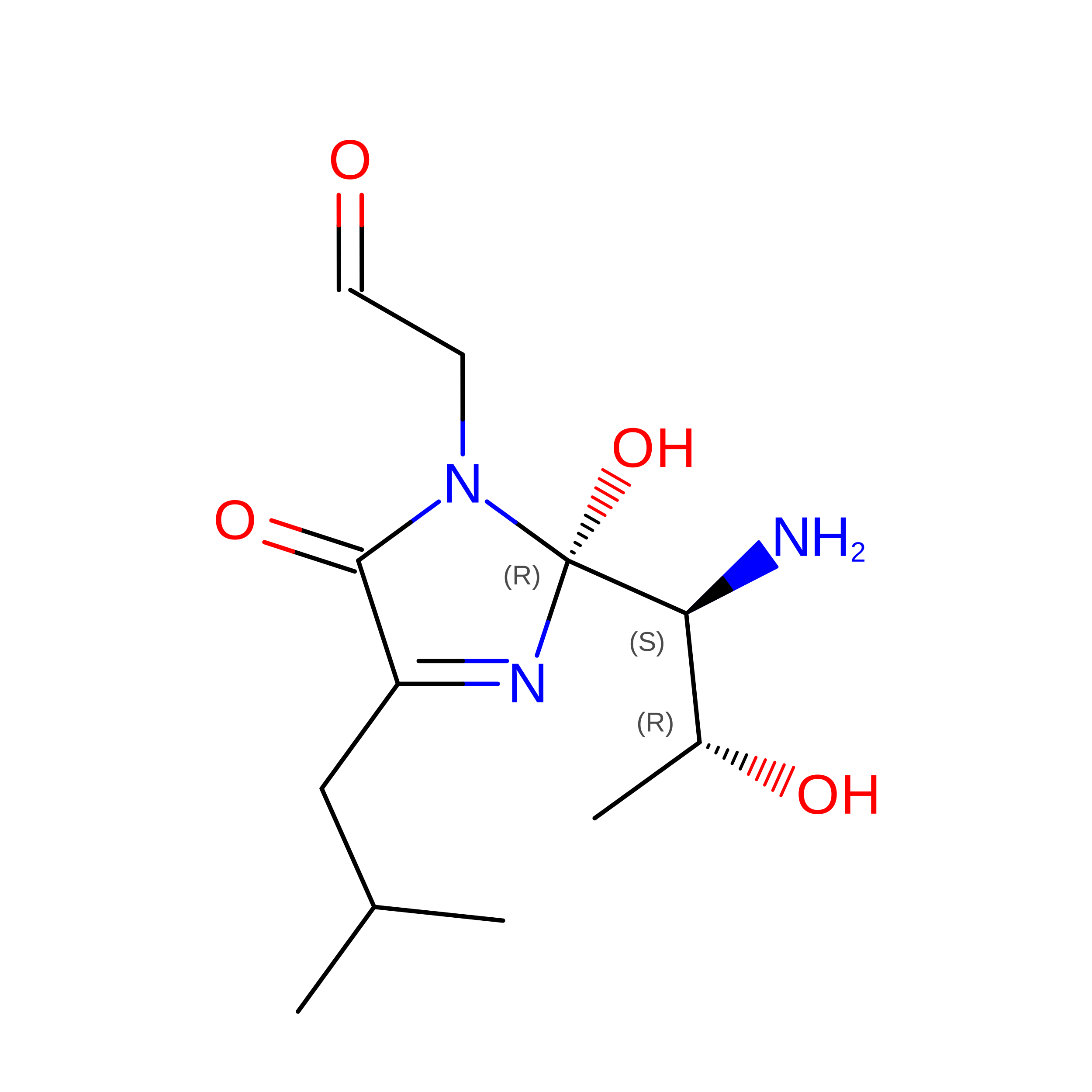
L-PEPTIDE LINKINGC12 H21 N3 O5THR, LEU, GLY

Experimental Data & Validation

Experimental Data

  • Method: X-RAY DIFFRACTION
  • Resolution: 1.50 Å
  • R-Value Free:  0.206 (Depositor), 0.188 (DCC) 
  • R-Value Work:  0.175 (Depositor), 0.174 (DCC) 
Space Group: P 21 21 21
Unit Cell:
Length ( Å )Angle ( ˚ )
a = 50.926α = 90
b = 62.464β = 90
c = 69.385γ = 90
Software Package:
Software NamePurpose
CNSrefinement
CRYSTALdata reduction
CCP4data scaling
CNSphasing

Structure Validation

View Full Validation Report


Entry History 

Deposition Data

Revision History  (Full details and data files)

  • Version 1.0: 2005-06-21
    Type: Initial release
  • Version 1.1: 2008-04-30
    Changes: Version format compliance
  • Version 1.2: 2011-07-13
    Changes: Version format compliance
  • Version 1.3: 2017-10-11
    Changes: Advisory
  • Version 1.4: 2018-04-04
    Changes: Data collection
  • Version 1.5: 2021-10-20
    Changes: Advisory, Database references, Derived calculations
  • Version 1.6: 2023-08-23
    Changes: Data collection, Refinement description
  • Version 1.7: 2023-11-15
    Changes: Data collection, Derived calculations
  • Version 2.0: 2024-07-10
    Changes: Data collection, Derived calculations, Non-polymer description, Structure summary
  • Version 2.1: 2024-11-20
    Changes: Structure summary
  • Version 3.0: 2026-03-18
    Changes: Polymer sequence