1WDA | pdb_00001wda

Crystal structure of human peptidylarginine deiminase type4 (PAD4) in complex with benzoyl-L-arginine amide


Experimental Data Snapshot

  • Method: X-RAY DIFFRACTION
  • Resolution: 2.30 Å
  • R-Value Free: 
    0.252 (Depositor), 0.250 (DCC) 
  • R-Value Work: 
    0.210 (Depositor), 0.213 (DCC) 
  • R-Value Observed: 
    0.215 (Depositor) 

wwPDB Validation 3D Report Full Report

Validation slider image for 1WDA

Ligand Structure Quality Assessment 


This is version 1.4 of the entry. See complete history

Literature

Structural basis for Ca(2+)-induced activation of human PAD4

Arita, K.Hashimoto, H.Shimizu, T.Nakashima, K.Yamada, M.Sato, M.

(2004) Nat Struct Mol Biol 11: 777-783

  • DOI: https://doi.org/10.1038/nsmb799
  • Primary Citation Related Structures: 
    1WD8, 1WD9, 1WDA

  • PubMed Abstract: 

    Peptidylarginine deiminase 4 (PAD4) is a Ca(2+)-dependent enzyme that catalyzes the conversion of protein arginine residues to citrulline. Its gene is a susceptibility locus for rheumatoid arthritis. Here we present the crystal structure of Ca(2+)-free wild-type PAD4, which shows that the polypeptide chain adopts an elongated fold in which the N-terminal domain forms two immunoglobulin-like subdomains, and the C-terminal domain forms an alpha/beta propeller structure. Five Ca(2+)-binding sites, none of which adopt an EF-hand motif, were identified in the structure of a Ca(2+)-bound inactive mutant with and without bound substrate. These structural data indicate that Ca(2+) binding induces conformational changes that generate the active site cleft. Our findings identify a novel mechanism for enzyme activation by Ca(2+) ions, and are important for understanding the mechanism of protein citrullination and for developing PAD-inhibiting drugs for the treatment of rheumatoid arthritis.


  • Organizational Affiliation
    • Graduate School of Integrated Science, Yokohama City University, 1-7-29 Suehiro-cho, Tsurumi-ku, Yokohama 230-0045, Japan.

Macromolecule Content 

  • Total Structure Weight: 75.55 kDa 
  • Atom Count: 5,145 
  • Modeled Residue Count: 628 
  • Deposited Residue Count: 670 
  • Unique protein chains: 1

Macromolecules

Find similar proteins by:|  3D Structure
Entity ID: 1
MoleculeChains  Sequence LengthOrganismDetailsImage
Protein-arginine deiminase type IV670Homo sapiensMutation(s): 1 
EC: 3.5.3.15
UniProt & NIH Common Fund Data Resources
Find proteins for Q9UM07 (Homo sapiens)
Explore Q9UM07 
Go to UniProtKB:  Q9UM07
PHAROS:  Q9UM07
GTEx:  ENSG00000159339 
Entity Groups
Sequence Clusters30% Identity50% Identity70% Identity90% Identity95% Identity100% Identity
UniProt GroupQ9UM07
Sequence Annotations
Expand
Reference Sequence

Small Molecules

Ligands 3 Unique
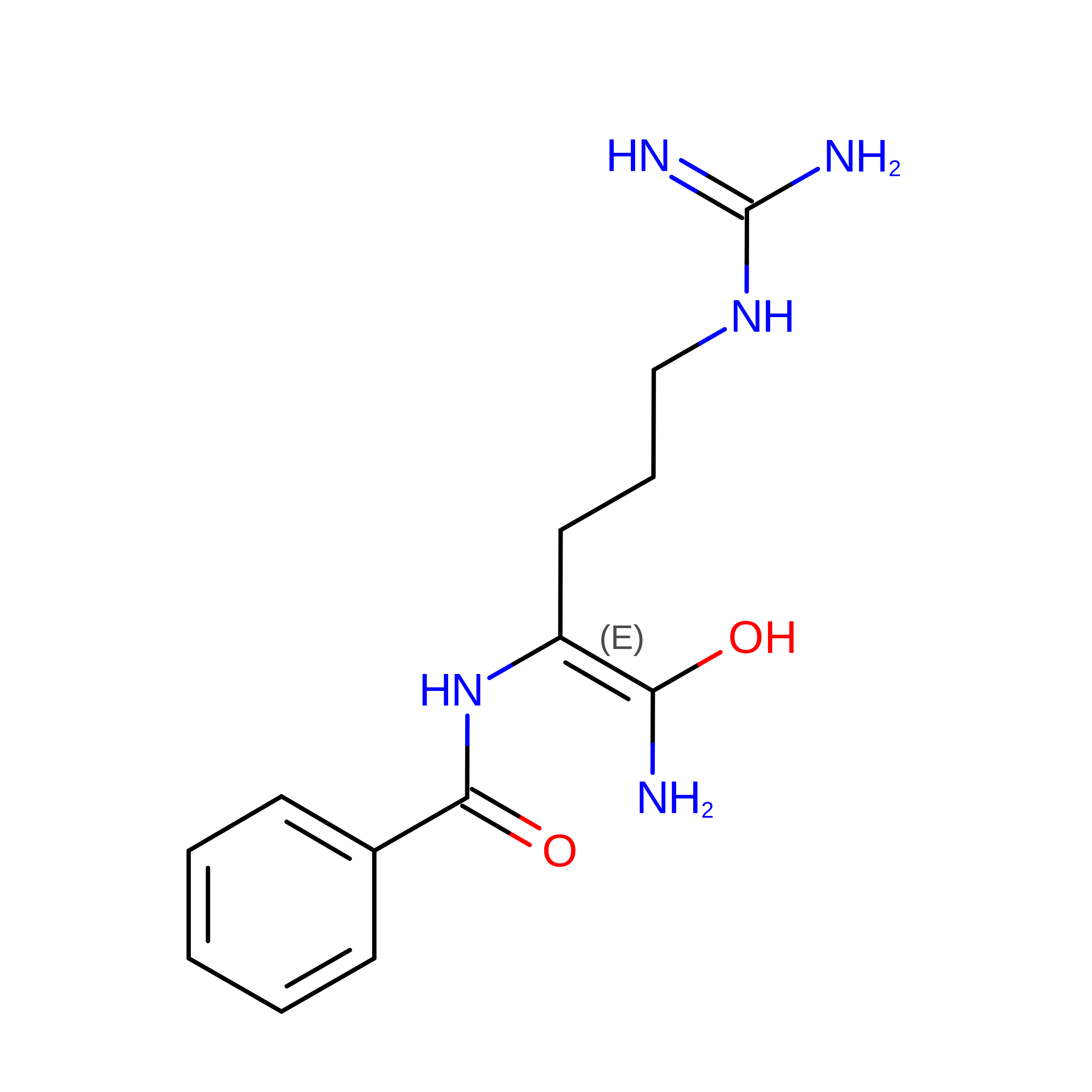
IDChains Name / Formula / InChI Key2D Diagram3D Interactions
BAG

Query on BAG


Download:Ideal Coordinates CCD File
J [auth A]N-[(E)-2-AMINO-1-(3-{[AMINO(IMINO)METHYL]AMINO}PROPYL)-2-HYDROXYVINYL]BENZAMIDE
C13 H19 N5 O2
YRINIXCRGISJPA-UHFFFAOYSA-N
SO4

Query on SO4


Download:Ideal Coordinates CCD File
G [auth A],
H [auth A],
I [auth A]
SULFATE ION
O4 S
QAOWNCQODCNURD-UHFFFAOYSA-L
CA

Query on CA


Download:Ideal Coordinates CCD File
B [auth A],
C [auth A],
D [auth A],
E [auth A],
F [auth A]
CALCIUM ION
Ca
BHPQYMZQTOCNFJ-UHFFFAOYSA-N

Experimental Data & Validation

Experimental Data

  • Method: X-RAY DIFFRACTION
  • Resolution: 2.30 Å
  • R-Value Free:  0.252 (Depositor), 0.250 (DCC) 
  • R-Value Work:  0.210 (Depositor), 0.213 (DCC) 
  • R-Value Observed: 0.215 (Depositor) 
Space Group: C 1 2 1
Unit Cell:
Length ( Å )Angle ( ˚ )
a = 146.133α = 90
b = 60.045β = 124.23
c = 115.406γ = 90
Software Package:
Software NamePurpose
REFMACrefinement
HKL-2000data reduction
SCALEPACKdata scaling
CNSphasing

Structure Validation

View Full Validation Report


Ligand Structure Quality Assessment 


Entry History 

Deposition Data

Revision History  (Full details and data files)

  • Version 1.0: 2004-07-13
    Type: Initial release
  • Version 1.1: 2008-04-30
    Changes: Version format compliance
  • Version 1.2: 2011-07-13
    Changes: Advisory, Version format compliance
  • Version 1.3: 2021-11-10
    Changes: Database references, Derived calculations
  • Version 1.4: 2024-05-29
    Changes: Data collection