1UN1 | pdb_00001un1

Xyloglucan endotransglycosylase native structure.


Experimental Data Snapshot

  • Method: X-RAY DIFFRACTION
  • Resolution: 2.10 Å
  • R-Value Free: 
    0.232 (Depositor), 0.239 (DCC) 
  • R-Value Work: 
    0.206 (Depositor), 0.215 (DCC) 
  • R-Value Observed: 
    0.208 (Depositor) 

wwPDB Validation 3D Report Full Report

Validation slider image for 1UN1

This is version 2.1 of the entry. See complete history

Literature

Crystal Structures of a Poplar Xyloglucan Endotransglycosylase Reveal Details of Transglycosylation Acceptor Binding

Johansson, P.Brumer, H.Baumann, M.Kallas, A.Henriksson, H.Denman, S.Teeri, T.T.Jones, T.A.

(2004) Plant Cell 16: 874

  • DOI: https://doi.org/10.1105/tpc.020065
  • Primary Citation Related Structures: 
    1UMZ, 1UN1

  • PubMed Abstract: 

    Xyloglucan endotransglycosylases (XETs) cleave and religate xyloglucan polymers in plant cell walls via a transglycosylation mechanism. Thus, XET is a key enzyme in all plant processes that require cell wall remodeling. To provide a basis for detailed structure-function studies, the crystal structure of Populus tremula x tremuloides XET16A (PttXET16A), heterologously expressed in Pichia pastoris, has been determined at 1.8-A resolution. Even though the overall structure of PttXET16A is a curved beta-sandwich similar to other enzymes in the glycoside hydrolase family GH16, parts of its substrate binding cleft are more reminiscent of the distantly related family GH7. In addition, XET has a C-terminal extension that packs against the conserved core, providing an additional beta-strand and a short alpha-helix. The structure of XET in complex with a xyloglucan nonasaccharide, XLLG, reveals a very favorable acceptor binding site, which is a necessary but not sufficient prerequisite for transglycosylation. Biochemical data imply that the enzyme requires sugar residues in both acceptor and donor sites to properly orient the glycosidic bond relative to the catalytic residues.


  • Organizational Affiliation
    • Department of Cell and Molecular Biology, Uppsala University, BMC, S-75124 Uppsala, Sweden.

Macromolecule Content 

  • Total Structure Weight: 66.43 kDa 
  • Atom Count: 4,695 
  • Modeled Residue Count: 531 
  • Deposited Residue Count: 556 
  • Unique protein chains: 1

Macromolecules

Find similar proteins by:|  3D Structure
Entity ID: 1
MoleculeChains  Sequence LengthOrganismDetailsImage
XYLOGLUCAN ENDOTRANSGLYCOSYLASE
A, B
278Populus tremulaMutation(s): 0 
EC: 2.4.1.207
UniProt
Find proteins for Q8GZD5 (Populus tremula x Populus tremuloides)
Explore Q8GZD5 
Go to UniProtKB:  Q8GZD5
Entity Groups
Sequence Clusters30% Identity50% Identity70% Identity90% Identity95% Identity100% Identity
UniProt GroupQ8GZD5
Glycosylation
Glycosylation Sites: 1
Sequence Annotations
Expand
Reference Sequence

Oligosaccharides

Help  
Entity ID: 2
MoleculeChains Length2D Diagram GlycosylationD Interactions
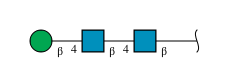
beta-D-mannopyranose-(1-4)-2-acetamido-2-deoxy-beta-D-glucopyranose-(1-4)-2-acetamido-2-deoxy-beta-D-glucopyranose
C, D
3N-Glycosylation
Glycosylation Resources
GlyTouCan: G15407YE
GlyCosmos: G15407YE
GlyGen: G15407YE

Small Molecules

Ligands 1 Unique
IDChains Name / Formula / InChI Key2D Diagram3D Interactions
AU

Query on AU


Download:Ideal Coordinates CCD File
E [auth B]GOLD ION
Au
ZBKIUFWVEIBQRT-UHFFFAOYSA-N

Experimental Data & Validation

Experimental Data

  • Method: X-RAY DIFFRACTION
  • Resolution: 2.10 Å
  • R-Value Free:  0.232 (Depositor), 0.239 (DCC) 
  • R-Value Work:  0.206 (Depositor), 0.215 (DCC) 
  • R-Value Observed: 0.208 (Depositor) 
Space Group: P 63
Unit Cell:
Length ( Å )Angle ( ˚ )
a = 188.762α = 90
b = 188.762β = 90
c = 45.973γ = 120
Software Package:
Software NamePurpose
REFMACrefinement
DENZOdata reduction
SCALEPACKdata scaling
RSPSphasing
MLPHAREphasing
SHARPphasing

Structure Validation

View Full Validation Report


Entry History 

Deposition Data

Revision History  (Full details and data files)

  • Version 1.0: 2004-03-18
    Type: Initial release
  • Version 1.1: 2011-05-08
    Changes: Version format compliance
  • Version 1.2: 2011-07-13
    Changes: Version format compliance
  • Version 2.0: 2020-07-29
    Type: Remediation
    Reason: Carbohydrate remediation
    Changes: Advisory, Atomic model, Data collection, Derived calculations, Other, Structure summary
  • Version 2.1: 2024-11-20
    Changes: Advisory, Data collection, Database references, Structure summary