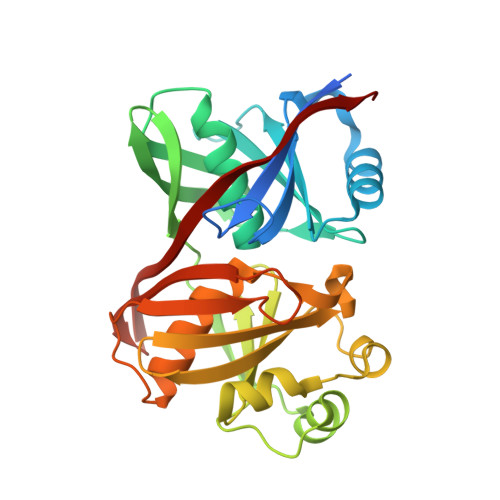
1U1W | pdb_00001u1w

Structure and function of phenazine-biosynthesis protein PhzF from Pseudomonas fluorescens 2-79


Experimental Data Snapshot

  • Method: X-RAY DIFFRACTION
  • Resolution: 1.35 Å
  • R-Value Free: 
    0.150 (Depositor), 0.170 (DCC) 
  • R-Value Work: 
    0.118 (Depositor), 0.144 (DCC) 
  • R-Value Observed: 
    0.120 (Depositor) 

Starting Model: experimental
View more details

wwPDB Validation 3D Report Full Report

Validation slider image for 1U1W

Ligand Structure Quality Assessment 


This is version 1.4 of the entry. See complete history

Literature

Structure and function of the phenazine biosynthetic protein PhzF from Pseudomonas fluorescens.

Blankenfeldt, W.Kuzin, A.P.Skarina, T.Korniyenko, Y.Tong, L.Bayer, P.Janning, P.Thomashow, L.S.Mavrodi, D.V.

(2004) Proc Natl Acad Sci U S A 101: 16431-16437

  • DOI: https://doi.org/10.1073/pnas.0407371101
  • Primary Citation Related Structures: 
    1SDJ, 1U1V, 1U1W, 1U1X, 1XUA, 1XUB

  • PubMed Abstract: 

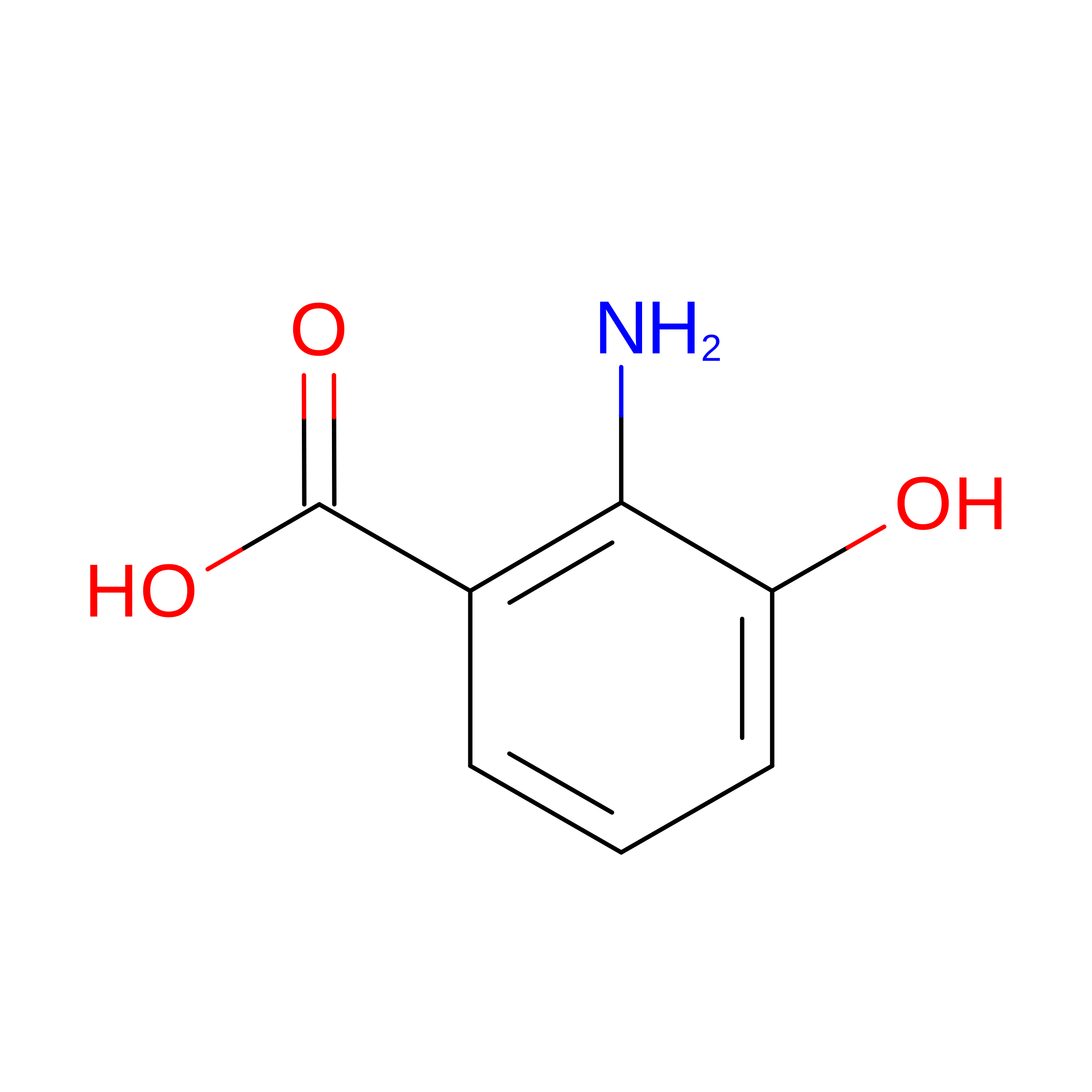
    Phenazines produced by Pseudomonas and Streptomyces spp. are heterocyclic nitrogen-containing metabolites with antibiotic, antitumor, and antiparasitic activity. The antibiotic properties of pyocyanin, produced by Pseudomonas aeruginosa, were recognized in the 1890s, although this blue phenazine is now known to be a virulence factor in human disease. Despite their biological significance, the biosynthesis of phenazines is not fully understood. Here we present structural and functional studies of PhzF, an enzyme essential for phenazine synthesis in Pseudomonas spp. PhzF shares topology with diaminopimelate epimerase DapF but lacks the same catalytic residues. The structure of PhzF in complex with its substrate, trans-2,3-dihydro-3-hydroxyanthranilic acid, suggests that it is an isomerase using the conserved glutamate E45 to abstract a proton from C3 of the substrate. The proton is returned to C1 of the substrate after rearrangement of the double-bond system, yielding an enol that converts to the corresponding ketone. PhzF is a dimer that may be bifunctional, providing a shielded cavity for ketone dimerization via double Schiff-base formation to produce the phenazine scaffold. Our proposed mechanism is supported by mass and NMR spectroscopy. The results are discussed in the context of related structures and protein sequences of unknown biochemical function.


  • Organizational Affiliation
    • Max Planck Institute of Molecular Physiology, Otto-Hahn-Strasse 11, 44227 Dortmund, Germany.

Macromolecule Content 

  • Total Structure Weight: 65.03 kDa 
  • Atom Count: 5,183 
  • Modeled Residue Count: 557 
  • Deposited Residue Count: 596 
  • Unique protein chains: 1

Macromolecules

Find similar proteins by:|  3D Structure
Entity ID: 1
MoleculeChains  Sequence LengthOrganismDetailsImage
Phenazine biosynthesis protein phzF
A, B
298Pseudomonas fluorescensMutation(s): 0 
Gene Names: phzF
EC: 5.3.3.17
UniProt
Find proteins for Q51792 (Pseudomonas fluorescens)
Explore Q51792 
Go to UniProtKB:  Q51792
Entity Groups
Sequence Clusters30% Identity50% Identity70% Identity90% Identity95% Identity100% Identity
UniProt GroupQ51792
Sequence Annotations
Expand
Reference Sequence

Experimental Data & Validation

Experimental Data

  • Method: X-RAY DIFFRACTION
  • Resolution: 1.35 Å
  • R-Value Free:  0.150 (Depositor), 0.170 (DCC) 
  • R-Value Work:  0.118 (Depositor), 0.144 (DCC) 
  • R-Value Observed: 0.120 (Depositor) 
Space Group: P 21 21 2
Unit Cell:
Length ( Å )Angle ( ˚ )
a = 92.6α = 90
b = 99.86β = 90
c = 57γ = 90
Software Package:
Software NamePurpose
REFMACrefinement
XDdata reduction
XDSdata scaling
MOLREPphasing

Structure Validation

View Full Validation Report


Ligand Structure Quality Assessment 


Entry History 

Deposition Data

Revision History  (Full details and data files)

  • Version 1.0: 2004-11-02
    Type: Initial release
  • Version 1.1: 2008-04-30
    Changes: Version format compliance
  • Version 1.2: 2011-07-13
    Changes: Non-polymer description, Version format compliance
  • Version 1.3: 2014-04-16
    Changes: Data collection
  • Version 1.4: 2023-08-23
    Changes: Data collection, Database references, Derived calculations, Refinement description