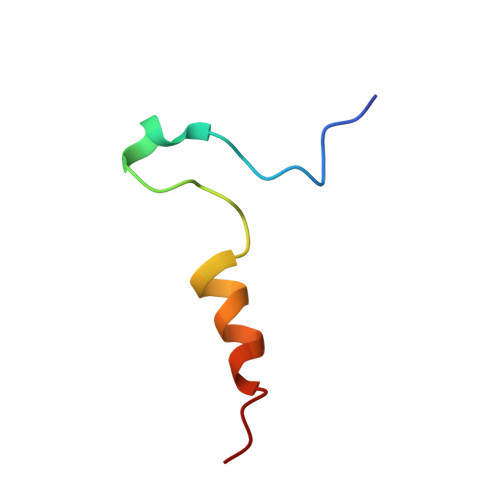
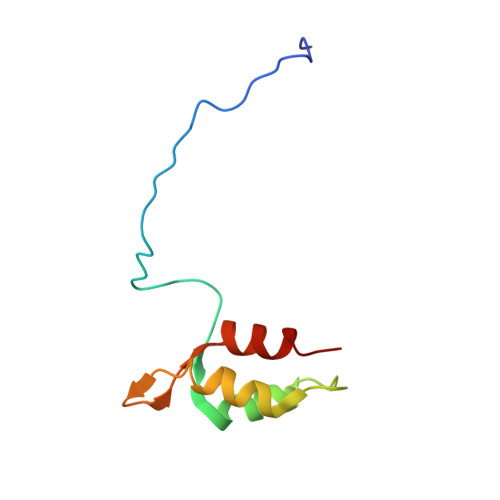
1SSE | pdb_00001sse

Solution structure of the oxidized form of the Yap1 redox domain


Experimental Data Snapshot

  • Method: SOLUTION NMR
  • Conformers Calculated: 100 
  • Conformers Submitted: 20 
  • Selection Criteria: Stuctures with the lowest energy and no NOE or dihedral violations > 0.5 A and 5 degrees, respectively. 

wwPDB Validation 3D Report Full Report

Validation slider image for 1SSE

This is version 1.4 of the entry. See complete history

Literature

Structural basis for redox regulation of Yap1 transcription factor localization.

Wood, M.J.Storz, G.Tjandra, N.

(2004) Nature 430: 917-921

  • DOI: https://doi.org/10.1038/nature02790
  • Primary Citation Related Structures: 
    1SSE

  • PubMed Abstract: 

    The ability of organisms to alter their gene expression patterns in response to environmental changes is essential for viability. A central regulator of the response to oxidative stress in Saccharomyces cerevisiae is the Yap1 transcription factor. Upon activation by increased levels of reactive oxygen species, Yap1 rapidly redistributes to the nucleus where it regulates the expression of up to 70 genes. Here we identify a redox-regulated domain of Yap1 and determine its high-resolution solution structure. In the active oxidized form, a nuclear export signal (NES) in the carboxy-terminal cysteine-rich domain is masked by disulphide-bond-mediated interactions with a conserved amino-terminal alpha-helix. Point mutations that weaken the hydrophobic interactions between the N-terminal alpha-helix and the C-terminal NES-containing domain abolished redox-regulated changes in subcellular localization of Yap1. Upon reduction of the disulphide bonds, Yap1 undergoes a change to an unstructured conformation that exposes the NES and allows redistribution to the cytoplasm. These results reveal the structural basis of redox-dependent Yap1 localization and provide a previously unknown mechanism of transcription factor regulation by reversible intramolecular disulphide bond formation.


  • Organizational Affiliation
    • Cell Biology and Metabolism Branch, National Institute of Child Health and Human Development, National Institutes of Health, Bethesda, Maryland 20892-5430, USA.

Macromolecule Content 

  • Total Structure Weight: 13.58 kDa 
  • Atom Count: 945 
  • Modeled Residue Count: 121 
  • Deposited Residue Count: 121 
  • Unique protein chains: 2

Macromolecules

Find similar proteins by:|  3D Structure
Entity ID: 1
MoleculeChains  Sequence LengthOrganismDetailsImage
AP-1 like transcription factor YAP135Saccharomyces cerevisiaeMutation(s): 0 
Gene Names: YAP1SNQ3PAR1PDR4YML007WYM9571.12
UniProt
Find proteins for P19880 (Saccharomyces cerevisiae (strain ATCC 204508 / S288c))
Explore P19880 
Go to UniProtKB:  P19880
Entity Groups
Sequence Clusters30% Identity50% Identity70% Identity90% Identity95% Identity100% Identity
UniProt GroupP19880
Sequence Annotations
Expand
Reference Sequence
Find similar proteins by:|  3D Structure
Entity ID: 2
MoleculeChains  Sequence LengthOrganismDetailsImage
AP-1 like transcription factor YAP186Saccharomyces cerevisiaeMutation(s): 0 
Gene Names: YAP1SNQ3PAR1PDR4YML007WYM9571.12
UniProt
Find proteins for P19880 (Saccharomyces cerevisiae (strain ATCC 204508 / S288c))
Explore P19880 
Go to UniProtKB:  P19880
Entity Groups
Sequence Clusters30% Identity50% Identity70% Identity90% Identity95% Identity100% Identity
UniProt GroupP19880
Sequence Annotations
Expand
Reference Sequence

Experimental Data & Validation

Experimental Data

  • Method: SOLUTION NMR
  • Conformers Calculated: 100 
  • Conformers Submitted: 20 
  • Selection Criteria: Stuctures with the lowest energy and no NOE or dihedral violations > 0.5 A and 5 degrees, respectively. 

Structure Validation

View Full Validation Report


Entry History 

Deposition Data

Revision History  (Full details and data files)

  • Version 1.0: 2004-08-31
    Type: Initial release
  • Version 1.1: 2008-04-29
    Changes: Version format compliance
  • Version 1.2: 2011-07-13
    Changes: Version format compliance
  • Version 1.3: 2022-03-02
    Changes: Data collection, Database references, Derived calculations
  • Version 1.4: 2024-11-20
    Changes: Data collection, Structure summary