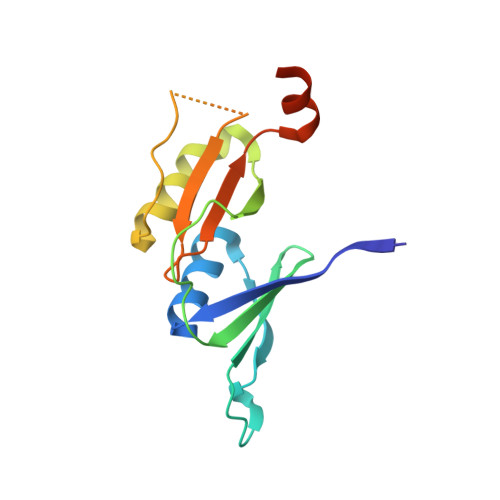
1R9C | pdb_00001r9c

Crystal Structure of Fosfomycin Resistance Protein FosX from Mesorhizobium Loti


Experimental Data Snapshot

  • Method: X-RAY DIFFRACTION
  • Resolution: 1.83 Å
  • R-Value Free: 
    0.243 (Depositor), 0.243 (DCC) 
  • R-Value Work: 
    0.202 (Depositor), 0.203 (DCC) 
  • R-Value Observed: 
    0.205 (Depositor) 

Starting Model: experimental
View more details

wwPDB Validation 3D Report Full Report

Validation slider image for 1R9C

This is version 1.3 of the entry. See complete history

Literature

Mechanistic diversity of fosfomycin resistance in pathogenic microorganisms.

Fillgrove, K.L.Pakhomova, S.Newcomer, M.E.Armstrong, R.N.

(2003) J Am Chem Soc 125: 15730-15731

  • DOI: https://doi.org/10.1021/ja039307z
  • Primary Citation Related Structures: 
    1R9C

  • PubMed Abstract: 

    Microbial resistance to the antibiotic fosfomycin [(1R,2S)-epoxypropylphosphonic acid, 1] is known to be mediated by thiol transferase enzymes FosA and FosB, which catalyze the addition of glutathione and l-cysteine to C1 of the oxirane, respectively. A probe of the microbial genome database reveals a related group of enzymes (FosX). The genes mlr3345 from Mesorhizobium loti and lmo1702 from Listeria monocytogenes were cloned and the proteins expressed. This heretofore unrecognized group of enzymes is shown to catalyze the Mn(II)-dependent addition of water to C1 of the oxirane. The ability of each enzyme to confer resistance in Escherichia coli is correlated with their catalytic efficiency, such that the M. loti protein confers low resistance while the Listeria enzyme confers very robust resistance. The crystal structure of the FosX from M. loti was solved at a resolution of 1.83 A. The structure reveals an active-site carboxylate (E44) located about 5 A from the expected position of the substrate that appears to be poised to participate in catalysis. Single turnover experiments in H218O and kinetic analysis of the E44G mutant of the FosX enzymes indicate that the carboxylate of E44 acts as a general base in the direct addition of water to 1. The FosX from M. loti also catalyzes the addition of glutathione to the antibiotic. The catalytic promiscuity and low efficiency of the M. loti protein suggest that it may be an intermediate in the evolution of clinically relevant fosfomycin resistance proteins such as the FosX from Listeria monocytogenese.


  • Organizational Affiliation
    • Departments of Biochemistry and Chemistry, Vanderbilt University, Nashville, Tennessee 37232-0146, USA.

Macromolecule Content 

  • Total Structure Weight: 32.52 kDa 
  • Atom Count: 2,073 
  • Modeled Residue Count: 243 
  • Deposited Residue Count: 278 
  • Unique protein chains: 1

Macromolecules

Find similar proteins by:|  3D Structure
Entity ID: 1
MoleculeChains  Sequence LengthOrganismDetailsImage
glutathione transferase
A, B
139Mesorhizobium lotiMutation(s): 0 
Gene Names: fosfomycin resistance protein
EC: 2.5.1.1
UniProt
Find proteins for Q98GG1 (Mesorhizobium japonicum (strain LMG 29417 / CECT 9101 / MAFF 303099))
Explore Q98GG1 
Go to UniProtKB:  Q98GG1
Entity Groups
Sequence Clusters30% Identity50% Identity70% Identity90% Identity95% Identity100% Identity
UniProt GroupQ98GG1
Sequence Annotations
Expand
Reference Sequence

Experimental Data & Validation

Experimental Data

  • Method: X-RAY DIFFRACTION
  • Resolution: 1.83 Å
  • R-Value Free:  0.243 (Depositor), 0.243 (DCC) 
  • R-Value Work:  0.202 (Depositor), 0.203 (DCC) 
  • R-Value Observed: 0.205 (Depositor) 
Space Group: P 21 21 2
Unit Cell:
Length ( Å )Angle ( ˚ )
a = 45.034α = 90
b = 84.024β = 90
c = 66.861γ = 90
Software Package:
Software NamePurpose
REFMACrefinement
DENZOdata reduction
SCALEPACKdata scaling
CNSphasing

Structure Validation

View Full Validation Report


Entry History 

Deposition Data

Revision History  (Full details and data files)

  • Version 1.0: 2004-02-10
    Type: Initial release
  • Version 1.1: 2008-04-29
    Changes: Version format compliance
  • Version 1.2: 2011-07-13
    Changes: Advisory, Version format compliance
  • Version 1.3: 2023-08-23
    Changes: Data collection, Database references, Derived calculations, Refinement description