1R6Z | pdb_00001r6z

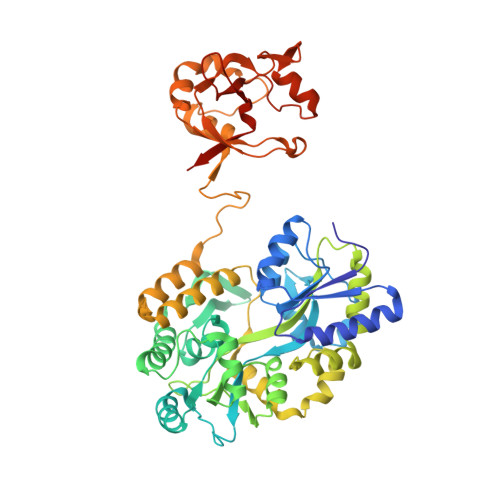
The Crystal Structure of the Argonaute2 PAZ domain (as a MBP fusion)


Experimental Data Snapshot

  • Method: X-RAY DIFFRACTION
  • Resolution: 2.80 Å
  • R-Value Free: 
    0.281 (Depositor), 0.232 (DCC) 
  • R-Value Work: 
    0.227 (Depositor), 0.240 (DCC) 

Starting Model: experimental
View more details

wwPDB Validation 3D Report Full Report

Validation slider image for 1R6Z

This is version 2.1 of the entry. See complete history

Literature

The crystal structure of the Argonaute2 PAZ domain reveals an RNA binding motif in RNAi effector complexes.

Song, J.J.Liu, J.Tolia, N.H.Schneiderman, J.Smith, S.K.Martienssen, R.A.Hannon, G.J.Joshua-Tor, L.

(2003) Nat Struct Biol 10: 1026-1032

  • DOI: https://doi.org/10.1038/nsb1016
  • Primary Citation Related Structures: 
    1R6Z

  • PubMed Abstract: 

    RISC, the RNA-induced silencing complex, uses short interfering RNAs (siRNAs) or micro RNAs (miRNAs) to select its targets in a sequence-dependent manner. Key RISC components are Argonaute proteins, which contain two characteristic domains, PAZ and PIWI. PAZ is highly conserved and is found only in Argonaute proteins and Dicer. We have solved the crystal structure of the PAZ domain of Drosophila Argonaute2. The PAZ domain contains a variant of the OB fold, a module that often binds single-stranded nucleic acids. PAZ domains show low-affinity nucleic acid binding, probably interacting with the 3' ends of single-stranded regions of RNA. PAZ can bind the characteristic two-base 3' overhangs of siRNAs, indicating that although PAZ may not be a primary nucleic acid binding site in Dicer or RISC, it may contribute to the specific and productive incorporation of siRNAs and miRNAs into the RNAi pathway.


  • Organizational Affiliation
    • Cold Spring Harbor Laboratory, Watson School of Biological Sciences, 1 Bungtown Road, Cold Spring Harbor, New York 11724, USA.

Macromolecule Content 

  • Total Structure Weight: 170.96 kDa 
  • Atom Count: 11,834 
  • Modeled Residue Count: 1,494 
  • Deposited Residue Count: 1,527 
  • Unique protein chains: 1

Macromolecules

Find similar proteins by:|  3D Structure
Entity ID: 1
MoleculeChains  Sequence LengthOrganismDetailsImage
Chimera of Maltose-binding periplasmic protein and Argonaute 2A [auth P],
B [auth A],
C [auth Z]
509Escherichia coliDrosophila melanogaster
This entity is chimeric
Mutation(s): 0 
Gene Names: MALEArgonaute 2 CG7439-PB
UniProt
Find proteins for P0AEX9 (Escherichia coli (strain K12))
Explore P0AEX9 
Go to UniProtKB:  P0AEX9
Find proteins for Q9VUQ5 (Drosophila melanogaster)
Explore Q9VUQ5 
Go to UniProtKB:  Q9VUQ5
Entity Groups
Sequence Clusters30% Identity50% Identity70% Identity90% Identity95% Identity100% Identity
UniProt GroupsP0AEX9Q9VUQ5
Sequence Annotations
Expand
Reference Sequence

Oligosaccharides

Help  
Entity ID: 2
MoleculeChains Length2D Diagram GlycosylationD Interactions
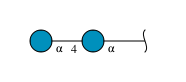
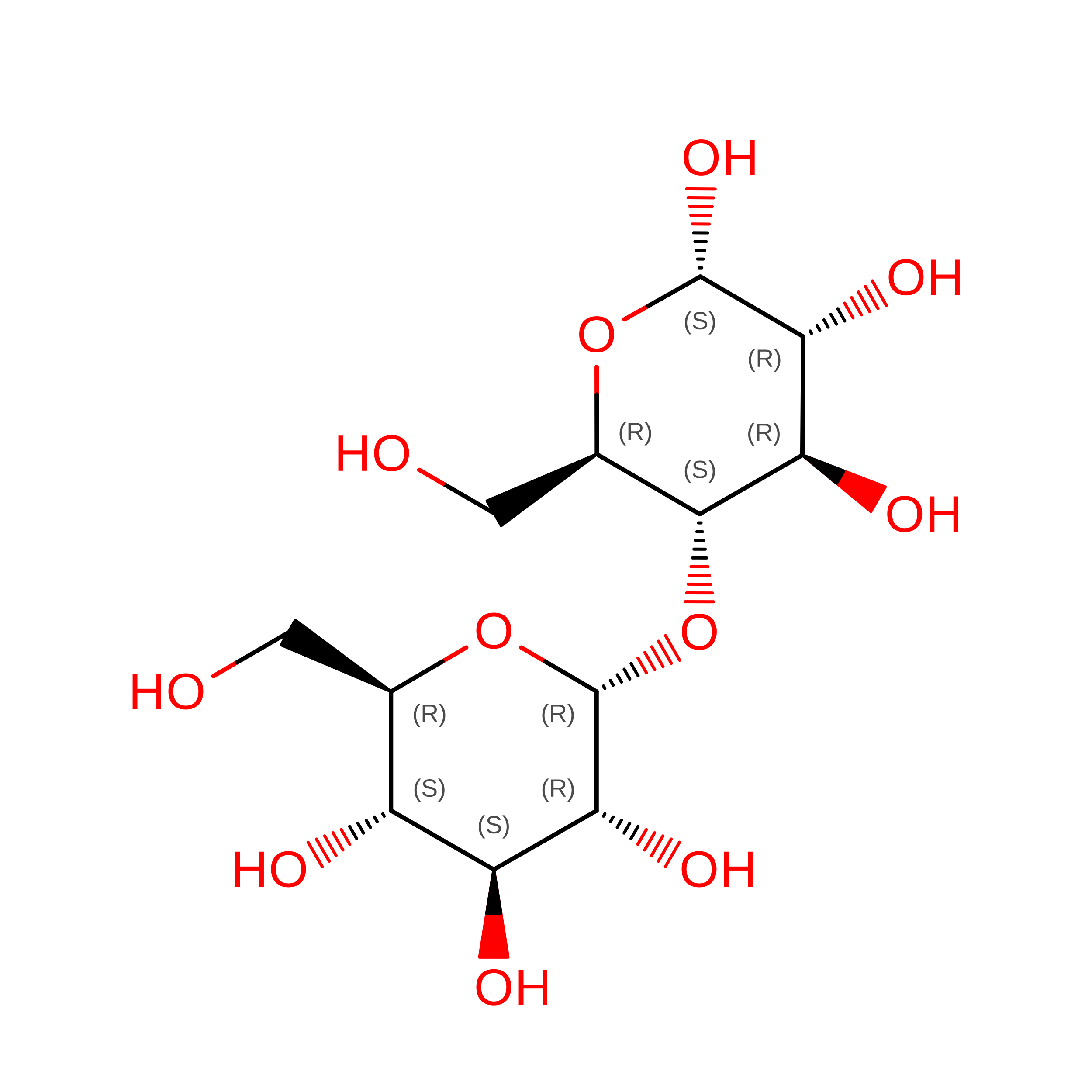
alpha-D-glucopyranose-(1-4)-alpha-D-glucopyranoseD [auth B],
E [auth C],
F [auth D]
2N/A
Glycosylation Resources
GlyTouCan: G07411ON
GlyCosmos: G07411ON

Small Molecules

Ligands 1 Unique
IDChains Name / Formula / InChI Key2D Diagram3D Interactions
NI

Query on NI


Download:Ideal Coordinates CCD File
G [auth P]
H [auth P]
I [auth P]
J [auth A]
K [auth A]
G [auth P],
H [auth P],
I [auth P],
J [auth A],
K [auth A],
L [auth A],
M [auth Z],
N [auth Z],
O [auth Z]
NICKEL (II) ION
Ni
VEQPNABPJHWNSG-UHFFFAOYSA-N

Biologically Interesting Molecules (External Reference) 

1 Unique

Experimental Data & Validation

Experimental Data

  • Method: X-RAY DIFFRACTION
  • Resolution: 2.80 Å
  • R-Value Free:  0.281 (Depositor), 0.232 (DCC) 
  • R-Value Work:  0.227 (Depositor), 0.240 (DCC) 
Space Group: P 65
Unit Cell:
Length ( Å )Angle ( ˚ )
a = 89.811α = 90
b = 89.811β = 90
c = 380.326γ = 120
Software Package:
Software NamePurpose
HKL-2000data collection
SCALEPACKdata scaling
AMoREphasing
CNSrefinement
HKL-2000data reduction

Structure Validation

View Full Validation Report


Entry History 

Deposition Data

Revision History  (Full details and data files)

  • Version 1.0: 2004-01-13
    Type: Initial release
  • Version 1.1: 2008-04-29
    Changes: Version format compliance
  • Version 1.2: 2011-07-13
    Changes: Derived calculations, Version format compliance
  • Version 1.3: 2017-08-16
    Changes: Refinement description, Source and taxonomy
  • Version 2.0: 2020-07-29
    Type: Remediation
    Reason: Carbohydrate remediation
    Changes: Atomic model, Data collection, Database references, Derived calculations, Non-polymer description, Structure summary
  • Version 2.1: 2023-08-23
    Changes: Data collection, Database references, Refinement description, Structure summary