1QZZ | pdb_00001qzz

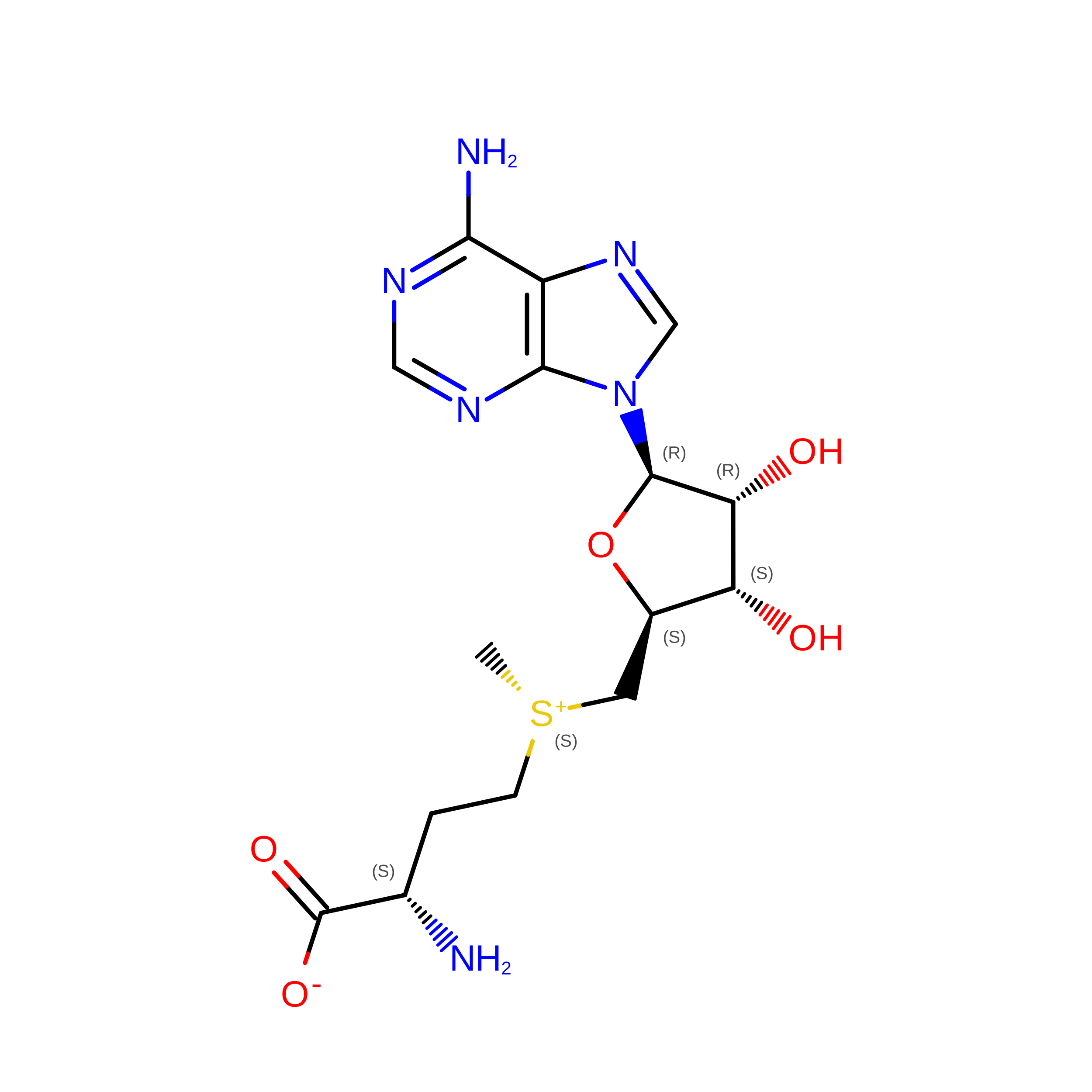
Crystal structure of aclacinomycin-10-hydroxylase (RdmB) in complex with S-adenosyl-L-methionine (SAM)


Experimental Data Snapshot

  • Method: X-RAY DIFFRACTION
  • Resolution: 2.10 Å
  • R-Value Free: 
    0.275 (Depositor), 0.275 (DCC) 
  • R-Value Work: 
    0.204 (Depositor), 0.211 (DCC) 
  • R-Value Observed: 
    0.210 (Depositor) 

wwPDB Validation 3D Report Full Report

Validation slider image for 1QZZ

Ligand Structure Quality Assessment 


This is version 1.4 of the entry. See complete history

Literature

Crystal Structure of Aclacinomycin-10-Hydroxylase, a S-Adenosyl-L-Methionine-dependent Methyltransferase Homolog Involved in Anthracycline Biosynthesis in Streptomyces purpurascens.

Jansson, A.Niemi, J.Lindqvist, Y.Mantsala, P.Schneider, G.

(2003) J Mol Biology 334: 269-280

  • DOI: https://doi.org/10.1016/j.jmb.2003.09.061
  • Primary Citation Related Structures: 
    1QZZ, 1R00

  • PubMed Abstract: 

    Anthracyclines are aromatic polyketide antibiotics, and several of these compounds are widely used as anti-tumor drugs in chemotherapy. Aclacinomycin-10-hydroxylase (RdmB) is one of the tailoring enzymes that modify the polyketide backbone in the biosynthesis of these metabolites. RdmB, a S-adenosyl-L-methionine-dependent methyltransferase homolog, catalyses the hydroxylation of 15-demethoxy-epsilon-rhodomycin to beta-rhodomycin, one step in rhodomycin biosynthesis in Streptomyces purpurascens. The crystal structure of RdmB, determined by multiwavelength anomalous diffraction to 2.1A resolution, reveals that the enzyme subunit has a fold similar to methyltransferases and binds S-adenosyl-L-methionine. The N-terminal domain, which consists almost exclusively of alpha-helices, is involved in dimerization. The C-terminal domain contains a typical alpha/beta nucleotide-binding fold, which binds S-adenosyl-L-methionine, and several of the residues interacting with the cofactor are conserved in O-methyltransferases. Adjacent to the S-adenosyl-L-methionine molecule there is a large cleft extending to the enzyme surface of sufficient size to bind the substrate. Analysis of the putative substrate-binding pocket suggests that there is no enzymatic group in proximity of the substrate 15-demethoxy-epsilon-rhodomycin, which could assist in proton abstraction and thus facilitate methyl transfer. The lack of a suitably positioned catalytic base might thus be one of the features responsible for the inability of the enzyme to act as a methyltransferase.


  • Organizational Affiliation
    • Molecular Structural Biology, Department of Medical Biochemistry and Biophysics, Karolinska Institutet, S-171 77 Stockholm, Sweden.

Macromolecule Content 

  • Total Structure Weight: 40.3 kDa 
  • Atom Count: 2,867 
  • Modeled Residue Count: 340 
  • Deposited Residue Count: 374 
  • Unique protein chains: 1

Macromolecules

Find similar proteins by:|  3D Structure
Entity ID: 1
MoleculeChains  Sequence LengthOrganismDetailsImage
aclacinomycin-10-hydroxylase374Streptomyces purpurascensMutation(s): 0 
Gene Names: rdmb
EC: 2.1.1 (UniProt), 4.1.1 (UniProt)
UniProt
Find proteins for Q54527 (Streptomyces purpurascens)
Explore Q54527 
Go to UniProtKB:  Q54527
Entity Groups
Sequence Clusters30% Identity50% Identity70% Identity90% Identity95% Identity100% Identity
UniProt GroupQ54527
Sequence Annotations
Expand
Reference Sequence

Experimental Data & Validation

Experimental Data

  • Method: X-RAY DIFFRACTION
  • Resolution: 2.10 Å
  • R-Value Free:  0.275 (Depositor), 0.275 (DCC) 
  • R-Value Work:  0.204 (Depositor), 0.211 (DCC) 
  • R-Value Observed: 0.210 (Depositor) 
Space Group: C 2 2 21
Unit Cell:
Length ( Å )Angle ( ˚ )
a = 63.12α = 90
b = 92.13β = 90
c = 115.33γ = 90
Software Package:
Software NamePurpose
DENZOdata reduction
SCALEPACKdata scaling
SOLVEphasing
REFMACrefinement

Structure Validation

View Full Validation Report


Ligand Structure Quality Assessment 


Entry History 

Deposition Data

Revision History  (Full details and data files)

  • Version 1.0: 2003-11-25
    Type: Initial release
  • Version 1.1: 2008-04-29
    Changes: Version format compliance
  • Version 1.2: 2011-07-13
    Changes: Derived calculations, Version format compliance
  • Version 1.3: 2018-02-28
    Changes: Advisory, Structure summary
  • Version 1.4: 2024-02-14
    Changes: Advisory, Data collection, Database references, Derived calculations