1Q6H | pdb_00001q6h

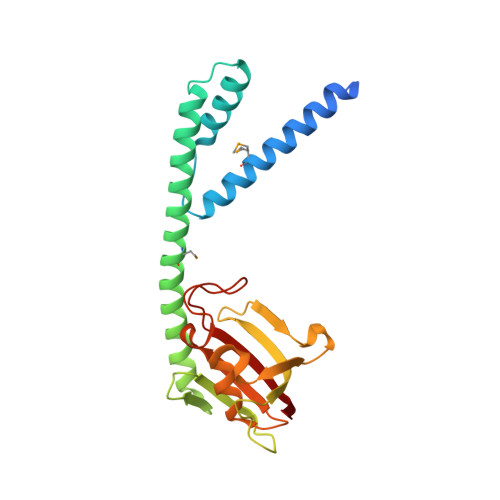
Crystal structure of a truncated form of FkpA from Escherichia coli


Experimental Data Snapshot

  • Method: X-RAY DIFFRACTION
  • Resolution: 1.97 Å
  • R-Value Free: 
    0.229 (Depositor), 0.250 (DCC) 
  • R-Value Work: 
    0.182 (Depositor), 0.197 (DCC) 
  • R-Value Observed: 
    0.184 (Depositor) 

Starting Model: experimental
View more details

wwPDB Validation 3D Report Full Report

Validation slider image for 1Q6H

This is version 1.4 of the entry. See complete history

Literature

Structural and functional studies of FkpA from Escherichia coli, a cis/trans peptidyl-prolyl isomerase with chaperone activity.

Saul, F.A.Arie, J.P.Vulliez-le Normand, B.Kahn, R.Betton, J.M.Bentley, G.A.

(2004) J Mol Biology 335: 595-608

  • DOI: https://doi.org/10.1016/j.jmb.2003.10.056
  • Primary Citation Related Structures: 
    1Q6H, 1Q6I, 1Q6U

  • PubMed Abstract: 

    The protein FkpA from the periplasm of Escherichia coli exhibits both cis/trans peptidyl-prolyl isomerase (PPIase) and chaperone activities. The crystal structure of the protein has been determined in three different forms: as the full-length native molecule, as a truncated form lacking the last 21 residues, and as the same truncated form in complex with the immunosuppressant ligand, FK506. FkpA is a dimeric molecule in which the 245-residue subunit is divided into two domains. The N-terminal domain includes three helices that are interlaced with those of the other subunit to provide all inter-subunit contacts maintaining the dimeric species. The C-terminal domain, which belongs to the FK506-binding protein (FKBP) family, binds the FK506 ligand. The overall form of the dimer is V-shaped, and the different crystal structures reveal a flexibility in the relative orientation of the two C-terminal domains located at the extremities of the V. The deletion mutant FkpNL, comprising the N-terminal domain only, exists in solution as a mixture of monomeric and dimeric species, and exhibits chaperone activity. By contrast, a deletion mutant comprising the C-terminal domain only is monomeric, and although it shows PPIase activity, it is devoid of chaperone function. These results suggest that the chaperone and catalytic activities reside in the N and C-terminal domains, respectively. Accordingly, the observed mobility of the C-terminal domains of the dimeric molecule could effectively adapt these two independent folding functions of FkpA to polypeptide substrates.


  • Organizational Affiliation
    • Unité d'Immunologie Structurale (C.N.R.S. U.R.A. 2185), Institut Pasteur, 25 rue du Dr Roux, 75724 Paris cedex 15, France.

Macromolecule Content 

  • Total Structure Weight: 48.58 kDa 
  • Atom Count: 3,700 
  • Modeled Residue Count: 420 
  • Deposited Residue Count: 448 
  • Unique protein chains: 1

Macromolecules

Find similar proteins by:|  3D Structure
Entity ID: 1
MoleculeChains  Sequence LengthOrganismDetailsImage
FKBP-type peptidyl-prolyl cis-trans isomerase fkpA
A, B
224Escherichia coliMutation(s): 2 
Gene Names: FKPA OR B3347
EC: 5.2.1.8
UniProt
Find proteins for P45523 (Escherichia coli (strain K12))
Explore P45523 
Go to UniProtKB:  P45523
Entity Groups
Sequence Clusters30% Identity50% Identity70% Identity90% Identity95% Identity100% Identity
UniProt GroupP45523
Sequence Annotations
Expand
Reference Sequence

Small Molecules

Modified Residues  1 Unique
IDChains TypeFormula2D DiagramParent
MSE
Query on MSE
A, B
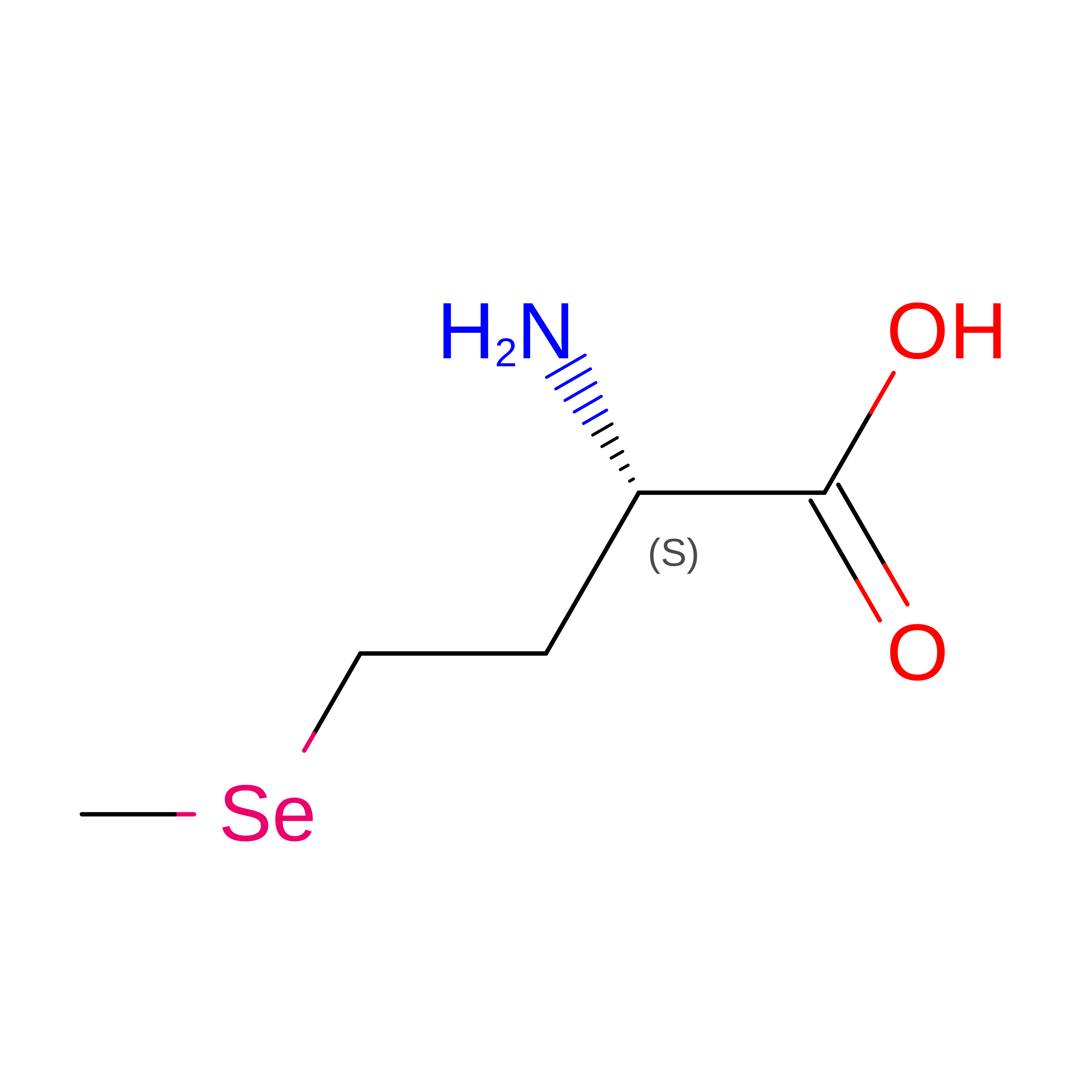
L-PEPTIDE LINKINGC5 H11 N O2 SeMET

Experimental Data & Validation

Experimental Data

  • Method: X-RAY DIFFRACTION
  • Resolution: 1.97 Å
  • R-Value Free:  0.229 (Depositor), 0.250 (DCC) 
  • R-Value Work:  0.182 (Depositor), 0.197 (DCC) 
  • R-Value Observed: 0.184 (Depositor) 
Space Group: P 21 21 21
Unit Cell:
Length ( Å )Angle ( ˚ )
a = 37.03α = 90
b = 85.23β = 90
c = 160.74γ = 90
Software Package:
Software NamePurpose
REFMACrefinement
DENZOdata reduction
CCP4data scaling
AMoREphasing

Structure Validation

View Full Validation Report


Entry History 

Deposition Data

Revision History  (Full details and data files)

  • Version 1.0: 2004-01-13
    Type: Initial release
  • Version 1.1: 2008-04-29
    Changes: Version format compliance
  • Version 1.2: 2011-07-13
    Changes: Advisory, Version format compliance
  • Version 1.3: 2024-04-03
    Changes: Data collection, Database references, Derived calculations, Refinement description
  • Version 1.4: 2024-10-09
    Changes: Structure summary