1PUO | pdb_00001puo

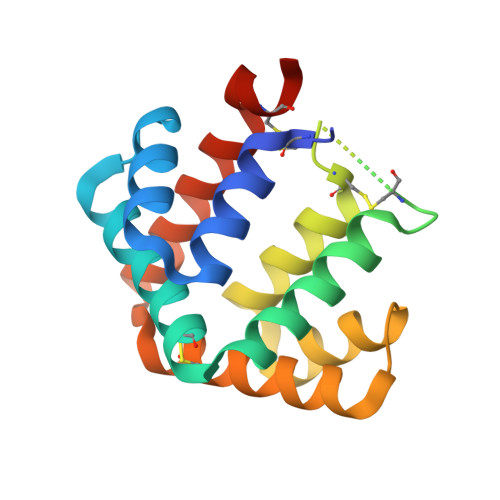
Crystal structure of Fel d 1- the major cat allergen


Experimental Data Snapshot

  • Method: X-RAY DIFFRACTION
  • Resolution: 1.85 Å
  • R-Value Free: 
    0.237 (Depositor), 0.244 (DCC) 
  • R-Value Work: 
    0.201 (Depositor) 
  • R-Value Observed: 
    0.203 (Depositor) 

wwPDB Validation 3D Report Full Report

Validation slider image for 1PUO

This is version 1.5 of the entry. See complete history

Literature

The crystal structure of the major cat allergen Fel d 1, a member of the secretoglobin family.

Kaiser, L.Gronlund, H.Sandalova, T.Ljunggren, H.G.van Hage-Hamsten, M.Achour, A.Schneider, G.

(2003) J Biological Chem 278: 37730-37735

  • DOI: https://doi.org/10.1074/jbc.M304740200
  • Primary Citation Related Structures: 
    1PUO

  • PubMed Abstract: 

    The domestic cat (Felis domesticus) is one of the most important causes of allergic asthma worldwide. The dominating cat allergen, Fel d 1, is composed of two heterodimers. Recently, it has been shown that recombinant Fel d 1, consisting of chain 2 and chain 1 fused together without additional linker, has immunological properties indistinguishable from the natural heterodimeric protein. Herein, we report the crystal structure of recombinant monomeric Fel d 1 at 1.85-A resolution, determined by multi-wavelength anomalous diffraction using selenomethionine substituted protein. Fel d 1 is an all-helical protein and consists of eight helices. The two halves of the recombinant Fel d 1 molecule, corresponding to the wild-type Fel d 1 chains, are very similar in three-dimensional structure, despite the lack of significant sequence identity. The structure of the Fel d 1 presents a striking similarity to that of uteroglobin, a steroid-inducible cytokine-like molecule with anti-inflammatory and immunomodulatory properties. An internal, asymmetric cavity is formed in the Fel d 1 that could bind an endogenous ligand. The distribution of residues lining this cavity suggests that such a ligand must be amphipathic. The structure of Fel d 1 displays the localization of three previously defined Fel d 1 IgE epitopes on the surface of the protein. The three-dimensional structure provides a framework for rational design of hypoallergenic mutants aimed for treatment of cat allergy.


  • Organizational Affiliation
    • Department of Medicine, Unit of Clinical Immunology and Allergy, Karolinska Institutet and Hospital L2:04, S-171 76 Stockholm, Sweden.

Macromolecule Content 

  • Total Structure Weight: 38.62 kDa 
  • Atom Count: 2,467 
  • Modeled Residue Count: 283 
  • Deposited Residue Count: 340 
  • Unique protein chains: 1

Macromolecules

Find similar proteins by:|  3D Structure
Entity ID: 1
MoleculeChains  Sequence LengthOrganismDetailsImage
Major allergen I polypeptide, fused chain 2, chain 1
A, B
170Felis catusMutation(s): 0 
Gene Names: CH2CH1
Membrane Entity: Yes 
UniProt
Find proteins for P30438 (Felis catus)
Explore P30438 
Go to UniProtKB:  P30438
Find proteins for P30440 (Felis catus)
Explore P30440 
Go to UniProtKB:  P30440
Entity Groups
Sequence Clusters30% Identity50% Identity70% Identity90% Identity95% Identity100% Identity
UniProt GroupsP30438P30440
Sequence Annotations
Expand
Reference Sequence

Experimental Data & Validation

Experimental Data

  • Method: X-RAY DIFFRACTION
  • Resolution: 1.85 Å
  • R-Value Free:  0.237 (Depositor), 0.244 (DCC) 
  • R-Value Work:  0.201 (Depositor) 
  • R-Value Observed: 0.203 (Depositor) 
Space Group: P 1 21 1
Unit Cell:
Length ( Å )Angle ( ˚ )
a = 43.29α = 90
b = 51.539β = 95.27
c = 67.725γ = 90
Software Package:
Software NamePurpose
REFMACrefinement
MOSFLMdata reduction
CCP4data scaling
SOLVEphasing
RESOLVEphasing

Structure Validation

View Full Validation Report


Entry History 

Deposition Data

Revision History  (Full details and data files)

  • Version 1.0: 2003-10-14
    Type: Initial release
  • Version 1.1: 2008-04-29
    Changes: Version format compliance
  • Version 1.2: 2011-07-13
    Changes: Version format compliance
  • Version 1.3: 2017-08-02
    Changes: Data collection, Refinement description, Source and taxonomy
  • Version 1.4: 2019-07-03
    Changes: Advisory, Author supporting evidence, Data collection, Derived calculations
  • Version 1.5: 2024-10-30
    Changes: Data collection, Database references, Derived calculations, Refinement description, Structure summary