1L3T | pdb_00001l3t

Crystal Structure of Bacillus DNA Polymerase I Fragment product complex with 10 base pairs of duplex DNA following addition of a single dTTP residue


Experimental Data Snapshot

  • Method: X-RAY DIFFRACTION
  • Resolution: 1.70 Å
  • R-Value Free: 
    0.231 (Depositor), 0.232 (DCC) 
  • R-Value Work: 
    0.206 (Depositor), 0.207 (DCC) 
  • R-Value Observed: 
    0.207 (Depositor) 

Starting Model: experimental
View more details

wwPDB Validation 3D Report Full Report

Validation slider image for 1L3T

This is version 2.1 of the entry. See complete history

Literature

Processive DNA synthesis observed in a polymerase crystal suggests a mechanism for the prevention of frameshift mutations

Johnson, S.J.Taylor, J.S.Beese, L.S.

(2003) Proc Natl Acad Sci U S A 100: 3895-3900

  • DOI: https://doi.org/10.1073/pnas.0630532100
  • Primary Citation Related Structures: 
    1L3S, 1L3T, 1L3U, 1L3V, 1L5U, 1LV5

  • PubMed Abstract: 

    DNA polymerases replicate DNA by adding nucleotides to a growing primer strand while avoiding frameshift and point mutations. Here we present a series of up to six successive replication events that were obtained by extension of a primed template directly in a crystal of the thermostable Bacillus DNA polymerase I. The 6-bp extension involves a 20-A translocation of the DNA duplex, representing the largest molecular movement observed in a protein crystal. In addition, we obtained the structure of a "closed" conformation of the enzyme with a bound triphosphate juxtaposed to a template and a dideoxy-terminated primer by constructing a point mutant that destroys a crystal lattice contact stabilizing the wild-type polymerase in an "open" conformation. Together, these observations allow many of the steps involved in DNA replication to be observed in the same enzyme at near atomic detail. The successive replication events observed directly by catalysis in the crystal confirm the general reaction sequence deduced from observations obtained by using several other polymerases and further refine critical aspects of the known reaction mechanism, and also allow us to propose new features that concern the regulated transfer of the template strand between a preinsertion site and an insertion site. We propose that such regulated transfer is an important element in the prevention of frameshift mutations in high-fidelity DNA polymerases. The ability to observe processive, high-fidelity replication directly in a crystal establishes this polymerase as a powerful model system for mechanistic studies in which the structural consequences of mismatches and DNA adducts are observed.


  • Organizational Affiliation
    • Department of Biochemistry, Duke University Medical Center, Durham, NC 27710, USA.

Macromolecule Content 

  • Total Structure Weight: 74.89 kDa 
  • Atom Count: 5,660 
  • Modeled Residue Count: 602 
  • Deposited Residue Count: 606 
  • Unique protein chains: 1
  • Unique nucleic acid chains: 2

Macromolecules


Find similar proteins by:|  3D Structure
Entity ID: 3
MoleculeChains  Sequence LengthOrganismDetailsImage
DNA Polymerase IC [auth A]580Geobacillus stearothermophilusMutation(s): 0 
EC: 2.7.7.7
UniProt
Find proteins for P52026 (Geobacillus stearothermophilus)
Explore P52026 
Go to UniProtKB:  P52026
Entity Groups
Sequence Clusters30% Identity50% Identity70% Identity90% Identity95% Identity100% Identity
UniProt GroupP52026
Sequence Annotations
Expand
Reference Sequence
Find similar nucleic acids by:  Sequence
Entity ID: 1
MoleculeChains LengthOrganismImage
5'-D(*GP*CP*GP*AP*TP*CP*AP*CP*GP*T)-3'A [auth B]10N/A
Sequence Annotations
Expand
Reference Sequence
Find similar nucleic acids by:  Sequence
Entity ID: 2
MoleculeChains LengthOrganismImage
5'-D(*GP*AP*CP*G*TP*AP*CP*GP*TP*GP*AP*TP*CP*GP*CP*A)-3'B [auth C]16N/A
Sequence Annotations
Expand
Reference Sequence

Oligosaccharides

Help  
Entity ID: 4
MoleculeChains Length2D Diagram GlycosylationD Interactions
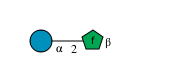
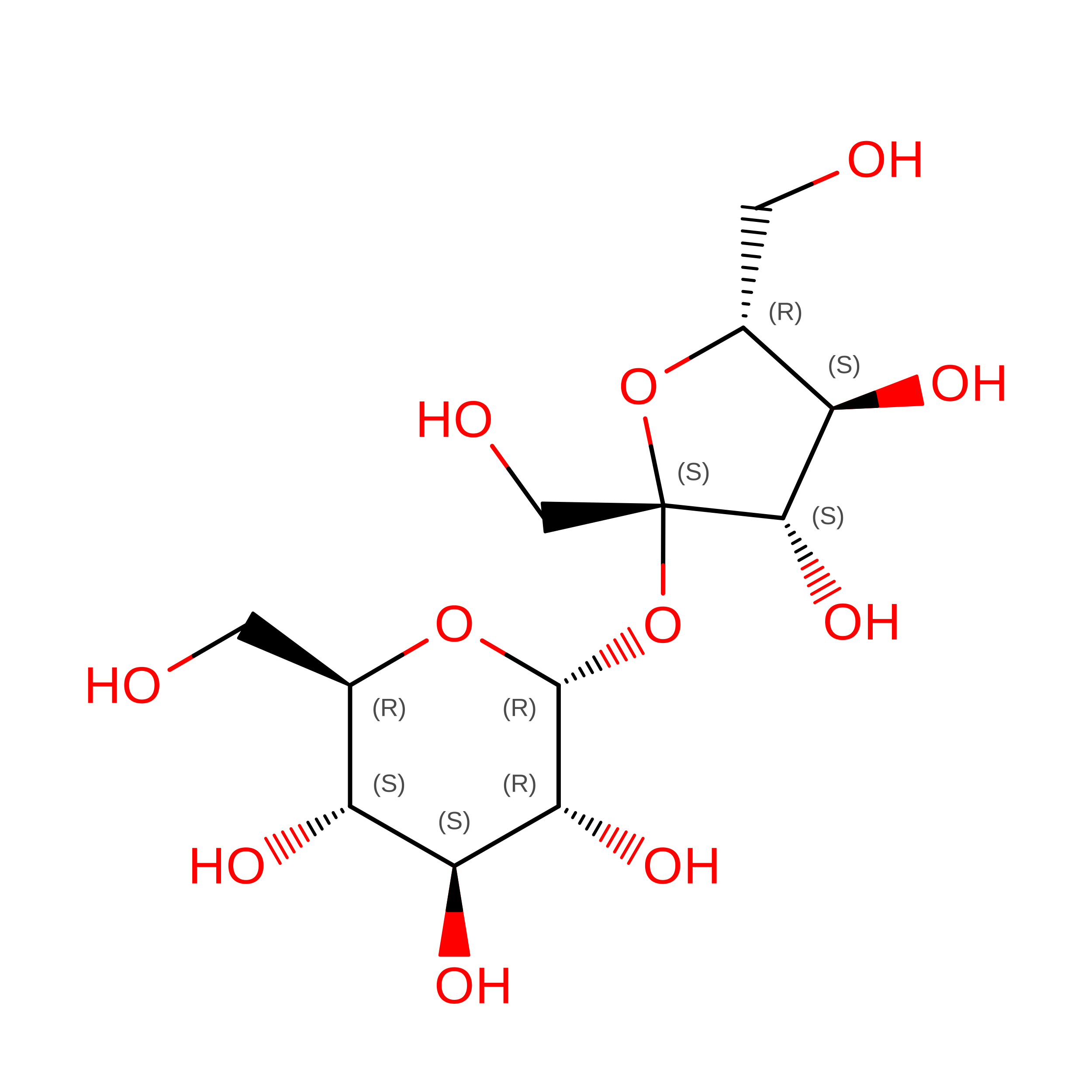
beta-D-fructofuranose-(2-1)-alpha-D-glucopyranose
D
2N/A
Glycosylation Resources
GlyTouCan: G05551OP
GlyCosmos: G05551OP

Biologically Interesting Molecules (External Reference) 

1 Unique

Experimental Data & Validation

Experimental Data

  • Method: X-RAY DIFFRACTION
  • Resolution: 1.70 Å
  • R-Value Free:  0.231 (Depositor), 0.232 (DCC) 
  • R-Value Work:  0.206 (Depositor), 0.207 (DCC) 
  • R-Value Observed: 0.207 (Depositor) 
Space Group: P 21 21 21
Unit Cell:
Length ( Å )Angle ( ˚ )
a = 87.53α = 90
b = 93.356β = 90
c = 106.229γ = 90
Software Package:
Software NamePurpose
DENZOdata reduction
SCALEPACKdata scaling
CNSrefinement
CNSphasing

Structure Validation

View Full Validation Report


Entry History 

Deposition Data

Revision History  (Full details and data files)

  • Version 1.0: 2003-03-25
    Type: Initial release
  • Version 1.1: 2008-04-28
    Changes: Version format compliance
  • Version 1.2: 2011-07-13
    Changes: Version format compliance
  • Version 2.0: 2020-07-29
    Type: Remediation
    Reason: Carbohydrate remediation
    Changes: Atomic model, Data collection, Derived calculations, Non-polymer description, Structure summary
  • Version 2.1: 2023-08-16
    Changes: Data collection, Database references, Refinement description, Structure summary