1H0B | pdb_00001h0b

Endoglucanase cel12A from Rhodothermus marinus


Experimental Data Snapshot

  • Method: X-RAY DIFFRACTION
  • Resolution: 1.80 Å
  • R-Value Free: 
    0.194 (Depositor), 0.183 (DCC) 
  • R-Value Work: 
    0.173 (Depositor), 0.168 (DCC) 
  • R-Value Observed: 
    0.173 (Depositor) 

Starting Model: experimental
View more details

wwPDB Validation 3D Report Full Report

Validation slider image for 1H0B

This is version 1.4 of the entry. See complete history

Literature

The Structure of Rhodothermus Marinus Cel12A, a Highly Thermostable Family 12 Endoglucanase, at 1.8 A Resolution

Crennell, S.J.Hreggvidsson, G.O.Nordberg Karlsson, E.

(2002) J Mol Biology 320: 883

  • DOI: https://doi.org/10.1016/s0022-2836(02)00446-1
  • Primary Citation Related Structures: 
    1H0B

  • PubMed Abstract: 

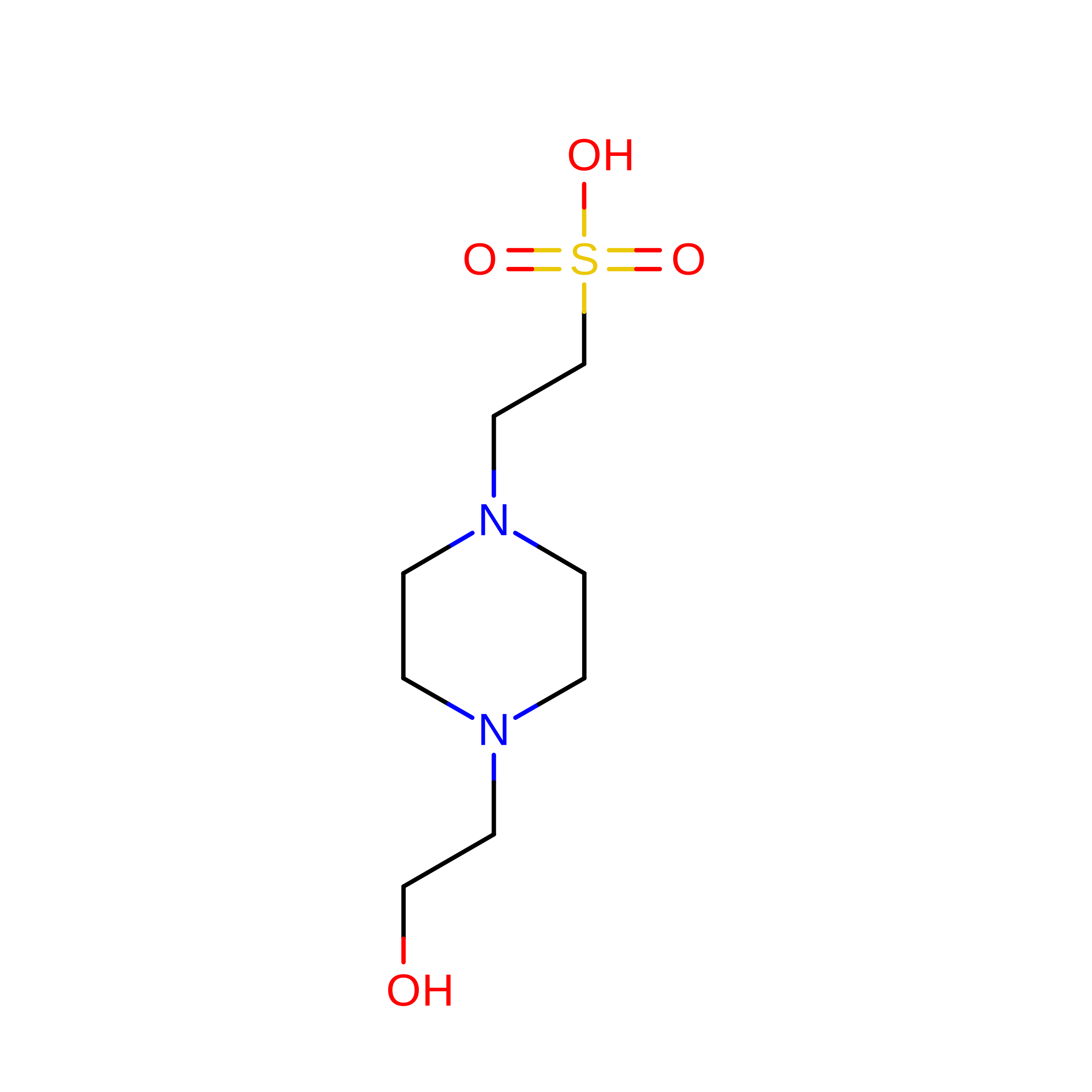
    Cellulose is one of the most abundant polysaccharides in nature and microorganisms have developed a comprehensive system for enzymatic breakdown of this ubiquitous carbon source, a subject of much interest in the biotechnology industry. Rhodothermus marinus produces a hyperthermostable cellulase, with a temperature optimum of more than 90 degrees C, the structure of which is presented here to 1.8 A resolution. The enzyme has been classified into glycoside hydrolase family 12; this is the first structure of a thermophilic member of this family to have been solved. The beta-jelly roll fold observed has identical topology to those of the two mesophilic members of the family whose structures have been elucidated previously. A Hepes buffer molecule bound in the active site may have triggered a conformational change to an active configuration as the two catalytic residues Glu124 and Glu207, together with dependent residues, are observed in a conformation similar to that seen in the structure of Streptomyces lividans CelB2 complexed with an inhibitor. The structural similarity between this cellulase and the mesophilic enzymes serves to highlight features that may be responsible for its thermostability, chiefly an increase in ion pair number and the considerable stabilisation of a mobile region seen in S. lividans CelB2. Additional aromatic residues in the active site region may also contribute to the difference in thermophilicity.


  • Organizational Affiliation
    • Department of Biology and Biochemistry, University of Bath, Claverton Down, Bath BA2 7AY, UK. bsssjc@bath.ac.uk

Macromolecule Content 

  • Total Structure Weight: 57.48 kDa 
  • Atom Count: 4,049 
  • Modeled Residue Count: 454 
  • Deposited Residue Count: 512 
  • Unique protein chains: 1

Macromolecules

Find similar proteins by:|  3D Structure
Entity ID: 1
MoleculeChains  Sequence LengthOrganismDetailsImage
CELLULASE
A, B
256Rhodothermus marinusMutation(s): 0 
EC: 3.2.1.4
UniProt
Find proteins for O33897 (Rhodothermus marinus)
Explore O33897 
Go to UniProtKB:  O33897
Entity Groups
Sequence Clusters30% Identity50% Identity70% Identity90% Identity95% Identity100% Identity
UniProt GroupO33897
Sequence Annotations
Expand
Reference Sequence

Small Molecules

Experimental Data & Validation

Experimental Data

  • Method: X-RAY DIFFRACTION
  • Resolution: 1.80 Å
  • R-Value Free:  0.194 (Depositor), 0.183 (DCC) 
  • R-Value Work:  0.173 (Depositor), 0.168 (DCC) 
  • R-Value Observed: 0.173 (Depositor) 
Space Group: P 21 21 21
Unit Cell:
Length ( Å )Angle ( ˚ )
a = 56.099α = 90
b = 67.779β = 90
c = 132.262γ = 90
Software Package:
Software NamePurpose
CNSrefinement
DENZOdata reduction
SCALEPACKdata scaling
AMoREphasing

Structure Validation

View Full Validation Report


Entry History 

Deposition Data

Revision History  (Full details and data files)

  • Version 1.0: 2003-06-12
    Type: Initial release
  • Version 1.1: 2011-05-08
    Changes: Version format compliance
  • Version 1.2: 2011-07-13
    Changes: Version format compliance
  • Version 1.3: 2023-12-13
    Changes: Data collection, Database references, Other, Refinement description
  • Version 1.4: 2024-11-13
    Changes: Structure summary