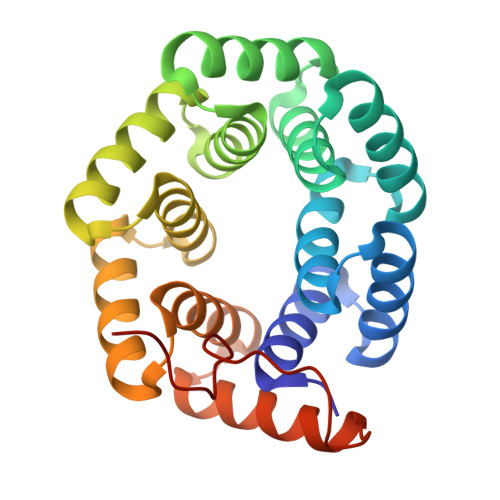
10YR | pdb_000010yr

Crystal structure of Q40A mutant of a computationally designed protein bound to a Mn-containing cofactor (L1-Q40A-dnMSBP)


Experimental Data Snapshot

  • Method: X-RAY DIFFRACTION
  • Resolution: 1.62 Å
  • R-Value Free: 
    0.222 (Depositor), 0.221 (DCC) 
  • R-Value Work: 
    0.179 (Depositor), 0.179 (DCC) 
  • R-Value Observed: 
    0.181 (Depositor) 

Starting Model: experimental
View more details

wwPDB Validation 3D Report Full Report

Validation slider image for 10YR

This is version 1.0 of the entry. See complete history. 

Literature

De Novo Design and Structural Optimization of Mn(salen)-Based Artificial Metalloenzymes for Asymmetric Sulfoxidation.

Wang, J.X., Deng, Y., Kalvet, I., Haque, A., Dai, H., Baker, D., Lu, Y.

(2026) Angew Chem Int Ed Engl : e5852828-e5852828

  • DOI: https://doi.org/10.1002/anie.5852828
  • Primary Citation Related Structures: 
    10YL, 10YM, 10YP, 10YR

  • PubMed Abstract: 

    Artificial metalloenzymes (ArMs) exhibit exceptional selectivity, yet extending their reactivity beyond native cofactors remains a major challenge. While previous designs using native protein scaffolds to incorporate nonnative cofactors have been reported, de novo protein design enables tailored scaffolds that incorporate nonnative cofactors, unlocking transformations inaccessible to natural enzymes. Here, we report the computational design of de novo proteins that bind Mn(salen)-based complexes for asymmetric sulfoxidation. The resulting ArMs outperform the free cofactor, achieving up to 45% yield and an enantiomeric ratio (e.r.) of 26:74 under optimized conditions. A 1.5 Å resolution crystal structure confirms the designed architecture and reveals key secondary-sphere interactions that govern reactivity. Guided by these insights, rational mutagenesis enhanced performance up to 79% yield and an e.r. up to 16:84. This work establishes a general strategy for integrating complex nonnative cofactors into de novo scaffolds, enabling selective catalysts for reactions beyond the reach of natural enzymes.


  • Organizational Affiliation: 
    • Department of Chemistry, University of Texas at Austin, Austin, Texas, USA.

Macromolecule Content 

  • Total Structure Weight: 24.91 kDa 
  • Atom Count: 2,007 
  • Modeled Residue Count: 230 
  • Deposited Residue Count: 232 
  • Unique protein chains: 1

Macromolecules

Find similar proteins by:|  3D Structure
Entity ID: 1
MoleculeChains  Sequence LengthOrganismDetailsImage
L1-Q40A-dnMSBP232synthetic constructMutation(s): 0 
Entity Groups
Sequence Clusters30% Identity50% Identity70% Identity90% Identity95% Identity100% Identity
Sequence Annotations
Expand
Reference Sequence

Small Molecules

Ligands 1 Unique
IDChains Name / Formula / InChI Key2D Diagram3D Interactions
A1C87(
Subject of Investigation/LOI)

Query on A1C87


Download:Ideal Coordinates CCD File
B [auth A]chlorido[2,2'-{(1R,2R)-cyclohexane-1,2-diylbis[(azanylylidene-kappaN)methanylylidene]}bis(4,6-di-tert-butylphenolato-kappaO)]manganate
C36 H52 Cl Mn N2 O2
FUUKZEVIXZEIBV-OHRASPNLSA-K

Experimental Data & Validation

Experimental Data

  • Method: X-RAY DIFFRACTION
  • Resolution: 1.62 Å
  • R-Value Free:  0.222 (Depositor), 0.221 (DCC) 
  • R-Value Work:  0.179 (Depositor), 0.179 (DCC) 
  • R-Value Observed: 0.181 (Depositor) 
Space Group: P 21 21 21
Unit Cell:
Length ( Å )Angle ( ˚ )
a = 46.925α = 90
b = 50.517β = 90
c = 84.771γ = 90
Software Package:
Software NamePurpose
JBluIce-EPICSdata collection
xia2data scaling
xia2data reduction
PHENIXphasing
PHENIXrefinement

Structure Validation

View Full Validation Report


Entry History 

& Funding Information

Deposition Data


Funding OrganizationLocationGrant Number
National Institutes of Health/National Institute of General Medical Sciences (NIH/NIGMS)United States--

Revision History  (Full details and data files)

  • Version 1.0: 2026-09-30
    Type: Initial release