Download Mendeley
De Novo Design and Structural Optimization of Mn(salen)-Based Artificial Metalloenzymes for Asymmetric Sulfoxidation.
Wang, J.X., Deng, Y., Kalvet, I., Haque, A., Dai, H., Baker, D., Lu, Y.(2026) Angew Chem Int Ed Engl : e5852828-e5852828
- PubMed: 42758048 Search on PubMed
- DOI: https://doi.org/10.1002/anie.5852828
- Primary Citation Related Structures:
10YL, 10YM, 10YP, 10YR - PubMed Abstract:
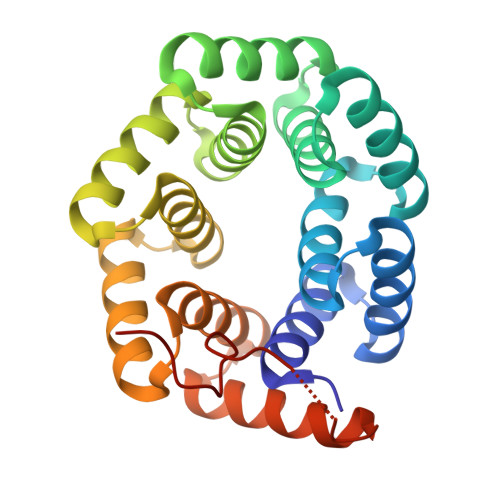
Artificial metalloenzymes (ArMs) exhibit exceptional selectivity, yet extending their reactivity beyond native cofactors remains a major challenge. While previous designs using native protein scaffolds to incorporate nonnative cofactors have been reported, de novo protein design enables tailored scaffolds that incorporate nonnative cofactors, unlocking transformations inaccessible to natural enzymes. Here, we report the computational design of de novo proteins that bind Mn(salen)-based complexes for asymmetric sulfoxidation. The resulting ArMs outperform the free cofactor, achieving up to 45% yield and an enantiomeric ratio (e.r.) of 26:74 under optimized conditions. A 1.5 Å resolution crystal structure confirms the designed architecture and reveals key secondary-sphere interactions that govern reactivity. Guided by these insights, rational mutagenesis enhanced performance up to 79% yield and an e.r. up to 16:84. This work establishes a general strategy for integrating complex nonnative cofactors into de novo scaffolds, enabling selective catalysts for reactions beyond the reach of natural enzymes.
- Department of Chemistry, University of Texas at Austin, Austin, Texas, USA.
Organizational Affiliation: