Download Mendeley
Mechanism of actin thin filament pointed-end elongation by leiomodin.
Brotzman, S.B., Palmer, N.J., Boczkowska, M., Dominguez, R.(2026) Nat Commun 17
- PubMed: 42477379 Search on PubMedSearch on PubMed Central
- DOI: https://doi.org/10.1038/s41467-026-74810-6
- Primary Citation Related Structures:
9ZZI, 9ZZJ, 9ZZM - PubMed Abstract:
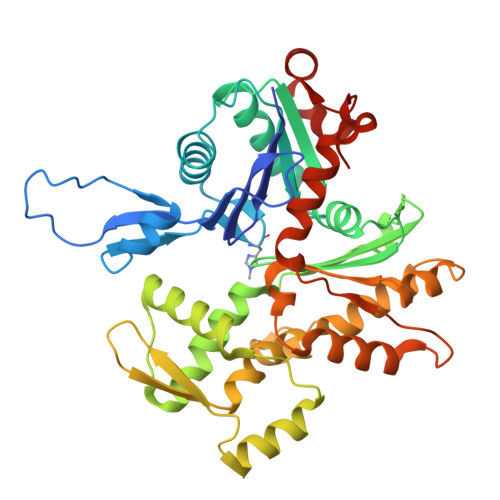
In non-muscle cells, actin filaments exhibit variable lengths and rapid turnover, with subunits adding primarily at the barbed end. The situation is strikingly different in striated muscle sarcomeres, where despite rapid turnover, actin thin filaments exhibit uniform length and exchange subunits primarily at the pointed end. This filament length uniformity is tightly regulated by several proteins, including the molecular ruler nebulin in skeletal muscle and the barbed- and pointed-end capping proteins CapZ and tropomodulin (Tmod) in both skeletal and cardiac muscles. Recent studies in cells and animal models have identified leiomodin-2 (Lmod2) as an additional regulator proposed to promote pointed-end elongation to maintain thin filament length. This activity would make leiomodin the only known eukaryotic factor to drive pointed-end elongation, yet its molecular mechanism remains unresolved. Here, we present a series of cryo-electron microscopy structures that support a stepwise elongation mechanism in which two Lmod2 molecules alternate at the pointed end while recruiting actin monomers. These findings establish the molecular basis of pointed-end elongation in muscle sarcomeres and provide a framework for understanding mutations in Lmod2 that cause dilated cardiomyopathy.
- Department of Physiology, Perelman School of Medicine, University of Pennsylvania, Philadelphia, PA, USA.
Organizational Affiliation: