Download Mendeley
Structure-Based Design of Covalent SARS-CoV‐2 Main Protease Inhibitors Targeting the Nirmatrelvir-Resistant E166 Mutants.
Cai, Z., Kohaal, N., Georgiou, K., Liang, X., Chi, X., Tan, H., Tan, B., Li, K., Fan, G., Lambrinidis, G., Kolocouris, A., Deng, X., Chen, Y., Wang, J.(2026) JACS Au 6: 233-244
- PubMed: 41614164 Search on PubMedSearch on PubMed Central
- DOI: https://doi.org/10.1021/jacsau.5c01178
- Primary Citation Related Structures:
9PBC, 9Q7S, 9XYM, 9XYX, 9XYZ, 9XZ6 - PubMed Abstract:
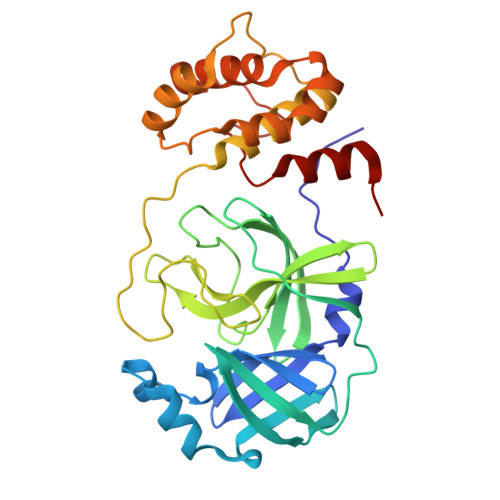
The COVID-19 pandemic spurred the rapid development of nirmatrelvir, a main protease (M pro ) inhibitor now widely prescribed as part of Paxlovid (nirmatrelvir plus ritonavir). However, increasing use has raised concerns about drug resistance. Resistance selection studies have identified multiple M pro mutations, with E166V emerging as a particularly resistant variant. Sequencing data from COVID-19 patients confirms E166V as a clinically relevant mutation, and importantly, this substitution also confers cross-resistance to several next-generation M pro inhibitors under development. In response, this study reports the rational design of inhibitors active against nirmatrelvir-resistant E166V/A mutants. The lead candidate, Jun13698 , shows potent inhibition of both wild-type M pro and the E166V/A mutants. Structural studies and molecular dynamics simulations reveal that Jun13698 forms stable complexes with wild-type and mutant proteases, consistent with its potent enzymatic and antiviral activity. Together, these findings position Jun13698 as a promising next-generation M pro inhibitor capable of overcoming clinically relevant nirmatrelvir resistance.
- Department of Medicinal Chemistry, Ernest Mario School of Pharmacy, Rutgers, the State University of New Jersey, Piscataway, New Jersey 08854, United States.
Organizational Affiliation: