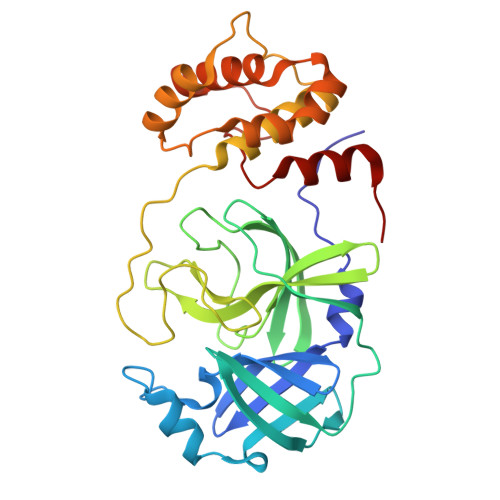
9PBC | pdb_00009pbc

Crystal Structure of SARS-CoV-2 Main Protease (Mpro) L50F/E166V Double Mutant


Experimental Data Snapshot

  • Method: X-RAY DIFFRACTION
  • Resolution: 2.10 Å
  • R-Value Free: 
    0.259 (Depositor), 0.270 (DCC) 
  • R-Value Work: 
    0.205 (Depositor) 
  • R-Value Observed: 
    0.208 (Depositor) 

Starting Model: experimental
View more details

wwPDB Validation 3D Report Full Report

Validation slider image for 9PBC

This is version 1.1 of the entry. See complete history. 

Literature

Structure-Based Design of Covalent SARS-CoV‐2 Main Protease Inhibitors Targeting the Nirmatrelvir-Resistant E166 Mutants.

Cai, Z., Kohaal, N., Georgiou, K., Liang, X., Chi, X., Tan, H., Tan, B., Li, K., Fan, G., Lambrinidis, G., Kolocouris, A., Deng, X., Chen, Y., Wang, J.

(2026) JACS Au 6: 233-244

  • DOI: https://doi.org/10.1021/jacsau.5c01178
  • Primary Citation Related Structures: 
    9PBC, 9Q7S, 9XYM, 9XYX, 9XYZ, 9XZ6

  • PubMed Abstract: 

    The COVID-19 pandemic spurred the rapid development of nirmatrelvir, a main protease (M pro ) inhibitor now widely prescribed as part of Paxlovid (nirmatrelvir plus ritonavir). However, increasing use has raised concerns about drug resistance. Resistance selection studies have identified multiple M pro mutations, with E166V emerging as a particularly resistant variant. Sequencing data from COVID-19 patients confirms E166V as a clinically relevant mutation, and importantly, this substitution also confers cross-resistance to several next-generation M pro inhibitors under development. In response, this study reports the rational design of inhibitors active against nirmatrelvir-resistant E166V/A mutants. The lead candidate, Jun13698 , shows potent inhibition of both wild-type M pro and the E166V/A mutants. Structural studies and molecular dynamics simulations reveal that Jun13698 forms stable complexes with wild-type and mutant proteases, consistent with its potent enzymatic and antiviral activity. Together, these findings position Jun13698 as a promising next-generation M pro inhibitor capable of overcoming clinically relevant nirmatrelvir resistance.


  • Organizational Affiliation: 
    • Department of Medicinal Chemistry, Ernest Mario School of Pharmacy, Rutgers, the State University of New Jersey, Piscataway, New Jersey 08854, United States.

Macromolecule Content 

  • Total Structure Weight: 33.7 kDa 
  • Atom Count: 2,434 
  • Modeled Residue Count: 305 
  • Deposited Residue Count: 305 
  • Unique protein chains: 1

Macromolecules

Find similar proteins by:|  3D Structure
Entity ID: 1
MoleculeChains  Sequence LengthOrganismDetailsImage
3C-like proteinase nsp5305Severe acute respiratory syndrome coronavirus 2Mutation(s): 2 
Gene Names: rep, 1a-1b
EC: 3.4.22.69
UniProt
Find proteins for P0DTD1 (Severe acute respiratory syndrome coronavirus 2)
Explore P0DTD1 
Go to UniProtKB:  P0DTD1
Entity Groups
Sequence Clusters30% Identity50% Identity70% Identity90% Identity95% Identity100% Identity
UniProt GroupP0DTD1
Sequence Annotations
Expand
Reference Sequence

Experimental Data & Validation

Experimental Data

  • Method: X-RAY DIFFRACTION
  • Resolution: 2.10 Å
  • R-Value Free:  0.259 (Depositor), 0.270 (DCC) 
  • R-Value Work:  0.205 (Depositor) 
  • R-Value Observed: 0.208 (Depositor) 
Space Group: C 1 2 1
Unit Cell:
Length ( Å )Angle ( ˚ )
a = 113.575α = 90
b = 54.028β = 101.24
c = 45.059γ = 90
Software Package:
Software NamePurpose
REFMACrefinement
HKL-2000data reduction
PDB_EXTRACTdata extraction
HKL-2000data scaling
PHASERphasing

Structure Validation

View Full Validation Report


Entry History 

& Funding Information

Deposition Data


Funding OrganizationLocationGrant Number
National Institutes of Health/National Institute Of Allergy and Infectious Diseases (NIH/NIAID)United StatesAI158775

Revision History  (Full details and data files)

  • Version 1.0: 2026-01-21
    Type: Initial release
  • Version 1.1: 2026-02-11
    Changes: Database references