Download Mendeley
Structural and Dynamic Insights into Acyl Carrier Protein upon Metal Binding and Acylation Revealed by NMR Spectroscopy and MD Simulations.
Lee, C.Y., Jang, S., Cho, H., Jeong, M.C., Oh, Y., Kim, Y.(2025) Int J Mol Sci 26
- PubMed: 41009570 Search on PubMedSearch on PubMed Central
- DOI: https://doi.org/10.3390/ijms26189005
- Primary Citation Related Structures:
9WAB - PubMed Abstract:
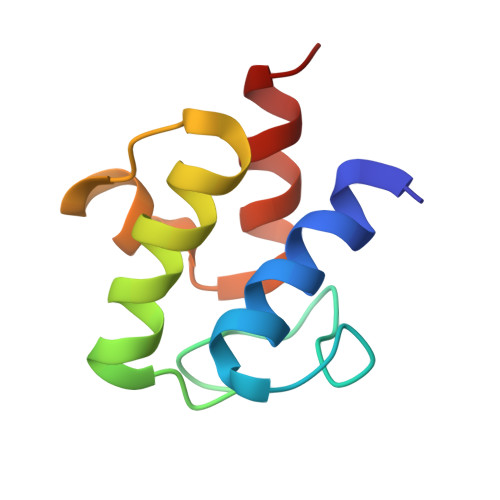
Protein dynamics are crucial for the acyl carrier protein (ACP) acting as a cofactor, communicating with various fatty acid synthesis (FAS) enzymes. Using a combination of NMR spectroscopy and molecular dynamics (MD) simulations, we demonstrate how the conformational flexibility of Escherichia coli ACP ( Ec ACP) modulates metal binding and facilitates its molecular switches, thereby determining the pathway for different acyl chains. Our results show that Ca 2+ binding greatly stabilizes the protein-boosting thermal stability by over 13 °C-and modulates its dynamic properties, affecting two acidic metal binding sites and the conformation of the hydrophobic cavity. Hydrogen-deuterium exchange and chemical denaturation experiments revealed that Ile11 and Ile72 are the key residues for the global folding of Ec ACP, stabilizing hydrophobic cavity. Backbone dynamics and MD simulation results indicate that longer acyl chains induce conformational adjustments, increasing flexibility in α3-helix and hydrophobic motifs, including Phe28 and Ile54. Furthermore, our findings highlight the conformational plasticity of Ec ACP, with key molecular switches, Leu42 and Leu46, adapting to accommodate various acyl chains and directing their pathway. These insights deepen our understanding of ACP flexibility and its functional role in FAS, offering a new strategy for designing inhibitors that target the dynamic nature of bacterial FAS pathways.
- Department of Bioscience and Biotechnology, Konkuk University, Seoul 05029, Republic of Korea.
Organizational Affiliation: