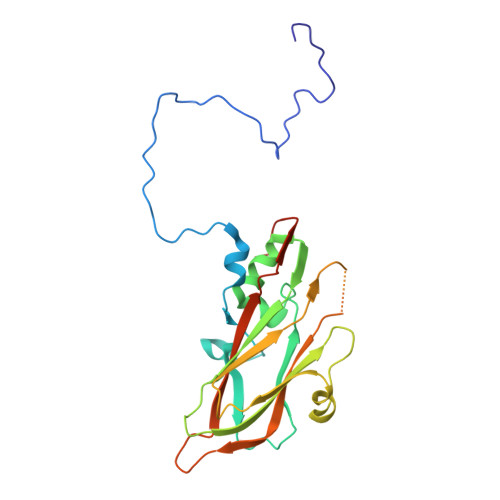
9VFP | pdb_00009vfp

Structure of CVA6 empty particle


Experimental Data Snapshot

  • Method: ELECTRON MICROSCOPY
  • Resolution: 3.33 Å
  • Aggregation State: PARTICLE 
  • Reconstruction Method: SINGLE PARTICLE 

wwPDB Validation 3D Report Full Report

Validation slider image for 9VFP

This is version 1.1 of the entry. See complete history

Literature

Molecular mechanisms of receptor recognition and antibody neutralization of coxsackievirus A6.

Ke, X.Li, X.Liu, Z.Liu, K.Liu, W.Yan, X.Shu, B.Zhang, C.

(2025) Nat Commun 17: 934-934

  • DOI: https://doi.org/10.1038/s41467-025-67666-9
  • Primary Citation Related Structures: 
    9VFP, 9VFQ, 9VFR, 9VFS, 9VFT, 9VFU, 9VG1

  • PubMed Abstract: 

    Coxsackievirus A6 (CVA6), a major cause of hand, foot, and mouth disease, lacks approved vaccines or drugs. KRM1 is its only known receptor, but its precise role remains unclear. This study investigates CVA6's entry mechanism and antibody neutralization. Cryo-EM shows CVA6 clinical strain HeB primarily exists as mature virions. KRM1 binding within the canyon triggers conversion to uncoating intermediate, defining KRM1 as an uncoating receptor for CVA6. However, KRM1 knockout reduces CVA6 infectivity without affecting attachment. Conversely, disrupting heparan sulfate proteoglycan (HSPG) impairs both viral attachment and infectivity, and CVA6 virions bind heparin directly. These results support a two-receptor entry model for CVA6: HSPG mediates viral attachment, while KRM1 induces uncoating. Additionally, we develop two CVA6-specific protective antibodies (1F4 and 3H7), targeting a new antigenic site near the three-fold axis of the viral capsid. These antibodies sterically block KRM1 binding and function post-attachment, consistent with KRM1's role. The findings elucidate CVA6 entry and offer a basis for antibody interventions.


  • Organizational Affiliation
    • State Key Laboratory of Virology and Biosafety, Wuhan Institute of Virology, Center for Biosafety Mega-Science, Chinese Academy of Sciences, Wuhan, Hubei, China.

Macromolecule Content 

  • Total Structure Weight: 88.03 kDa 
  • Atom Count: 4,880 
  • Modeled Residue Count: 640 
  • Deposited Residue Count: 801 
  • Unique protein chains: 3

Macromolecules

Find similar proteins by:|  3D Structure
Entity ID: 1
MoleculeChains  Sequence LengthOrganismDetailsImage
Genome polyprotein305Coxsackievirus A6Mutation(s): 0 
UniProt
Find proteins for A0A222NWY2 (Coxsackievirus A6)
Explore A0A222NWY2 
Go to UniProtKB:  A0A222NWY2
Entity Groups
Sequence Clusters30% Identity50% Identity70% Identity90% Identity95% Identity100% Identity
UniProt GroupA0A222NWY2
Sequence Annotations
Expand
Reference Sequence
Find similar proteins by:|  3D Structure
Entity ID: 2
MoleculeChains  Sequence LengthOrganismDetailsImage
Genome polyprotein256Coxsackievirus A6Mutation(s): 0 
EC: 3.4.22.29 (PDB Primary Data), 3.6.1.15 (PDB Primary Data), 3.4.22.28 (PDB Primary Data), 2.7.7.48 (PDB Primary Data)
UniProt
Find proteins for A0A7D0TR32 (Coxsackievirus A6)
Explore A0A7D0TR32 
Go to UniProtKB:  A0A7D0TR32
Entity Groups
Sequence Clusters30% Identity50% Identity70% Identity90% Identity95% Identity100% Identity
UniProt GroupA0A7D0TR32
Sequence Annotations
Expand
Reference Sequence
Find similar proteins by:|  3D Structure
Entity ID: 3
MoleculeChains  Sequence LengthOrganismDetailsImage
Genome polyprotein240Coxsackievirus A6Mutation(s): 0 
EC: 3.4.22.29 (PDB Primary Data), 3.6.1.15 (PDB Primary Data), 3.4.22.28 (PDB Primary Data), 2.7.7.48 (PDB Primary Data)
UniProt
Find proteins for A0A4P2SK07 (Coxsackievirus A6)
Explore A0A4P2SK07 
Go to UniProtKB:  A0A4P2SK07
Entity Groups
Sequence Clusters30% Identity50% Identity70% Identity90% Identity95% Identity100% Identity
UniProt GroupA0A4P2SK07
Sequence Annotations
Expand
Reference Sequence

Experimental Data & Validation

Experimental Data

  • Method: ELECTRON MICROSCOPY
  • Resolution: 3.33 Å
  • Aggregation State: PARTICLE 
  • Reconstruction Method: SINGLE PARTICLE 
EM Software:
TaskSoftware PackageVersion
RECONSTRUCTIONcryoSPARC

Structure Validation

View Full Validation Report


Entry History 

& Funding Information

Deposition Data


Funding OrganizationLocationGrant Number
National Science Foundation (NSF, China)China--

Revision History  (Full details and data files)

  • Version 1.0: 2025-11-26
    Type: Initial release
  • Version 1.1: 2026-06-10
    Changes: Data collection, Database references