9U9J | pdb_00009u9j

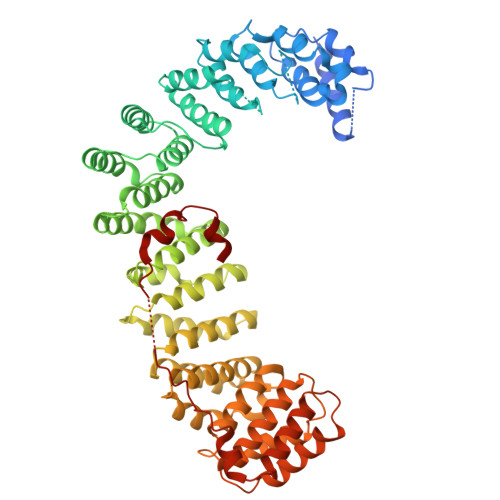
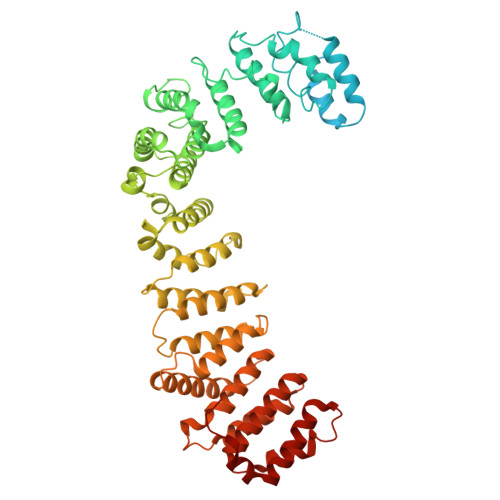
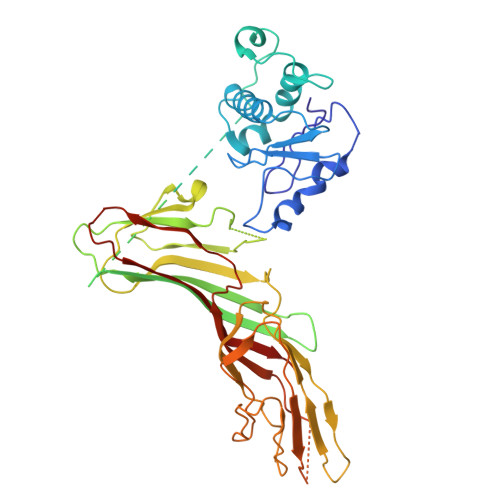
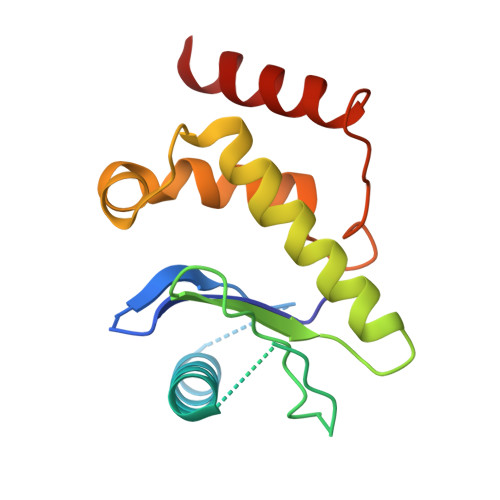
M4-CTD-docked AP-4 core in apo form


Experimental Data Snapshot

  • Method: ELECTRON MICROSCOPY
  • Resolution: 4.20 Å
  • Aggregation State: PARTICLE 
  • Reconstruction Method: SINGLE PARTICLE 

wwPDB Validation   3D Report Full Report


This is version 1.1 of the entry. See complete history


Literature

Structural basis for the dynamic conformations of AP-4 and its association with ARF1.

Wang, Y.Li, W.Qiu, Y.Wu, S.Hong, L.Zhao, Y.Feng, W.

(2026) Nat Commun 17

  • DOI: https://doi.org/10.1038/s41467-026-68679-8
  • Primary Citation of Related Structures:  
    9U9I, 9U9J, 9U9R, 9U9S

  • PubMed Abstract: 

    Among the distinct adaptor protein (AP) complexes, AP-4 primarily functions as a non-clathrin-coated vesicle machinery essential for intracellular membrane trafficking. ARF1 is a master regulator of AP-4 membrane recruitment, but the underlying mechanism remains elusive. Here, we present the cryo-EM structures of soluble AP-4 and the AP-4/ARF1 complex. Unexpectedly, AP-4 adopts a dynamic equilibrium between closed and open conformations, caused by loose contacts between its medium subunit and central core. ARF1 binding induces only subtle changes in AP-4, which retains its conformational equilibrium. Mutations at the AP-4/ARF1 interface disrupt complex formation and impair ARF1-dependent membrane recruitment. Efficient membrane recruitment of AP-4 likely requires the synergistic engagement of ARF1 and cargoes. Disrupting the conformational flexibility of AP-4 interferes with this synergistic effect and compromises AP-4-mediated membrane trafficking. Our findings may redefine AP-4 as a conformationally dynamic complex modulated by cooperative interactions, providing insights into neurodevelopmental disorders associated with AP-4 dysfunction.


  • Organizational Affiliation
    • State Key Laboratory of Biomacromolecules, Institute of Biophysics, Chinese Academy of Sciences, 15 Datun Road, Beijing, China.

Macromolecules
Find similar proteins by:  (by identity cutoff)  |  3D Structure
Entity ID: 1
MoleculeChains Sequence LengthOrganismDetailsImage
AP-4 complex subunit beta-1A [auth B]568Homo sapiensMutation(s): 0 
Gene Names: AP4B1
UniProt & NIH Common Fund Data Resources
Find proteins for Q9Y6B7 (Homo sapiens)
Explore Q9Y6B7 
Go to UniProtKB:  Q9Y6B7
PHAROS:  Q9Y6B7
GTEx:  ENSG00000134262 
Entity Groups  
Sequence Clusters30% Identity50% Identity70% Identity90% Identity95% Identity100% Identity
UniProt GroupQ9Y6B7
Sequence Annotations
Expand
  • Reference Sequence
Find similar proteins by:  (by identity cutoff)  |  3D Structure
Entity ID: 2
MoleculeChains Sequence LengthOrganismDetailsImage
AP-4 complex subunit epsilon-1B [auth E]612Homo sapiensMutation(s): 0 
Gene Names: AP4E1
UniProt & NIH Common Fund Data Resources
Find proteins for Q9UPM8 (Homo sapiens)
Explore Q9UPM8 
Go to UniProtKB:  Q9UPM8
PHAROS:  Q9UPM8
GTEx:  ENSG00000081014 
Entity Groups  
Sequence Clusters30% Identity50% Identity70% Identity90% Identity95% Identity100% Identity
UniProt GroupQ9UPM8
Sequence Annotations
Expand
  • Reference Sequence
Find similar proteins by:  (by identity cutoff)  |  3D Structure
Entity ID: 3
MoleculeChains Sequence LengthOrganismDetailsImage
AP-4 complex subunit mu-1C [auth M]453Homo sapiensMutation(s): 0 
Gene Names: AP4M1MUARP2
UniProt & NIH Common Fund Data Resources
Find proteins for O00189 (Homo sapiens)
Explore O00189 
Go to UniProtKB:  O00189
PHAROS:  O00189
GTEx:  ENSG00000221838 
Entity Groups  
Sequence Clusters30% Identity50% Identity70% Identity90% Identity95% Identity100% Identity
UniProt GroupO00189
Sequence Annotations
Expand
  • Reference Sequence
Find similar proteins by:  (by identity cutoff)  |  3D Structure
Entity ID: 4
MoleculeChains Sequence LengthOrganismDetailsImage
AP-4 complex subunit sigma-1D [auth S]144Homo sapiensMutation(s): 0 
Gene Names: AP4S1
UniProt & NIH Common Fund Data Resources
Find proteins for Q9Y587 (Homo sapiens)
Explore Q9Y587 
Go to UniProtKB:  Q9Y587
PHAROS:  Q9Y587
GTEx:  ENSG00000100478 
Entity Groups  
Sequence Clusters30% Identity50% Identity70% Identity90% Identity95% Identity100% Identity
UniProt GroupQ9Y587
Sequence Annotations
Expand
  • Reference Sequence
Experimental Data & Validation

Experimental Data

  • Method: ELECTRON MICROSCOPY
  • Resolution: 4.20 Å
  • Aggregation State: PARTICLE 
  • Reconstruction Method: SINGLE PARTICLE 
EM Software:
TaskSoftware PackageVersion
MODEL REFINEMENTPHENIX

Structure Validation

View Full Validation Report


Entry History & Funding Information

Deposition Data


Funding OrganizationLocationGrant Number
Not fundedChina--

Revision History  (Full details and data files)

  • Version 1.0: 2026-03-04
    Type: Initial release
  • Version 1.1: 2026-03-18
    Changes: Data collection, Database references